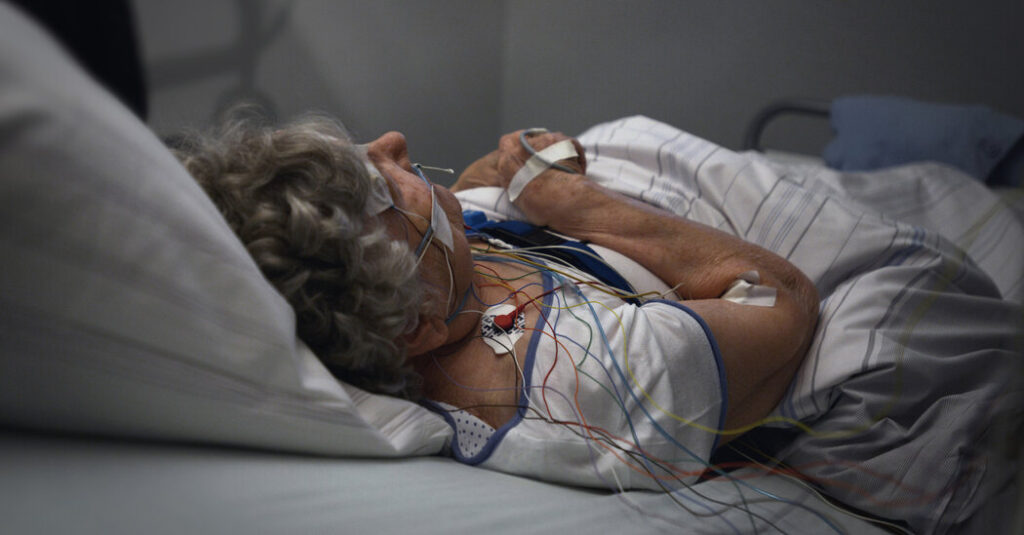
Many people have a cartoonish idea of narcolepsy, perhaps picturing someone falling asleep standing up.
What people don’t understand is that sleepiness can infiltrate every aspect of daily life, said Julie Flygare, 42, who was diagnosed with the sleep disorder in 2007, during her second year of law school. It interferes with memory, attention and weighs down everyday existence like a “heaviness on the skull,” she said.
While taking her current medications, Ms. Flygare has four to six precious hours of wakefulness a day, and still needs a nap. Positive feelings, like, say, the joy of hitting a volley in tennis, trigger episodes of cataplexy; her muscles go slack and her grip on the racket loosens. She, like many other patients, struggled for years to be correctly diagnosed and to find the right combination of stimulants or other drugs to ease her symptoms.
Since then, Ms. Flygare has been waiting, and pushing for, a drug aimed not just at alleviating sleepiness, but at replacing a crucial missing brain chemical. Last month, she saw it happen. A first-of-its-kind drug for the sleep disorder narcolepsy was approved by the F.D.A., offering a new treatment for people who live with the debilitating fog of sleepiness.
The new drug developed by Takeda Pharmaceutical Co., called Orzeyful, marks a long-sought success in the quest to mimic an essential brain peptide called orexin, which is missing in people with type 1 narcolepsy. About 120,000 people in the United States suffer from this type of narcolepsy, which causes pervasive sleepiness and episodes of cataplexy. Other companies, including Alkermes and Eli Lilly, are chasing close behind.
To test narcolepsy treatments, doctors use a “maintenance of wakefulness test” in which a person sits in a dim room for 40 minutes.
“You have to stay awake. You cannot read, you cannot watch TV, you cannot talk,” said Dr. Emmanuel Mignot, a sleep researcher at Stanford and one of the leaders of the trial testing Orzeyful. “For a normal person, it’s already tough; for a person with narcolepsy, it’s impossible.”
Before treatment, patients fell asleep within four to five minutes, according to a study published Wednesday in The New England Journal of Medicine. In two late-stage trials, nearly 300 patients between the ages of 16 and 70 received either Orzeyful or a placebo for 12 weeks. On Orzeyful, they could stay awake for more than 20 minutes — about twice as long as currently available medications, according to Dr. Thomas Scammell, a sleep researcher at Beth Israel Deaconess Medical Center in Boston.
Dr. Scammell, who was not involved in the study, said he thought that the drug could be “transformative.” Patients taking the drug have reported developing hobbies for the first time; dancing, playing ice hockey or spontaneously socializing.
Ms. Flygare participated in one of the trials testing Orzeyful and recalled that when she was dropped off at the site for her first visit, she had been unable to think clearly and could barely walk because she was off her medications. (It is necessary to have a “blank slate” to test the effects of a new drug.)
Later, when the same driver picked her up after she’d started the medication, she remembers making a joke. It’s the kind of casual, offhand human interaction that would typically have triggered her cataplexy and made her knees buckle.
“The wakefulness had a different tone to it; it felt sunnier” compared to her experience with stimulants, said Ms. Flygare, who founded a nonprofit called Project Sleep that raises awareness of sleep disorders. The nonprofit receives funding from drug companies, including Takeda, and last year, Ms. Flygare served as a consultant to the company on patient perspectives in clinical trials.
Orzeyful is a pill taken twice a day. It will not be available until the Drug Enforcement Administration determines its classification as a controlled substance, which is expected to occur by November. Physicians are thrilled to have a new tool, but there remain many unknowns: How well will it work long-term? Will a drug that activates orexin receptors alter people’s risk for other neurological diseases?
The long road to the new drug began more than two decades ago, when scientists first discovered that people with narcolepsy lacked orexin .
Orexins are produced by brain cells and work like a key fitting into a lock, by binding to two different receptors on the surface of cells in a region of the brain called the hypothalamus. Blocking the lock, like sticking a piece of tape over it, was a straightforward drug development problem and several insomnia treatments based on this idea have been approved. But designing a key that opened the lock required more finesse.
“It’s hard,” said Andrew Plump, president of research and development at Takeda. The drug is an “agonist” that must activate the receptor by binding to it, imitating what naturally-occurring orexin does.
The second problem was that narcolepsy is rare.
“They said our science is very interesting and exciting, but narcolepsy, after all, is one in several thousands — not very rare, but not very common,” said Dr. Masashi Yanagisawa, a molecular biologist at University of Tsukuba in Japan who led one of the teams that discovered orexin in 1998.
A Takeda scientist who had a friend with narcolepsy initiated the project by screening a vast library of molecules for promising hits. “We got one,” Dr. Plump said. “And nobody in their right mind would ever start a drug discovery program with a single hit.”
The scientist was so passionate that the work began, but it wasn’t a slam dunk. An early version needed to be administered by IV. Another candidate caused liver injury.
Other companies are following close behind. Beyond sleep, the approval sets off a race to develop a new class of medicines that show early hints of promise in a host of ailments, from A.D.H.D. to neurodegenerative diseases.
Alkermes has a similar drug in late-stage testing against narcolepsy. Blair Jackson, chief executive of the Dublin-based company, said it has identified 19 areas within neuroscience where such drugs could have potential. Eli Lilly recently agreed to pay up to $7.8 billion for Centessa Pharmaceuticals, a biotech company with similar drugs in the pipeline.
“Sleep is the low-hanging fruit,” said Luis de Lecea, a molecular biologist at Stanford and part of the team that also discovered orexin — though they called it hypocretin — in 1998. Narcolepsy patients lack orexin, but it also declines with Alzheimer’s disease, Parkinson’s disease, P.T.S.D. and even normal aging.
Wall Street analysts have drawn hopeful comparisons to the GLP-1 drugs, which started out as diabetes treatments, then expanded into weight loss and are now being tested against a slew of diseases.
Ms. Flygare is hopeful too. She began organizing sleep awareness walks with just a few friends, at a time when drug companies had little interest in the field.
“This has been feeling like such a full circle moment for me,” she said.
The post A New Drug Lifts the Fog of Sleepiness for Those With Narcolepsy appeared first on New York Times.