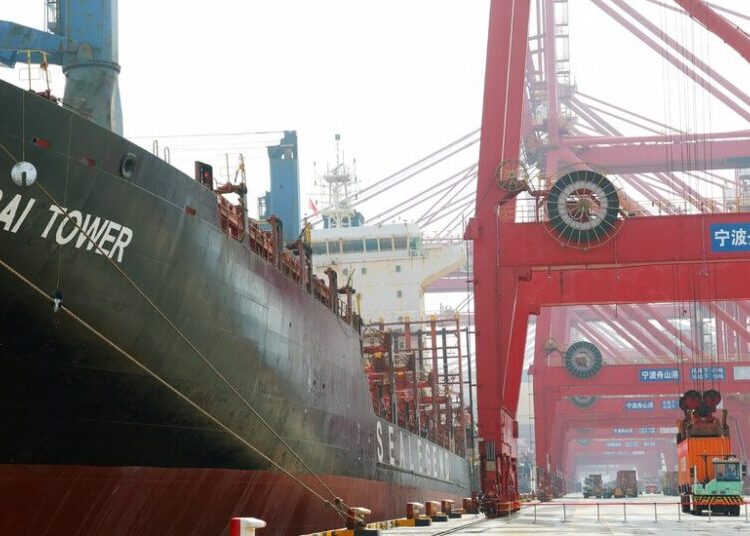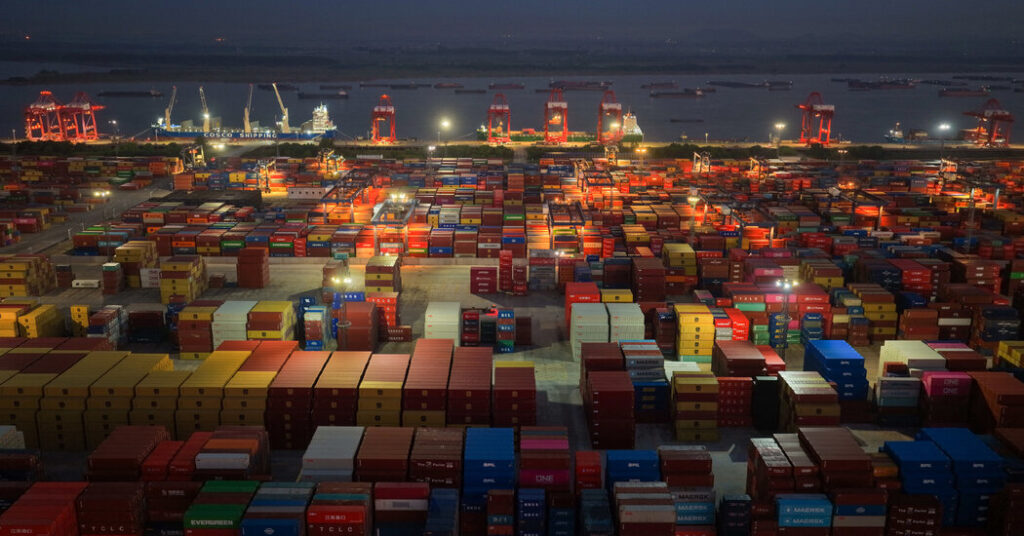
When President Trump and China’s leader, Xi Jinping, meet this month to talk about a fragile trade truce, one issue is sure to dominate: China’s seemingly unstoppable export engine.
Chinese customs data released on Tuesday showed that in August, China sold $119.09 billion more in goods to the world than it bought — the fourth month in a row that the trade surplus topped $100 billion. Exports rose by 25 percent in U.S. dollar terms, while imports climbed 28 percent.
So far this year, the trade gap is already over $800 billion, and economists say it is on track to surpass last year’s $1.2 trillion, a milestone no other country has reached.
In the early months of his second term, Mr. Trump made confronting China on trade a centerpiece of his agenda, unleashing hefty tariffs on the country to try to force a sweeping economic deal. But after Beijing retaliated by choking off rare earths exports, the Trump administration was forced to back down and accept a modest truce.
While China’s trade surplus with the United States narrowed earlier, it has begun expanding again, testing the limits of the détente. The trade disparity with the United States in August grew even wider, swelling by 44 percent to more than $29 billion, the widest gap since Mr. Trump returned to office in January, 2025.
China’s domestic economic troubles have helped set it on a collision course with some of the world’s biggest economies. Facing cutthroat competition and frugal consumers at home, where the economy is growing at its slowest rate in three years, China’s factories have sought markets overseas, where their cheap goods are welcomed. Chinese exports this year have grown everywhere. They have ballooned by nearly 26 percent with Southeast Asia and more than 25 percent with Africa. Its exports to Canada are up by more than 10 percent.
Some of the demand for Chinese goods has been driven by a voracious appetite around the world to build out artificial intelligence capabilities.
Exports of Chinese semiconductors and automatic data processing machines grew by nearly 130 percent and 77 percent in August compared with the same period last year. Demand for China’s electric vehicles also remains strong, as the war in Iran has dragged on for six months, disrupting the flow of oil through the Strait of Hormuz and sending oil and gas prices higher.
China’s yawning trade gap with the world has frustrated officials in many of the biggest economies, who are worried about the growing dominance of Chinese companies across a range of industries, as well as the flood of goods into their countries. Many officials argue that China’s manufacturing dominance is the result of heavy government subsidies that favor Chinese companies.
The European Union’s trade commissioner recently gave Beijing an October deadline to provide “concrete results” of its efforts to rebalance a record trade deficit with Europe — with proposed measures like granting European companies more access to the Chinese market — or to risk “harsher measures.”
The tensions spilled into the open last week at a gathering of economic officials from the Group of 20 nations. Treasury Secretary Scott Bessent accused China of blocking a joint statement by the group because it opposed language that criticized countries “with excessive and persistent external surpluses.”
Beijing has denied that it is intentionally creating trade imbalances, arguing that its competitive edge is a result of innovation and efficient manufacturing. The government accused Mr. Bessent of using international forums like the G20 to “hype narratives” about trade imbalances and to “manufacture pretexts for pressuring and restricting China.”
The trade tensions will be front and center during talks between Mr. Trump and Mr. Xi, who is expected to visit Washington later this month.
The latest trade data will give Mr. Trump “fresh ammunition” going into the talks with Mr. Xi, said Han Lin, the China country director of The Asia Group, a consulting firm.
“But it also strengthens Xi’s hand. China’s exports remain resilient despite U.S. tariffs, underscoring Beijing’s leverage,” said Mr. Lin.
The widening trade gap is also a symptom of lackluster demand at home. Consumer spending has been weak, while youth unemployment remains high. In August, China’s imports slowed, even as the country imported more high-tech goods like automatic data processing machines and semiconductors. Foreign car shipments have fallen around 20 percent so far this year as domestic brands dominate the market.
China’s oil imports continued to fall in August and were down nearly 15 percent from the same period a year earlier. China is the world’s biggest buyer of oil, but has pared back its purchases since the war with Iran began.
Murphy Zhao contributed reporting.
The post China’s Surging Exports Loom Over Trump’s Talks With Xi appeared first on New York Times.