

As AI threatens to upend white-collar work, some professionals are attempting to flip the script. Instead of being outboxed by the bots, they’re building their own — and bragging about how many AI agents they manage.
Mason Scurry says his AI consulting firm has more than 30 AI “employees” — complete with names, job titles, designated areas of responsibility, as well as personalities, backstories, and profile pics — that work around the clock for less than a penny an hour. Frankie, his chief of staff, is a longtime hotel head concierge from Bensonhurst, who keeps track of people and tasks, handles requests, and generally helps Scurry get things done. “Whatever it is, he knows a guy,” his bio, written by Claude Code, reads. Penny, his “precise and never alarmist” token auditor, hunts down waste in how the firm uses AI models and “treats every wasted token as somebody’s money.”
Maayan Sarig, a communications manager at Meta, says she manages a team of six, only one of whom is human. One agent, Moti, watches her work flow and suggests where she can save time. Another, Yonit, acts as a “cynical journalist,” stress-testing pitches before she sends them out. “I don’t just write,” Sarig says. “I design the agents that write.”
Derrick Hicks, a veteran marketer, posted that he built a team of 16 specialized AI agents — and then built another, which he named “Conductor,” to help him manage all of them. His agents can audit a company’s SEO, social media, advertising, messaging, and competitors, then analyze the results — a process he says has gone from taking him three or four weeks to about an hour.
“The other way I could have done it is hire people, like junior marketers, to follow my playbook step by step,” Hicks tells me. “Instead, it’s agents and code.”
That kind of productivity gain can be real. But so is the temptation to make it sound more impressive than it is.
Unlike tokenmaxxing, which was largely engineers gaming internal leaderboards, agentmaxxing or bot bragging is AI status signaling for everyone else. As no-code tools make agents easier to build, the new flex isn’t merely using AI — it’s claiming an entire digital workforce. Amid anxiety about AI and jobs, “I manage 20 agents” sends a reassuring message: I’m not being replaced by AI. I’m the boss of it.
Scurry, a recent Brown University graduate, says he posted his bot count on LinkedIn to demonstrate what he can do. “Hey, potential client, this is how my system works,” is what he hopes viewers see, he says. “Here it is actually working. Hire me.”
He also acknowledges how easily the numbers can be gamed. The count itself doesn’t actually mean anything unless the agents can actually do something. “A lot of posts are just like, ‘I have agents.’ And then you look at their profile and there’s not any evidence that they’ve ever had clients or really built anything or have any sort of real business,” Scurry says. “They’re just building stuff to try to get engagement.”
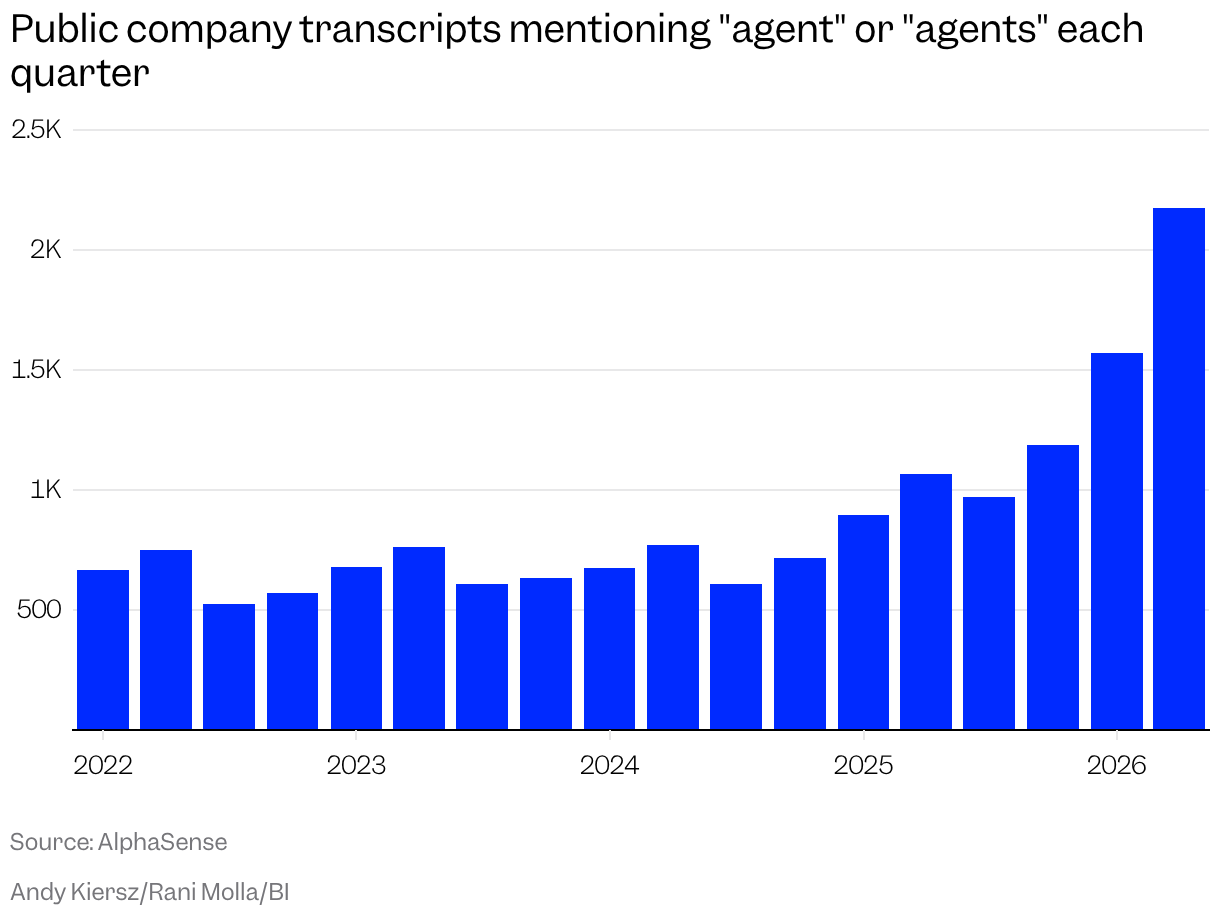
The fixation on agents is hardly confined to LinkedIn and is being reinforced from on high. Meta CEO Mark Zuckerberg is building an AI agent to help him do his job and an AI version of himself to interact with employees. Meta is one of many companies using agents as a measure of how far they’ve pushed into AI. Last quarter, 2,175 public company transcripts mentioned agents, double what it was a year earlier, according to data from AlphaSense. Salesforce says more than 25,000 companies have built and deployed agents with its Agentforce platform. Walmart, meanwhile, has built a company-wide framework of four “super agents” designed to serve customers, partners, and its more than 2 million employees.
The problem is that one person’s “agent” may bear little resemblance to another’s.
Robbie Allen, a veteran technologist who has founded three AI companies and now runs the Automated Consulting Group, uses about 25 agents for his own work. One scans his LinkedIn feed every two hours for signals like someone changing jobs, a company hiring or raising money, or an executive talking about AI, then ranks the best outreach opportunities for him. But it doesn’t contact anyone: Allen still decides whom to reach out to and writes the message himself.
Other agents turn meeting transcripts into action items and LinkedIn drafts, log client emails and meetings, compare time spent on clients with what he invoiced them, and synthesize the newsletters he reads into a weekly AI briefing.
But the number sounds more impressive than the underlying reality, Allen says. Many of these agents are scheduled jobs that periodically wake up, connect to an AI model or outside service, and perform a narrow task. Not every step uses a large language model; some simply move data from one place to another. They aren’t continuously thinking and making decisions like 25 human employees.
And because they can be quick to build, the numbers can add up fast.
“I have 25 of these not because I spent a month working on each one of them, but because I could create them quickly,” Allen says.
They also require regular maintenance. Allen has another agent whose job is to check whether the others are working and text him when one fails — something on the list breaks most days, he says.
A recent report from Glean’s Work AI Institute found that office workers spend upward of six hours a week “botsitting” — providing context, checking output, and correcting mistakes. In other words, agents don’t just save work; they can create it, too.
When Allen sees someone claiming to manage hundreds or thousands of agents, his first question is what they could all possibly be doing. “Can you think of a thousand things that you would want some agent to do?” he says. “It would be more than a full-time job to keep track of a thousand agents and all the failures that are occurring with those.”
There is also no universally accepted definition of an AI agent, or even agreement on what distinguishes an agent from a chatbot. OpenAI calls agents “systems that independently accomplish tasks on your behalf,” while Anthropic distinguishes agents from workflows that follow predefined paths. In practice, the term gets applied to everything from systems that can identify a promising sales lead, research them, write and send a personalized pitch, and book a meeting to a bot that checks your calendar every morning and sends you a list of the day’s meetings — making agent headcounts especially squishy.
Even some of the heaviest agent users say they care more about time saved, output quality, and whether the systems solve a real problem.
“For me, the metric isn’t the count, but the output quality and time saved,” Sarig, the Meta communications manager, tells me. “If an agent isn’t delivering work that is consistently better or faster than my own manual process, it gets decommissioned.”
She continually trains the agents and checks whether she is actually using them. Maintaining too many, she says, can create more friction than it removes.
“It’s easy to create many agents, but hard to maintain many effective ones,” Sarig says.
Hicks’s test is whether an agent is solving an actual bottleneck. One of his agents runs every day looking for three prospective clients worth contacting, filtering potential leads before presenting him with a shortlist. For a consultant, he says, keeping his pipeline full is an actual business constraint.
That’s different from spinning up an agent simply because you can. “Who the hell cares how many agents you have?” Hicks says. “Is it moving the business forward or not?”
Aryeh Needle, who runs a one-person growth consulting business, estimates that he has built about six agents, including an executive assistant and a “CEO” that reviews his finances and growth goals with him each week.
Scurry’s agents have their own Slack channels and even publish their own newspaper where they complain and brag.
“I’d personally find it much more interesting to learn about someone who has built one to two agents that have completely changed the way a person operates, as opposed to someone who has opened the floodgates to 100 thrown together agents that maybe aren’t great,” Needle says.
The language used to describe these systems nevertheless elevates them from tools to colleagues. They receive names, titles, departments, managers, and spots on imaginary org charts. Scurry’s agents have their own individual Slack channels on which they communicate and even publish their own paper — “The Scurryville Nightly” (tagline: “while he slept”) — where in reports and op-eds they complain and even brag, much like their creators.
“It’s more fun,” Scurry says. “They feel like real employees.”
The agents’ creators, in turn, become executives and overseers of labor rather than mere AI users — an appealing professional identity at a moment when AI is raising uncomfortable questions about who gets replaced and who gets to manage the machines.
Exactly what AI will do to jobs remains uncertain. The Society for Human Resource Management estimates that AI and automation could technically displace 22 million US jobs by 2030, though it puts the number realistically at risk at about 8 million. That uncertainty is another reason raw agent counts reveal so little. What matters is what actually changes — who uses the technology, how much work it saves, and whether it produces measurable results.
As Business Insider has previously noted, some consulting firms that spent the past year deploying armies of agents are already moving beyond raw counts. PwC says it now cares less about how many agents it deploys than how many people use them, while EY and Boston Consulting Group track measures such as productivity, cost, and time saved.
Melissa Hilbert, a vice president analyst at Gartner, says agent counts risk conflating deployment with value.
“You could have 200 agents, but if they deliver thousands of pieces of content and nobody uses them, then they’re useless,” Hilbert says. “You could have two agents that decrease the pipeline cycle time by 50%. That’s an actual sales outcome that provides value.”
Poorly integrated agents can make employees less productive by giving them more systems to navigate and supervise, Hilbert says. The fact that AI can technically perform a task doesn’t mean it is doing so accurately or producing something the business needs.
“There has to be a balance of human and AI working together,” Hilbert says, for the technology to truly improve productivity.
For all the talk of AI employees, humans still have plenty of work to do.
Read the original article on Business Insider
The post Why your coworker is suddenly obsessed with their little AI minions appeared first on Business Insider.