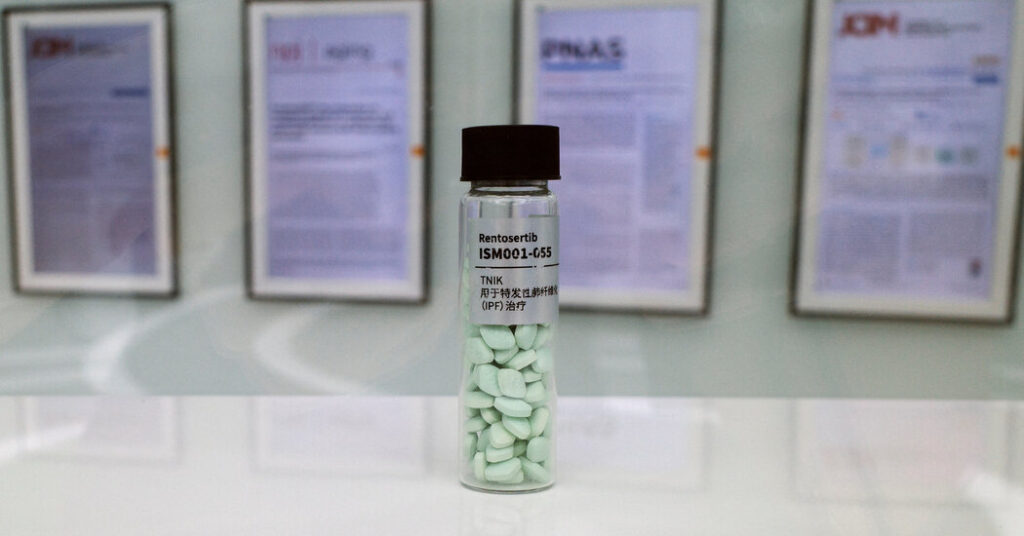
Last year, a clinical trial conducted by Insilico Medicine, a company that aims to accelerate drug discovery using artificial intelligence, indicated that one of its drug candidates could help treat patients suffering from a chronic lung disease.
Now, the company says that data from the same clinical trial shows a more intriguing possibility: that the drug could also slow the aging process.
The molecular structure of the drug, called rentosertib, was generated with the assistance of A.I. Results of the new study, published Monday in the journal Nature Biotechnology, show that the drug reduced the biological markers of age as measured by six “aging clocks,” a different kind of A.I. technology designed to predict a person’s morbidity and mortality.
This elaborate clinical trial is a milestone in the widespread effort to improve health care using the same A.I. techniques that underpin popular chatbots like ChatGPT and image generators like Midjourney. Insilico is just one of many start-ups, tech giants and academic labs working to accelerate drug discovery and hone other medical tasks with help from these methods.
The recent rise of aging clocks is helping to push these efforts beyond short-term treatments and into the realm of longevity research. These systems estimate how quickly a person’s body is aging — or even how quickly individual organs are aging relative to the rest of the body. But scientists continue to debate how much useful information these so-called clocks are able to provide.
While Insilico’s clinical trial shows the promise of several A.I. techniques, its drug candidate could still be years away from regulatory approval, even for use in sick patients. And the company has not yet tested its anti-aging effects in healthy patients.
“This drug looks encouraging,” said Eric Topol, a cardiologist and the author of the book “Super Agers.” “But we do not yet have a definitive trial to make the final judgment.”
Insilico began exploring the new wave of A.I. technologies more than a decade ago. Founded in 2014 by Alex Zhavoronkov, a Latvian-Canadian mathematician, physicist and biotechnologist, the company was among the earlier efforts to streamline drug discovery using what are called neural networks.
Using techniques similar to those that train A.I. systems like ChatGPT, Insilico first built a model to analyze a giant pool of data spanning health records for thousands of medical patients; blood tests describing the microscopic proteins created inside their bodies; and myriad academic papers detailing the effects of these proteins. With this system, the company is trying to identify particular proteins that lead to illness and disease.
Insilico then built a second system that analyzes troves of data describing the physical shape of proteins and the way these tiny biological mechanisms bind to other molecules. This system is designed to generate entirely new molecules that could bind to a particular drug target and neutralize its effects.
“It is like scanning a lock and generating a key that fits the lock,” Dr. Zhavoronkov said in an interview.
This is how he and his company developed rentosertib, which is meant to treat a disease called idiopathic pulmonary fibrosis, or I.P.F. Sometimes called “the Alzheimer’s of the lungs,” I.P.F. is a chronic disease that thickens and scars pulmonary tissue, reducing its ability to move oxygen into the bloodstream. The condition can lead to death, even within a few years.
Last year, with its clinical trial, Insilico showed that its drug candidate could significantly expand air capacity inside the lungs of patients who had I.P.F. But that was only part of the trial. Dr. Zhavoronkov said his company also designed the drug in an effort to generally extend a patient’s life span.
Separate from the tests involving I.P.F., the trial used six aging clocks to measure the markers of age in patients both before and after treatment with the drug. Across the 43 patients who participated in the trial, the clocks — which essentially try to predict a person’s age based on measurements of how well their cell, tissues and organs are functioning — showed significant reductions in the predicted age.
Each clock relies on a different analysis of those markers that yields a different prediction. During the trial, all six clocks showed a reduction in predicted age after patients took the drug for 12 weeks.
“This is the first study that shows, very clearly, that predicted biological age can be reduced,” said Vadim Gladyshev, a Harvard Medical School professor who helped build one of these aging clocks.
He acknowledged, however, that the study was far from conclusive, pointing out that the sample size was small and that aging clocks are not always reliable. Most notably, Insilico’s drug has not yet been tested in healthy patients: Because the company conducted its clinical trial solely with I.P.F. patients, the results could be unique to those with this particular condition.
But some experts believe that Insilico’s elaborate study could serve as a blueprint for future longevity research.
“These are methods we will use in future trials,” said Evelyne Bischof, a professor of medicine at Tel Aviv University who specializes in longevity.
The post Early Data Indicates an A.I.-Generated Drug Could Slow Aging appeared first on New York Times.