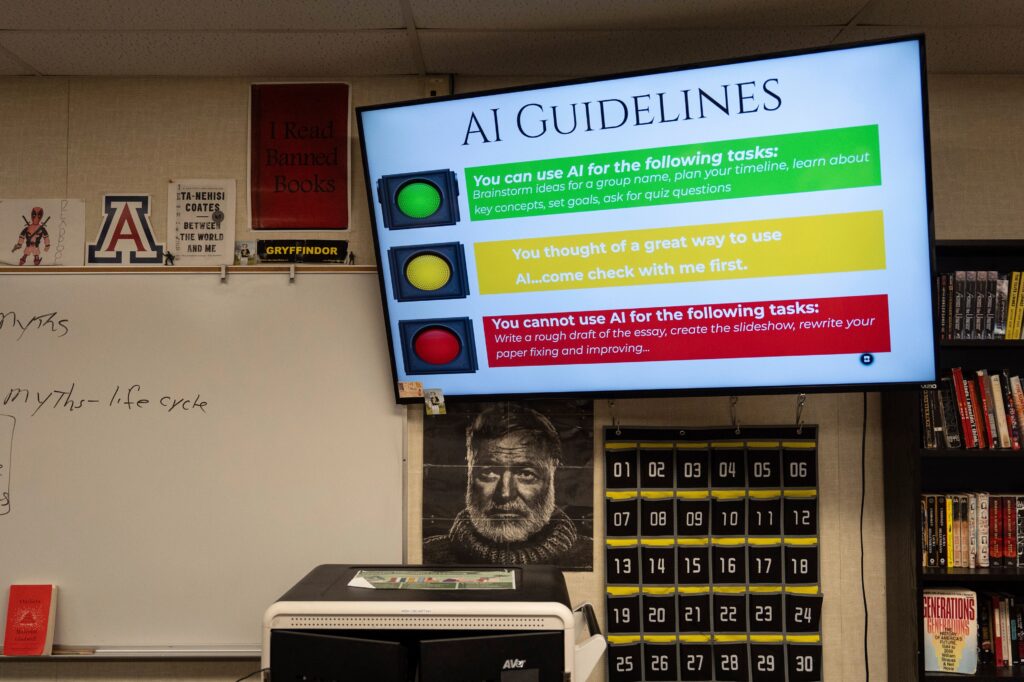
There’s a good chance artificial intelligence is being used in your child’s classroom this year. And it might be newly accessible for younger students through the online platform they use to submit assignments and communicate with their teachers.
The expansion of AI in schools has raised concerns about data privacy, children outsourcing critical thinking to machines and whether the virtual platforms on which students spend hours weekly are doing what they promise — even as the technology also boosts efficiency and can help tailor some instruction in helpful ways.
About 60 percent of teachers report using AI to grade papers, develop lesson plans, write emails to families and more, according to a 2025 Walton Family Foundation and Gallup survey. Nearly 70 percent of teens are using it, largely for schoolwork, a Common Sense Media survey published in August found. In younger grades, students are learning from AI-powered math and reading tutors.
But there is little consensus about how AI should be used in schools. Just a handful of states require the teaching of AI literacy or have passed laws setting data privacy requirements specifically for children using AI tools.
“It’s like the wild, wild west out there,” said Jeff Riley, executive director of Day of AI, a digital literacy nonprofit. “Finding that balance between what’s fair and what’s foul is something that we as a country haven’t done a good job of figuring out.”
Here are some tips — from school leaders, researchers, and technology experts — for navigating AI at your child’s school this year.
Ask what AI is doing, not just whether it’s being used
Some experts suggest seeking specifics from teachers and principals on how the technology is being deployed. This can help families understand if schools are working to reduce risks associated with AI, such as learning loss and weakened human connections.
Parents should ask which AI tools are being used and why, said Ayisha Irfan, founder of Augmented Intelligence Advisory, which works with school districts on AI literacy. The educational technology movement has infused classrooms with hundreds of digital tools to help students learn better, but parents should be skeptical.
“No educational outcome has ever happened randomly because of a policy,” Irfan said. She suggested that families ask how school leaders know the tools work and how the software helps students achieve their learning goals.
Parents should also be aware of the potential benefits of AI for individualized learning. Heidi Sipe, superintendent of the Umatilla School District in Oregon, said it has helped teachers cut down on administrative tasks, leaving more time for teaching, and some teachers have used it to modify lessons for children with disabilities.
In New York, literacy coach Selina Yu Ye worked with a first-grade teacher who used Microsoft Copilot to create a graphic for a reading lesson and translate parts of it into Spanish.
“We’ve seen so much potential, particularly on the educator side,” Ye said. At the same time, she cautioned that AI can make mistakes — she’s seen it botch a translation. “Teachers really have to make professional judgments.”
Some districts set students up with AI-powered tutoring apps. In Savannah-Chatham County schools in Georgia, some students with disabilities used an AI tutor that listened to children read aloud, screened for dyslexia and flagged areas for improvement.
In City Schools of Decatur, middle-schoolers have used AI to come up with different ways to solve a math problem, said superintendent Gyimah Whitaker.
“It’s helping brainstorm multiple ways to solve a problem and, at the same time, teaching them another way” to work through problems, she said. The district is also testing an AI-powered program designed to help high-schoolers study for exams.
“Everyone is grappling with how to use it and how to leverage it,” she said.
Understand data privacy policies
School systems are rolling out new restrictions and policies on AI as classes resume. These rules are important for understanding which uses of AI are allowed and how student data is treated.
One question families can ask is whether the tool their child is using is district-approved, meaning it’s been properly vetted, said Pete Just, AI project director at the Consortium for School Networking, which represents education technology professionals. Sometimes teachers find online applications on their own and, thinking they are safe, input student data into platforms that might not be secure.
“That’s dangerous,” Just said. “School districts need to be transparent and do a good job helping their teachers understand, through professional development, what is and isn’t allowed.”
Some states — including Indiana and Rhode Island— have passed laws focused specifically on AI and cybersecurity. Others have outlined how AI may be used, such as a Nevada law that prohibits schools from using AI to do the jobs of school counselors, psychologists and social workers. In Illinois, state officials expanded the definition of cyberbullying to include deepfakes, or AI-generated media that falsely depicts a person engaged in an activity without their consent.
Experts said parents should ask their school systems whether they have vetted the AI tools their district is using, and who can see student information entered into it. They should also ask what happens to students’ data if the district’s contract with a platform ends, Just said.
Still, schools have little control over big tech companies.
Google Classroom, a platform teachers use to assign work and communicate with students, recently opened its Gemini chatbot feature to students of all ages. The feature had been restricted to users 18 and older.
Through a new tab in Google Classroom, Gemini will allow students to seek AI help with assignments, as well as generate quizzes, write study guides and more, according to a Google blog postabout the change. More than 150 million students and teachers around the world use Google Classroom, the company’s website says.
A Google spokesperson said the feature was “preannounced” in June to give school districts notice of the changes. Students will see the feature only if administrators have already turned Gemini features on, and it can be disabled at any time.
“The Gemini in Classroom tab allows students to engage with Gemini in a way that is grounded in their course materials and vetted with pedagogy and safety experts,” a spokesperson said in a statement.
But the change did not leave schools with much time before the new academic year to go through their normal processes for vetting new technology, Education Week reported.
“To just flip a switch without having given teachers the chance to come up with their own understanding … doesn’t keep students and teachers and parents at the center of their child’s education,” Irfan said.
Know where learning ends and cheating begins
Academic integrity is high on educators’ list of concerns this year.
Of the students who say they use AI to get answers to schoolwork, a quarter use the chatbot-generated answer as-is, according to the Common Sense Media survey. More than 30 percent of teens get an answer, then rewrite it to sound like them.
Some classrooms have turned to oral exams and written assignments to curb cheating. Districts are also using screen recording software to track what students do on school-issued devices, as well as browser blockers that prevent children from opening new windows during exams.
But even those programs have drawbacks. Sipe, the Oregon superintendent, said last year a student was accused of cheating after a screen recording tool captured her pasting a large chunk of text into a Google Doc. Pasting like that can be an indication that a student has lifted an answer from a chatbot.
In this case, though, the student didn’t have a computer at home, so she typed her essay on her phone, Sipe said. The student then pasted the text from her phone into her computer at school.
If a student is suspected of stealing answers, Sipe said adults should first ask the child to show how they completed the task. “We should be very cautious about throwing the cheating word around.”
Other experts suggested parents ask their school systems when AI can be used for schoolwork, and when it is prohibited. They can also ask whether students have an option for challenging accusations of cheating.
The post AI has gone back to school, too. Here’s what parents should know. appeared first on Washington Post.