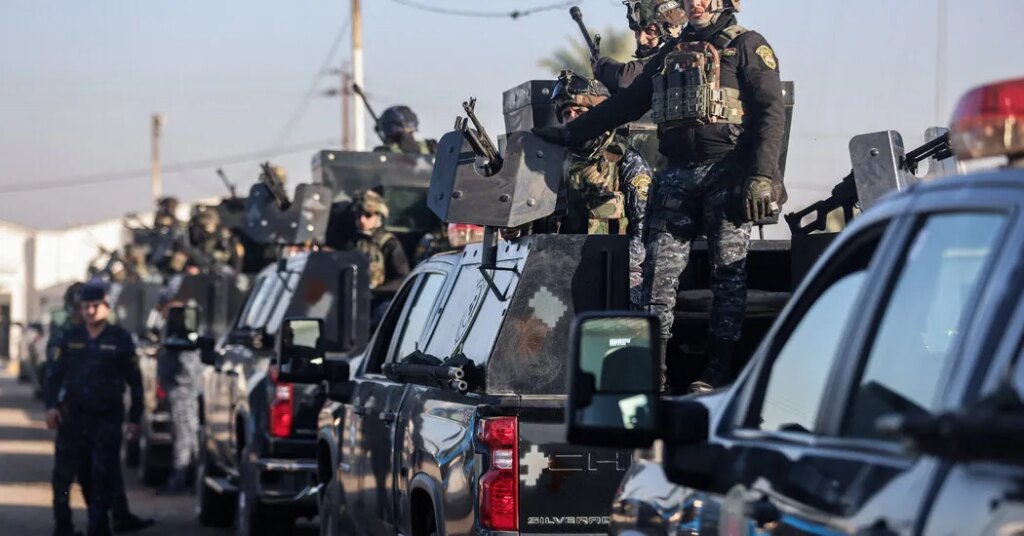
Iraqi security forces were deployed on Friday in territory long controlled by the country’s most powerful Iran-backed militia, handing Prime Minister Ali al-Zaidi’s government a symbolic victory after he had threatened to dislodge the armed group.
Military and police units entered Jarf al-Sakhar, a sprawling area southwest of Baghdad, for the first time in more than a decade, the prime minister’s office said. The militia, Kataib Hezbollah, has dominated the area for years.
But it was unclear whether the group would withdraw, a crucial factor in determining whether the government can claw back power from the dozens of militias that operate in Iraq outside of its control.
Mr. al-Zaidi took office six months ago, at a time when Iraq has come under increasing pressure from the Trump administration to disarm the Iran-backed groups. He has promised to dismantle the militias by June 30, 2027.
The prime minister is moving quickly to try to gain control of the area because of concerns that fighting between Washington and Tehran could intensify soon, according to an official briefed on the negotiations between the government and Kataib Hezbollah to avoid an armed confrontation. Mr. al-Zaidi wanted to limit the group’s ability to join any return to all-out war, said the official, who spoke on condition of anonymity because of the sensitivity of the talks.
The Iraqi government had set a deadline of Friday for Kataib Hezbollah’s forces to leave the area after a government inquiry said it had corroborated intelligence reports that the group was involved in oil smuggling and pipeline tampering in the area. Mr. al-Zaidi dismissed nine security and administrative officials and ordered the armed forces into Jarf al-Sakhar. A deal was agreed before the deadline expired.
The contours of the agreement between the government and Kataib Hezbollah were still being finalized, but the deployment did not appear to be a full takeover of the area. It was unclear whether the group would be forced out entirely and whether its activities, which analysts say include arms smuggling and weapons production, would be significantly curtailed.
A plan outlined by the prime minister’s office called for an Iraqi army brigade and a federal police brigade to be deployed alongside paramilitary groups that operate under a grouping known as the Popular Mobilization Forces. The grouping is technically under the authority of Iraq’s national security forces but some militias operate with a large degree of independence and have deep ties with Kataib Hezbollah. Those links could allow the group to retain influence over strategic areas in Jarf al-Sakhar.
Mr. al-Zaidi said in an address to the Iraqi security units that were deployed on Friday that “everyone will integrate into the armed forces under one banner and one command and one law,” adding that there would be “no weapon outside the authority of the state.”
The arrangement could still allow Kataib Hezbollah to retain influence through state-aligned factions that have longstanding ties to the group, according to Lahib Higel, deputy program director for the Middle East and North Africa at the International Crisis Group. Even so, she said, the arrival of army and police units represented real progress.
“Zaidi will still be able to sell this as a success — which it is, considering that no other prime minister has even been able to enter this location,” Ms. Higel said.
Iraq, like Iran, has a majority Shiite Muslim population. Iran-backed Shiite militias seized control of Jarf al-Sakhar from the Islamic State in 2014, after the jihadist group had swept across Iraq and captured more than a third of it. Local authorities renamed the area Jarf al-Nasr, or Bank of Victory. The fighting displaced thousands of its mostly Sunni residents, and militia forces have prevented many of them from returning.
The area has since become a largely closed military zone dominated by Kataib Hezbollah. The U.S. military said in 2020 that the group maintained heavy-rocket storage and propellant-production facilities there.
Iraqi political and militia leaders had intervened to avoid a confrontation between the government and Kataib Hezbollah. Esmail Qaani, the head of Iran’s elite Quds Force — an arm of its military that arms and trains militias across the Middle East — traveled to Baghdad to help mediate the standoff, according to the official briefed on the talks and an Iraqi official, who spoke on condition of anonymity because of the sensitivity of the discussions.
Mr. Qaani’s role underscored the limits of the Iraqi prime minister’s effort to curb groups closely aligned with Tehran, analysts said.
“If Kataib Hezbollah leaves Jarf al-Sakhar voluntarily, it is a modest victory for the prime minister, but ultimately, one that was facilitated by the Iranians,” said Victoria Taylor, director of the Iraq Initiative at the Atlantic Council and a former State Department official.
The post Iraqi Forces Enter Stronghold of Powerful Iran-Backed Militia appeared first on New York Times.