NEW YORK — Matches ending past 2 a.m. The unending din inside Arthur Ashe and Louis Armstrong stadiums. Social media influencers filming content during points. And, on Friday, the pungent smell of marijuana wafting onto the court strongly enough for the world’s No. 1 player to complain to the chair umpire.
The U.S. Open has long prided itself as being the loudest, brashest and unmistakably New York-iest of tennis’ four Grand Slam tournaments. But through the first week of this year’s event, a question has intruded on the spectacle: When does atmosphere start to supersede tennis?
“I think it makes it fun, because it makes it New York that it’s so kind of all over the place and chaotic,” top-ranked American and No. 3 seed Jessica Pegula said Friday. But, she added, some things could be better managed to keep outside factors from interfering with matches.
The latest example came during Aryna Sabalenka’s third-round victory over Kamilla Rakhimova. The two-time defending champion from Belarus stopped play to tell the chair umpire she could smell marijuana.
“Guys, you can do whatever, you can smoke whatever, you can relax as much as you can,” Sabalenka said afterward. “But please, do not do it around the tennis courts. It’s a bit tricky to handle that smell while you’re trying to compete at your best.”
It was hardly the first sensory intrusion at Flushing Meadows.
Noise, odors and general mayhem have gone hand-in-hand at the tournament almost since it moved here in 1978. Jets from nearby LaGuardia Airport roared overhead and trains rumbled alongside the grounds. Late nights and boozy fans could add to the mayhem. Contemporary accounts of the 1979 tournament described hamburgers sizzling over charcoal and pungent knockwurst and sauerkraut mixing with overflowing garbage cans and a mysterious Grandstand stench thought to come from decomposing soft-drink syrup in a drain.
That same year produced one of the most calamitous nights in tournament history.
During a second-round match between two of tennis’ most combustible personalities, Ilie Nastase and John McEnroe, chair umpire Frank Hammond penalized and eventually defaulted Nastase for his behavior. The crowd revolted, showering the court with cups, beer cans and garbage. Officials reversed the default and removed Hammond from the chair. After a roughly 20-minute interruption, play resumed, with McEnroe finally winning at 12:35 a.m.
In short, unruly crowds, strange smells, intrusive noise and late nights are not unique inventions of the TikTok era.
What has changed is the scale and, increasingly, the intentionality of the display.
During former No. 1 Naomi Osaka’s opening match on Ashe, a group of influencers in a courtside suite drew attention for making videos and using lights while play was underway. The episode went viral and prompted debate about the growing presence of content creators at sporting events — and whether newcomers are being adequately schooled in tennis’ distinct etiquette.
Japan’s Osaka, the 2018 and 2020 U.S. Open champion, saw the benefit of introducing the sport to new audiences, but also a limit.
“If you come to a sporting event, you have to respect the sport,” she said following her win. Osaka added, “I think it has to be managed a lot better.”
No. 4 seed Coco Gauff took a similar view, suggesting that brands inviting influencers could do more to educate them about customs such as avoiding flash photography and excessive talking during points, which goes against the grain of most major sporting events.
“If you’re being invited to a red carpet, you wouldn’t show up in jeans,” 2023 U.S. Open champion Gauff said in a news conference. “I think it’s just follow the etiquette of the sport. That’s all.”
For players, the distinction between atmosphere and interference can be more than a matter of manners. Noise and crowd movement can make it harder to pick up an opponent’s ball, often where tolerance for the commotion ends.
On Thursday, No. 11 seed Marta Kostyuk of Ukraine called Ashe and Armstrong “very, very, very loud” at virtually all times. Constant noise can eventually fade into the background, but initially it can be difficult to adjust.
During one stretch on Ashe, Kostyuk said, “I didn’t even hear the ball, like even when I was hitting it.”
Alex de Minaur offered a similar assessment.
“At times on Ashe or on Louis … it’s sometimes so loud you struggle to hear the ball,” said the sixth-seeded Australian, who bowed out in the second round on Thursday. “That’s probably something you don’t really get anywhere else.”
The sensory overload has been accompanied by some extraordinarily late nights, which have some wondering about how to better handle scheduling of a sport with no time clock, or whether it’s reasonable for any athlete to compete at that hour. Three of the first six night sessions at the U.S. Open have finished past 2 a.m. the following morning.
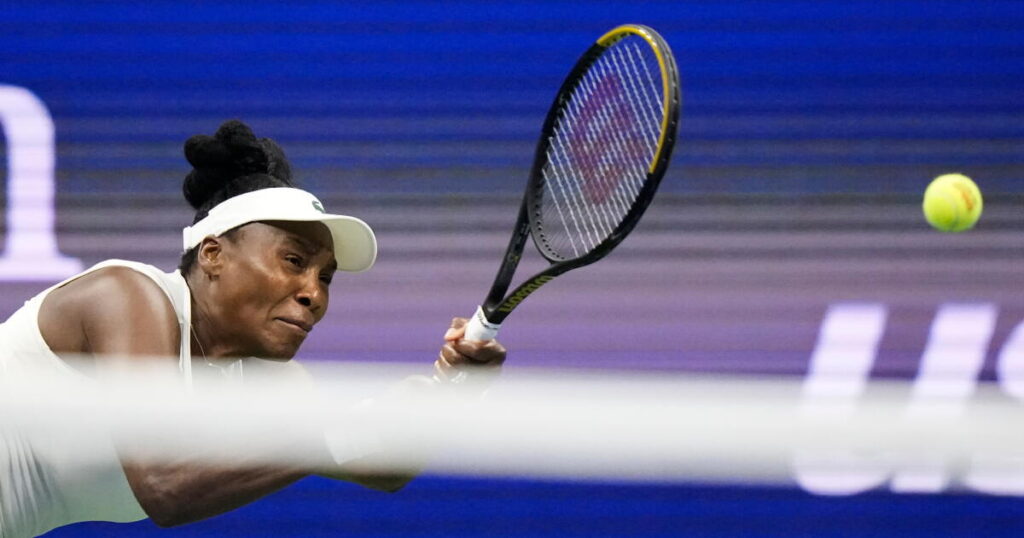
Venus Williams and Sofia Kenin did not begin their first-round match until 12:13 a.m. — the tournament’s latest match start in history. Kenin completed her victory at 2:01 a.m.
Williams, 46 and the 2000 and 2001 U.S. Open titlist, called the evening “completely insane” and said finding her best tennis in the wee hours of the morning was difficult.
Four nights later, No. 1 seed Alexander Zverev of Germany needed four hours, 33 minutes to beat Quentin Halys in another five-set Ashe marathon, finally finishing at about 2:15 a.m.
Yet many players don’t mind the madness.
Learner Tien knew what he faced when he stepped on Armstrong against retiring star Gael Monfils of France.
“I expected a very rowdy court, rowdy match,” the 20-year-old Irvine native said after dispatching Monfils in straight sets on Thursday. “I’m glad the atmosphere was like that. I think it makes the matches a lot more enjoyable.”
His boundary was simple: “As long as no one is shouting in the middle of the points and stuff, I think it’s great.”
Even Sabalenka, marijuana notwithstanding, said she loves the noise.
“I really enjoy this loud atmosphere in the stadium,” the 28-year-old said.
That contradiction is at the heart of the U.S. Open, even if there appears to be a growing disconnect between sport and spectacle.
Unlike Wimbledon’s manicured restraint or the French Open’s Parisian chic, New York has long offered something more unruly, with night tennis, celebrity, noise and spectators willing to make themselves part of the show. The atmosphere isn’t incidental to the tournament’s identity. It is part of the product.
If the USTA’s new chief executive has his way, there will be more of it. Craig Tiley, who took over the organization in July after two decades helping transform the Australian Open into an entertainment festival, said in a pre-tournament news conference he wants the U.S. Open to become a “tennis Disneyland.” He did not mean it as a warning.
And tennis is changing. Tournaments are pursuing younger audiences accustomed to the continuous movement and noise of other professional sports, challenging traditions that have long governed how spectators behave.
Pegula suggested some of the friction may simply be newcomers learning those traditions.
“Tennis etiquette, it’s something you have to learn as you go to these events,” she said. “Hopefully now that there has been some attention towards it that maybe now when they do come to matches they’ll be a little bit more informed.”
The post With late matches, intruding influencers and odd smells, is tennis losing at the U.S. Open? appeared first on Los Angeles Times.