When Helen Ferguson Williams was a girl, she begged her mother, Mary Elizabeth Ferguson, to take her to the Norfolk Botanical Garden. She wanted to be in the crowd when the Azalea Queen — often the daughter of a U.S. president or a foreign dignitary — received her crown of flowers.
Years later, Helen’s niece asked Mary Elizabeth to take her to the garden to see the Christmas lights, a display that attracts more than 100,000 visitors each year. In both instances, the answer was the same.
“She kept saying no, she didn’t want to go out there,” says Helen, 74.
So no one in the Norfolk-based Ferguson family, which eventually included throngs of grandchildren and great-grandchildren, ever visited the garden.
All that changed, however, about a decade ago. In 2007, Helen got a call from Martha McClenny Williams (no relation to Helen), a member of the garden’s board of directors. Helen’s mother, Martha Williams told her, was the last known living worker of the Black, mostly female crew who built the garden in the late 1930s, a project of the Works Progress Administration, which was created in 1935 to put Americans back to work during the Great Depression.
Mary Elizabeth Ferguson was 19 when she was hired by the WPA in 1938, the mother of a young son with an out-of-work husband. She would be one of 200 African American women and 20 African American men who worked through bitter winters and brutal summers, felling massive trees, moving wheelbarrows of heavy sludge and planting thousands of flowers on the swampy, snake-infested land that became the Norfolk Botanical Garden.
Because of Jim Crow laws, the workers were not allowed to enter the garden after the work was complete. Even when segregation ended around 1965, many of them never visited, including Ferguson. And she never talked about the sweat and sore muscles that made it possible.
“They wanted to put that painful past behind them,” says Martha Williams, explaining that before the Great Depression, the women had been educators, seamstresses and nurses. “They had done the work but didn’t tell anyone.”
That long silence has been an obstacle in the Norfolk Botanical Garden’s ongoing mission to identify and honor all 220 workers, which it does every September during its WPA Heritage Day (this year on Sept. 20), when descendants of the 79 WPA workers located so far gather to read their names out loud.
And this year is even more significant. On Sept. 12, the garden is publicly unveiling a new memorial to those original gardeners: a custom chandelier by Dale Chihuly, a celebrated glass artist known for his massive and colorful installations. It will hang above the new $50 million Garden of Tomorrow — a conservatory built to house and protect the world’s most threatened plants. A riot of pinks and reds and purples, the chandelier features every shade of azalea that the workers planted.
“It is an honor to have my work become a part of the Norfolk Botanical Garden’s permanent collection and its history,” Chihuly said in an email. “I hope it captures the spirit and dedication of the 220 WPA workers who first shaped the azalea garden.”
The story behind the blooms
In the mid-1930s, city leaders in Norfolk set out to build an azalea garden on 100 sodden acres just north of downtown, hoping to imitate the success of similar gardens in Charleston, South Carolina, which drew scores of tourists even during the Great Depression. The WPA awarded the city a grant of $76,278 and assigned it to a crew of 220 Black workers. Each was issued a shovel, pickax, rake and bucket.
One of those workers was Marie Freeman Davis Boyd. To her granddaughter Barbara Rice, she was Big Mama. Growing up, Rice spent a lot of time with Boyd, learning to cook and sew.
“She taught me on one of those old Singer sewing machines with the pedal, and I used to sit on the floor by her, and I would push the pedal,” recalls Rice, 81, who lives in Virginia Beach. That’s when Big Mama shared stories about her days on the WPA crew.
“It was a swamp, so it was infested with mosquitos and snakes and other animals,” Rice says. “She did wear a dress but also thick, thick rubber galoshes because they were standing in water and mud, and, if you got too close to a snake, it would bite into the rubber instead of your skin.”
In the winter, workers wrapped their legs in rags to keep warm.
Boyd told her granddaughter that she was picked up every morning by a government truck, carrying with her all the food and water she would need for the day. There were no bathrooms or drinking water at the work site. “If you needed to go, you had to find a tree or a bush or something,” Rice says, “and the other ladies would kind of watch and kind of keep an eye out for you.”
Over four years, using only hand tools, the women and men cleared 75 acres, cutting down 70-foot pines and wrenching stumps from the muck. They hauled the equivalent of 150 truckloads of dirt to build a levee for the surrounding lake. And they planted 4,000 azaleas, 2,000 rhododendrons and several thousand camellias, shrubs and daffodils that still delight the garden’s half-million annual visitors.
It was backbreaking work for just 25 cents an hour but still more than they could get from government relief funds.
By the time the project ran out of WPA money in 1942, the 220 workers had created a world-class garden, one lauded on the cover of National Geographic.
“There was so much recognition, but no one ever mentioned the people who actually did the work to make this beautiful garden,” Martha Williams says.
Finding the gardeners
In 2003, a group of middle school students made it their class project to encourage diversity at the Norfolk Botanical Garden. At the time, Martha Williams says, “there was absolutely minimal African American attendance at the garden.”
Assisted by Martha Williams, the students began researching the garden’s origins and discovered the story that had been virtually forgotten in the intervening decades. Hoping to create an oral history, the students placed an ad in the local paper looking for family members of the workers. Staff announced the search at civic club meetings, community festivals and church events.
Altogether, the students found 11 children of those who had worked on the garden. Their project ended in 2005, but Martha Williams, who now serves as the garden’s historian, continued the search. Over 20 years, she has located an additional 67 descendants and even found one living worker — Mary Elizabeth Ferguson.
But even then, it took Ferguson, who opened her own beauty salon after her stint in the WPA, a few years to visit the garden.
“I don’t think any of the ladies, including my mom, really wanted to go back there after everything they had been through,” Helen Williams says.
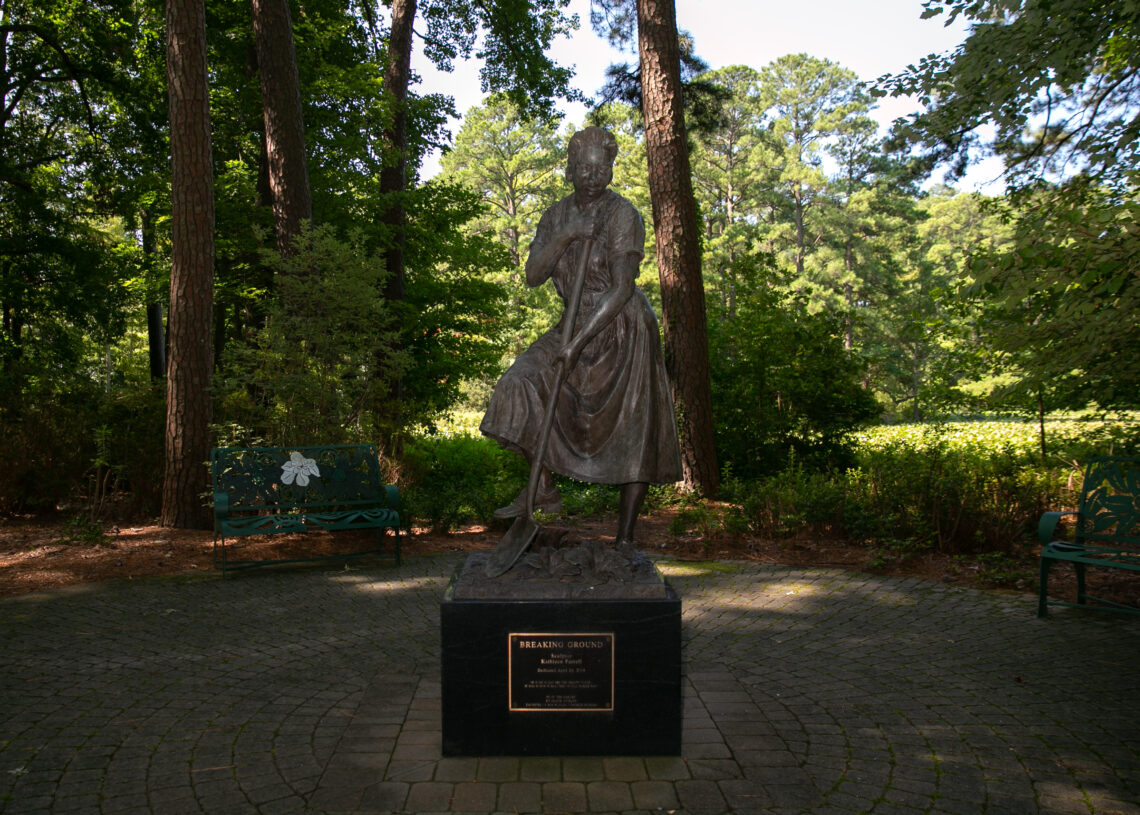
Eventually, Ferguson agreed to visit in 2009, on the garden’s inaugural WPA Garden Heritage Day, to unveil a bronze sculpture called “Breaking Ground” that honored the women and men who had toiled there. Seventy years after the government truck dropped her off at home for the last time, Ferguson climbed into a stretch limousine the garden had sent to retrieve her.
“She just loved that,” says Helen Williams. “She loved the attention.” Ferguson returned for Heritage Day — often with dozens of family members at her side — every year until she died in 2017 at age 97.
Meanwhile, the search for the workers continues. “If you heard stories in your family or if you have some pictures, we’d like to talk with you more and find out if your family member may have worked at the garden,” Martha Williams says. Workers would have been born between 1885 and 1922 and been a resident of the city of Norfolk during the Great Depression.
Helen Williams says that discovering her mother’s story has made the garden, once off-limits, a central meeting place for Ferguson’s family.
“I love going there. My mom’s children, my children, my grandchildren and great-grandchildren — they all love going there,” she says. “They love going to where great-great grandma was.”
The post A once-segregated botanical garden honors the Black workers who built it appeared first on Washington Post.