Sudan’s authoritarian government built a secret stockpile of chemical weapons that senior military officials sought to conceal after chlorine bombs were used against rebel forces, according to internal videos, documents, text messages and other materials reviewed by The Washington Post.
The materials indicate that Sudan’s chemical weapons effort involved diverting shipments of chlorine meant to provide safe drinking water, hiding warhead production sites on military bases, testing bombs in remote desert locations and drawing up lists of targets where toxic gas could penetrate enemy defenses.
Three years of civil war there have created the world’s worst humanitarian crisis.
The images and documents, which have not been previously reported, go well beyond the limited information made available by the U.S. government when it imposed economic sanctions on Sudan following a pair of suspected chlorine gas attacks in September 2024.
Any stockpiling and use of chemical weapons would violate long-standing international bans aimed at eradicating a notoriously inhumane form of warfare, and put Sudan in the company of Syria and Iraq as states that have been condemned in recent decades for deploying chemical agents against their own people.
Sudanese officials, including the country’s ruler, Gen. Abdel-Fattah al-Burhan, have denied that the government has developed or used chemical weapons.
The Sudanese government and the army did not immediately respond to requests for comment.
The trove was provided to The Post by Middle Eastern security officials who said the material had been obtained through sources in Sudan. The officials spoke on the condition that neither they nor their government be identified.
The files include documents allegedly prepared by Sudanese military officials that refer to “dual-effect” munitions filled with “choking gas,” videos that show weapons tests producing plumes of green-yellow vapor, and messages between Sudanese military officials indicating that the country’s security forces had stockpiled as many as 290 chemical munitions. It is not clear from the materials what Sudan has done with that alleged stockpile.
In vetting the files, The Post consulted more than two dozen Western intelligence officials, chemical weapons inspectors and experts at human rights organizations. All described the material as credible evidence of a chemical weapons program but emphasized that a conclusive assessment would require access to suspected weapons sites and witnesses, which has not been provided since the start of the civil war.
“The evidence is both alarming and a cause for deep concern,” said Gareth Williams, a former senior official at the Organization for the Prohibition of Chemical Weapons who is now a senior fellow at the Royal United Services Institute, a British defense and security think tank.
The stockpiling of chlorine munitions “cannot be definitively verified from visual evidence alone,” Williams said. “But the indicators are strongly consistent with a chemical weapons program.”
Developing or using chemical weapons would violate the Chemical Weapons Convention, a treaty among 193 nations, which Sudan signed in 1999. The treaty prohibits developing, stockpiling or using chemical weapons and requires signatories to allow inspections by the Organization for the Prohibition of Chemical Weapons.
Al-Burhan is scheduled to deliver a speech representing Sudan at the United Nations General Assembly later this month.
The development of a chemical weapons arsenal would add a dangerous element to a civil war between the Sudanese Armed Forces (SAF) led by al-Burhan — which controls Khartoum, the capital, as well as much of the eastern side of the country — and the paramilitary Rapid Support Forces, or RSF, which occupies much of Darfur in the west and is led by al-Burhan’s former deputy, Gen. Mohamed Hamdan Dagalo.
Both sides have been accused of atrocities including rape, the killing of children and ethnic violence targeting non-Arab communities. More than 13 million people have been displaced by the war, according to the United Nations, which said that an RSF campaign in Darfur last year had “the defining characteristics of genocide.”
U.N. arms embargoes and U.S. attempts to broker a ceasefire have failed to stop the civil war, which erupted after the ouster of Sudan’s long-standing leader.
Sudan also has served as a proxy battleground for Middle Eastern states, pitting U.S. allies against one another. Egypt, Saudi Arabia and Turkey are key supporters of the SAF, while the RSF is backed by the United Arab Emirates, according to Western security officials and human rights organizations.
Chlorine gas munitions, which are crude weapons that hark back to the trench warfare of World War I, are unlikely to alter Sudan’s stalemate, according to security officials and experts. But text messages sent by Sudanese military officers, according to Middle East security officials, indicate that the SAF saw chemical attacks as a means of sowing panic and flushing out enemy forces from dug-in positions.
In one exchange, a person identified as a Sudanese officer refers to police barracks including guard towers under RSF control, saying that the complex “should be targeted … the gas will cover all these towers and any sniper will come down” where SAF fighters can “neutralize them.”
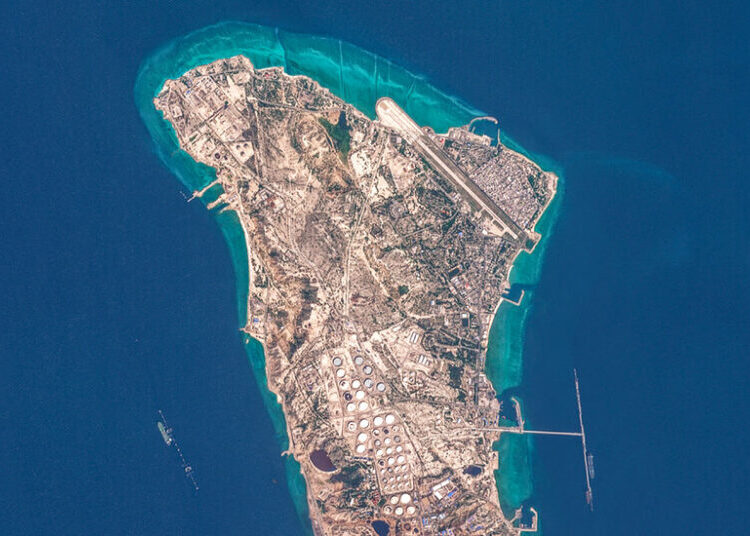
It is unclear whether chemical weapons were used on the barracks. The messages were sent in December 2024, according to the materials provided to The Post, three months after Sudan is alleged by the United States to have carried out chlorine gas attacks on RSF positions at the Al Jaili oil refinery and Garri Military Base north of Khartoum, according to security officials and experts.
There are indications in the files that Sudan has deployed chlorine bombs in other cases. A text exchange from late 2024 appears to show a Sudanese officer reporting that hundreds of chlorine bombs were assembled and stored at Merowe Air Base, a key installation for Sudan’s air force, and that 106 bombs had been used.
A separate message believed to have been sent to an SAF officer involved in airstrikes included a video of an apparent war victim with charred skin. “Your cooking,” the message said.
The Middle Eastern security officials who provided the documents to The Post identified the sender of the messages as Tariq Madani, whom the officials described as an SAF officer and the chief architect of Sudan’s chemical weapons program. Madani appears repeatedly in the materials, sending images of apparent bomb assembly facilities, commenting on warhead specifications and trading messages about the program with Sudanese officials including al-Burhan, according to Middle East security officials.
The U.S. Treasury Department imposed sanctions on Madani earlier this year for his role as a senior official in Sudan’s military procurement program, as well as his position as managing director of a firm, Target Multi-Activities Company Ltd., which “has imported explosives and related material into Sudan from Egyptian and Indian companies.”
Middle East security officials provided a cellphone number associated with the messages and voice notes attributed to Madani. The number appears in publicly available databases as belonging to Madani. An individual who answered a call to that number acknowledged that his name was Tariq but denied any awareness or involvement in chemical weapons production.
“I don’t know about this,” he said. “I am a civilian and this is a military question that you should ask a military person because I don’t know about this subject.”
Digital forensics experts contacted by The Post to review the audio and key visual materials found no evidence of manipulation.
The experts included Catalin Grigoras, director of the National Center for Media Forensics at the University of Colorado at Denver, and Hafiz Malik, an engineering professor at the University of Michigan-Dearborn.
In the case of text messages, the documents provided to The Post reference the phone numbers of senders and recipients and, in some cases, their alleged identities.
In assembling its alleged arsenal, Sudan appears to have relied on scrap components, diverted chlorine shipments and a crude manufacturing process, according to the materials.
The trove includes photos and videos that show dozens of makeshift bombs stacked in warehouse-style structures. Several photos show piles of canisters like those widely used in backyard barbecues, tanks whose primary use is to store liquefied gas and that are then fitted by welders with nose cones, spring-loaded firing pins and aerodynamic fins meant to ensure the bombs fall tip-first on their targets.
One video appears to show a primitive system for filling munitions with chlorine drawn from yellow bulk storage cylinders. The video shows metal tubs connected to a supply of chilled water amid a tangle of valves and hoses. Weapons experts said the system is likely used to chill canisters as they are filled with liquefied gas, a process that generates heat.
Other images appear to show a weapons rack mounted to the cargo floor of an Antonov An-32 aircraft, a Soviet-designed plane used by Sudan’s air force. The mechanism appears to be designed to function as a conveyor, weapons experts said, allowing bombs to be loaded and dropped out the plane’s cargo door.
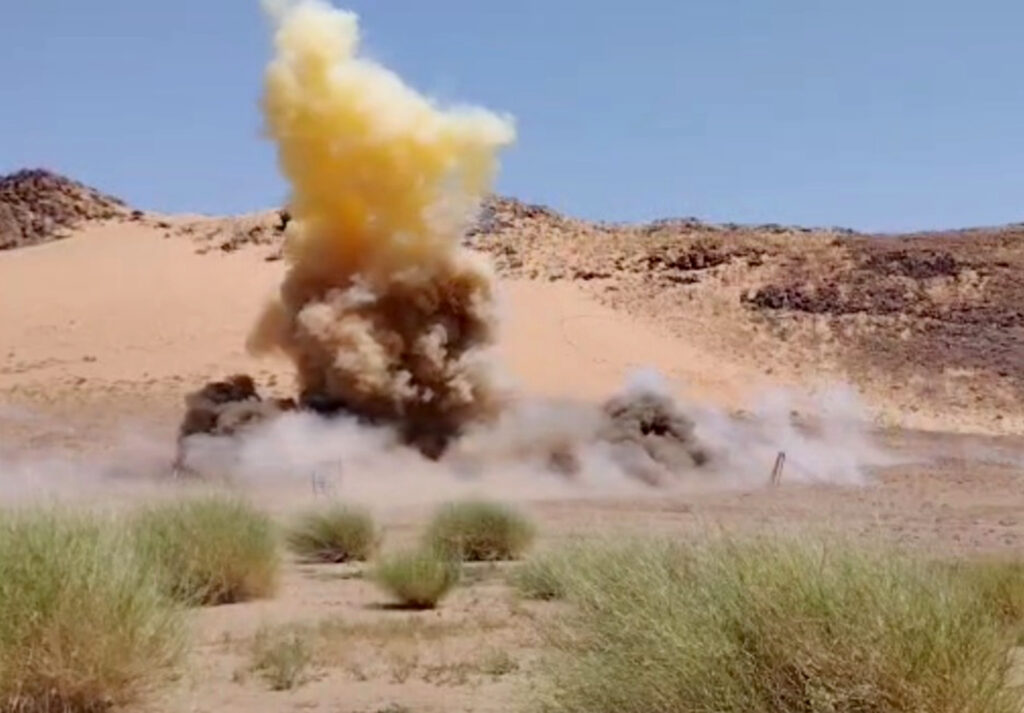
The most striking images in the files appear to show weapons tests in remote patches of desert. In one video, the hum of an approaching aircraft can be heard before projectiles strike the sand, sending up tall plumes of yellow vapor — a color associated with chlorine, experts said. Unseen observers can be heard cheering the explosions.
Documents appear to indicate that Sudan modified its warhead designs over time, increasing the size of the canisters and packing separate chambers with ball bearings meant to maim or kill.
One document describes the specifications of a “dual-effect” bomb that is four-feet in length and contains “15 kg gas” as well as 20 kilograms of explosives.
The files also indicate that SAF officers were focused on covering their tracks. The same document includes Arabic text saying that “the main purpose of the new design is to conceal any evidence of the use of chemicals and to release the gas from the tank directly in a perfect way,” according to a Washington Post translation.
The materials provide conflicting information on how Sudan obtained chlorine, a chemical that is critical to eliminating harmful bacteria from drinking supplies but when used in a bomb burns the skin and penetrates the lungs, potentially causing respiratory failure.
Images of canisters found at the sites of the 2024 attacks enabled France 24, a French news outlet, and C4ADS, a U.S.-based research organization, to trace the chlorine tanks to a supplier in India that said it had shipped the chemical solely for water treatment purposes.
The images examined by C4ADS show bulk chlorine tanks that appear to have burst upon impact, rather than bombs with detonation systems and tail fins.
A Middle East security official who shared the documents with The Post said they believed that the intelligence files show that the SAF was still testing its chlorine bomb designs during that period, and that they weren’t approved for use at the time of the attack on the refinery.
Documents and messages in the trove indicate Sudan may have other sources of chlorine. Messages that the Middle East officials said were sent by Madani mention the arrival of 20 large tanks via a border crossing with Egypt, and assert a capacity to produce as many as 1,100 bombs.
Other messages mention water treatment plants. A voice note officials attributed to Madani refers to “chlorine cylinders which are used for sanitation and to kill bacteria” at a purification facility. The cylinders “come through U.N. health care programs or whatever,” the speaker says, adding that “we took some of them from there.”
A spokesperson for UNICEF, a U.N. agency focused on the protection of children, said that it had supplied chlorine gas to the Khartoum State Water Corporation from 2023 to 2025 for use at six water treatment plants including Al-Manarah, a facility mentioned in the files.
UNICEF monitors such shipments, the spokesperson said, and “has no record of any UNICEF-supplied chlorine being diverted or misused in Sudan.”
“Chlorine supplied by UNICEF has one purpose: making water safe to drink,” the spokesperson, Joe English, said. “Any other use would be a serious breach of the terms on which it is provided, and of the principles under which humanitarian assistance is delivered.”
The United States announced new sanctions on Sudan last year in response to its alleged use of chemical weapons, imposing restrictions on loans, exports and technical assistance to the country.
The State Department said at the time that it had determined that Sudan “used chemical weapons in violation of international law” but provided few details about the evidence it had weighed in making that decision.
In September 2025, in a message that the Middle Eastern officials say was written by Madani, he sought to assure al-Burhan, Sudan’s leader, that a military base where weapons were stored had been “emptied of traces and residue,” according to text messages.
In a bid to stave off international pressure, al-Burhan publicly announced in May last year the formation of a Sudanese committee to investigate allegations that the SAF had used chemical weapons.
A document outlining the probe directed that Madani be included “due to his expertise” — giving the program’s alleged architect an apparent role in the investigation. The document is dated July 2025 and bears al-Burhan’s signature.
Sudan announced the findings of that investigation last fall, saying that “based on available evidence and data from field measurements … there is no evidence of chemical or radioactive contamination.”
Suzan Haidamous, Joyce Sohyun Lee and Jarrett Ley contributed to this report.
About this story
At The Post’s request, Catalin Grigoras, director of the National Center for Media Forensics at the University of Colorado at Denver, Hafiz Malik, an engineering professor at the University of Michigan-Dearborn who researches multimedia forensics, and two of Malik’s students, Jaskirat Sudan and Surya Subramani, conducted a deep forensic analysis of the audio. They found no traces of AI-manipulation in the audio files. The analysis, which included comparisons to confirmed recordings of al-Burhan speaking, was inconclusive on whether he was the speaker in the audio files, in part due to their low quality.
Also at The Post’s request, key images and videos in the report were analyzed by Hany Farid, chief scientist at GetReal Security and a professor of computer science at Dartmouth College specializing in digital forensic and video/image confirmation. Farid conducted a battery of tests, including an analysis of lighting and shadows, perspective geometry, and statistical patterns that distinguish between real and generated visual content. No indication of manipulation in any of the visuals analyzed was found. At the same time, the analysis does not independently verify that the claims made about the images are correct.
The post Trove of documents reveals alleged chemical weapons stockpile in Sudan appeared first on Washington Post.