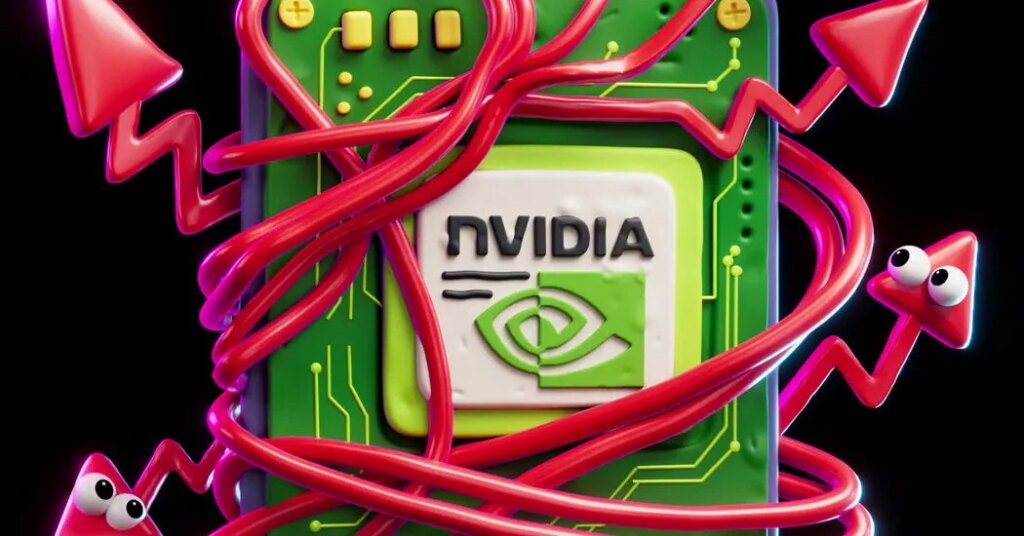
Nvidia shareholders have lost so much money that the sum is practically unfathomable: around $2 trillion from late October through Thursday. Only Apple, Microsoft, Alphabet and Amazon — and, for a brief time on Thursday, Anthropic — are even worth that much.
Nvidia’s vanished stock market value was roughly equivalent, in dollar terms, to simultaneously wiping three corporate giants, like JPMorgan, Exxon Mobil and United Health Care, off the face of the earth.
Not all of this colossal loss of wealth can be attributed to the forced departure of Jensen Huang, the Nvidia co-founder. But, undoubtedly, a great deal of Nvidia’s stock market plight stems from his unceremonious exit.
No wonder a swelling group of Nvidia loyalists is agitating for his return to the company. Mr. Huang said on Tuesday that he would be “honored to answer these calls and return as C.E.O.,” but the company’s board quickly made it clear that it would not welcome him back. So I wouldn’t count on Mr. Huang’s imminent return.
Yet this needn’t be a continuing calamity for Nvidia’s stock. History suggests that no executive at a mature company is irreplaceable, even if he is a global celebrity and a firm founder. After the initial shock and once a permanent replacement is in place, many companies recover in the stock market, several studies show.
Every company is different, however. The role of Mr. Huang at Nvidia poses special problems in assessing the company’s chances of prospering without him.
It’s not merely that he occupied a central position in what has arguably been the most important company in the most important industry in the world economy. Mr. Huang was also a pivotal player in U.S.-Chinese corporate relations, and the extent of his involvement in the supply of Nvidia chips and computing power to companies based in China isn’t yet known.
“Nvidia’s sales to China could be worth 20 percent or 30 percent” of the company’s peak stock market value, Aswath Damodaran, a New York University finance professor, said in an interview. That’s a big caveat, he said. It could be an exception to the rule that a stock like Nvidia ought to be solid enough to recover fully after a change in leadership.
Without Mr. Huang’s China connections, and amid national security concerns, investigations, congressional hearings and a harsher regulatory climate, “it may already be too late to restore all the lost value” coming from Nvidia’s sales, direct and indirect, to China, he said.
The Nvidia Saga
While much remains to be discovered, the basics of the Nvidia story are widely known. It designs advanced chips that power artificial intelligence, which made it an earnings machine, producing astonishing profits that, until its recent debacle, buoyed the entire stock market.
The company also served as a kind of central bank for the A.I. industry, pumping hundreds of billions of dollars into aspiring competitors, suppliers and customers, as my colleagues, Maureen Farrell and Rob Copeland, have written. For example, it committed to invest $10 billion in Anthropic before that A.I. giant’s initial public offering this week.
Nvidia remains a financial powerhouse — with revenue of $115.8 billion and profit of $65.3 billion in the three months through October, according to its latest disclosures on Tuesday. Both figures exceeded Wall Street’s expectations, and Nvidia projected revenue in the current quarter to be even larger, about $130 billion. Its longtime chief financial officer, Colette Kress, has been running the company on an interim basis since Nov. 12. That’s when Mr. Huang resigned.
He stepped down in the wake of a New York Times report that he had an affair with an employee at Nvidia, as well as with Alice Huang, a businesswoman whom U.S. intelligence has determined is an asset for Chinese intelligence. On Monday, the Trump administration moved to block the sale of advanced chips to data centers of the type run by Ms. Huang. She started a Singapore company called Megaspeed that is under investigation over allegations of smuggling chips to China. Chinese officials have denied that Ms. Huang is a spy for China. In his public comments in China, President Trump played down the episode.
C.E.O.s and Stock Returns
The vast literature on the stock market effects of abrupt C.E.O. departures fails to offer many definitive lessons.
One thing that is clear, however, is that hasty executive exits tend to upset the stock market over short periods. One study of 30 such cases by BCA Research, an independent financial research firm, found that over the last three decades, 70 percent of the companies underperformed their benchmark significantlyover the following month.
In a separate study, Bespoke Investment Group, another independent research firm, examined how stocks performed one year after the chief executives were pushed out by their boards. It examined 30 cases that occurred within the last 10 years and found that, on average, the companies’ shares were down 12 percent one year later.
There was a silver lining in the Bespoke study. Of the six companies in the group in which the chief executives had to leave for what Bespoke called “bad behavior” involving “an inappropriate personal relationship,” their average stock was up 12 percent.
In an interview, Paul Hickey, a co-founder of Bespoke, called those returns “somewhat positive but not dramatic, because the market in that period was positive.” In fact, the S&P 500 over the last 10 years gained an annualized 13 percent, according to FactSet.
Yet another study, by Commons Capital, a wealth management firm, focused on 15 corporate founders who left their companies for a variety of reasons since 1985. It found that although the stock shares of most companies declined in the 12 months after a C.E.O. departure, a few well-known companies prospered.
Perhaps the most prominent was Apple, whose top executive, Steve Jobs, departed twice: in 1985, when he was pushed out by the Apple board; and in 2011, when he resigned because of the pancreatic cancer that led to his death. Both times, Apple stock soared over the following 12 months. But Mr. Jobs’s first successor, John Sculley, was himself forced out in 1993 when the company’s fortunes were ebbing. The second coming of Mr. Jobs culminated in the creation of the iPhone, the sleek gadget that transformed the world and turned around Apple’s fortunes. Mr. Jobs’s second successor, Tim Cook, never pretended to be the creative maestro that Mr. Jobs was, but Mr. Cook led Apple to tremendous gains, as an efficient and mature company, until resigning as chief executive and becoming chairman this year.
I ran the numbers on FactSet: From Aug. 24, 2011, when Mr. Cook became chief executive, until April 20, 2026, when he announced his resignation, Apple shares returned 24.3 percent, annualized, including dividends, compared with 15.2 percent for the S&P 500.
Nvidia, at this stage, seems to be “a fairly mature company with a good pipeline of products and a deep bench,” Mr. Damodaran said. “It could well resemble Apple under Tim Cook,” if not for the issues with China and the turbulence of the A.I. industry itself.
So what should one conclude from all this? Predicting how Nvidia will fare is a hazardous task. Whether Nvidia shares soar once again will depend on very specific issues that I won’t even try to assess in advance.
As an investor, I don’t even attempt to judge individual securities. Instead, I hold a part of the entire stock and bond markets through low-cost index funds and try to prosper over long periods when the economy does. What’s happened to Nvidia shares over the last month only reinforces the case.
Nvidia was the biggest company in the stock market until recently, and its decline is dragging down broad index returns. But at least these losses are being buffered by other stocks and bonds.
The future of A.I. and of the stock market won’t depend on just one company — not on Nvidia and probably not on Anthropic, which began trading shares to the public on Thursday. But Anthropic warned in its prospectus that its A.I. has the potential to destroy humanity.
Even well-diversified investors have plenty to worry about.
The post Stocks Often Prosper After an Abrupt C.E.O. Exit. Is Nvidia Different? appeared first on New York Times.