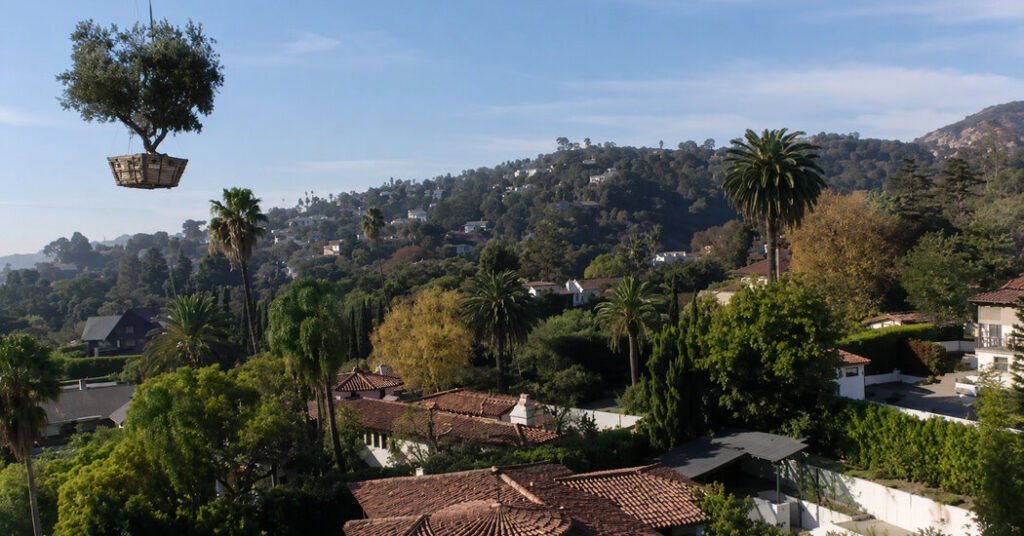
Imagine lifting a chair and moving it to a corner of the living room. Now imagine that the chair is 50 feet tall and weighs 100 tons. That, or something very like it, is the daily task of specialized workers who uproot and replant trees that may have been saplings when Ronald Reagan was a child.
“Every day, that’s what we do,” said Tom Cox, a co-founder of Environmental Design, a company in Texas that sources and transplants some of the largest and heaviest trees in the world. “People who can afford it want the biggest, and they want the best in everything, and they want it now.”
The commerce in old trees is certainly not new. But as the billionaire class rapidly grows and the net worth of the richest Americans soars at unprecedented rates, the mature tree business is booming, according to experts in this once-niche industry.
“Of course, people have done big trees before,” Andres Blanco, a partner at Ferguson & Shamamian Architects in New York, said. “But not at this scale. The money is now out of control.”
Tech moguls and hedge-fund titans these days want their estates to look as if they have existed since time immemorial. And so stately trees are on the move, finding new homes in moneyed enclaves across the country, from the Hamptons to Silicon Valley. Arboreal specimens the size of dinosaurs are being wrenched from the earth, trussed and loaded onto flatbed trucks to hit the road.
In Palm Beach, Fla., landscape architects are routinely given the task of digging up and replanting horticultural rarities. Recently, Fernando Wong Outdoor Living Design installed a pair of banyan trees on a client’s estate. “Each was $250,000,” Tim Johnson, an owner of the company, said.
Especially popular among the mega-mansion set of South Florida is the Canary Island date palm. A full-grown specimen costs, on average, $50,000, Johnson said.
“The thing is, you need matched pairs,” he added.
A yet greater status symbol may be the African baobab, Johnson said. He noted that a client recently purchased one for $500,000. “A whole subculture has developed where trees are coveted like art and fetch similar prices,” he said.
Along a stretch of Bellevue Avenue in Newport, R.I., two billionaires have squared off in recent years in what appears to be a landscaping duel. Larry Ellison, the chief executive of Oracle, the data and software storage company, has added dozens of mature specimens (along with scores of ancient boulders) to the sloping lawns of his seaside estate, Beechwood, which was once owned by an Astor.
A short stroll away, Stephen A. Schwarzman, the philanthropist and chief executive of the Blackstone private equity company, has similarly enriched the oceanfront acres of Miramar, a 30,000-square-foot mansion designed by the prolific architect Horace Trumbauer in the early 20th century.
Since Schwarzman bought Miramar for $27 million in 2021, the estate has undergone extensive restoration. One budget item in the makeover is a dense privacy screen encircling the property. It is composed of more than 100 American holly trees in full maturity, each roughly 18 feet tall. Given that one holly of that scale fetches more than $10,000, according to industry experts, the cost of the screen was likely more than $1 million.
Madison Cox, the principal of Madison Cox Associates, the company credited with landscaping the Schwarzman estate, said that Miramar represented the “quintessential example of first-quarter-of-the-21st-century spending.”
“Instant gratification” is the goal, said Mariah Whitmore, whose Whitmore Nursery on Long Island provided, among other greenery, the hollies for Miramar. In a race to soften landscapes and render their properties instantly old, moneyed clients are more willing to spend for the majesty of trees in full maturity, she said.
“Budgets have grown, trees included,” Whitmore added. “It’s about the immediacy.”
The trade in mature trees has a long and storied history, extending at least to the 18th century and the English gardener Lancelot Brown, nicknamed Capability. Even in his time, Brown was equally celebrated and reviled for reshaping English landscapes to suit the shifting tastes of his landed clientele.
During the peak of his influence, the continental gardens that had previously been the fashion fell victim to estate owners who “simply couldn’t, or wouldn’t, wait the 30 or more years needed for an oak to attain a lofty height,” as one of Brown’s biographers noted. Clipped parterres gave way to swaths of acreage studded with transplanted giants.
To find a time when the commerce in big trees was as brisk as it is now, one would have to look back to the Gilded Age, when the era’s so-called robber barons ransacked virgin forests for sylvan ornaments to adorn their baronial estates.
In 1901, The New York Times reported that the steel magnate Andrew Carnegie had uprooted some 30 trees, each more than 60 feet tall, from the forests of New York and Connecticut and had them relocated to the grounds of his newly built mansion on Fifth Avenue.
“It’s always boys and toys,” said Tanya Kelley, a landscape designer who has practiced for three decades on Aquidneck Island, where Newport is situated.
“Yachts, houses, art, trees, it’s always essentially the same thing,” Kelley continued. “It’s, My tree is bigger, my crane is taller, than yours.”
In Carnegie’s day, most transplants were dug by hand with spades to preserve their delicate root systems. They were then tipped over to allow for their delicate undercarriages to be trussed in an elaborate corset of “drum-lacing” and rolled onto horse-drawn flatbeds. Drum-lacing remains an integral part of the process, though the wagons are now tractor-trailers, the hoists driven on diesel and the specimens as large as advances in technology allow.
Cox, the tree vendor in Texas, started his company in 1977. In 1993, he bought the company that pioneered the hydraulic tree spade, a gargantuan scoop that supports hefty trees when they are relocated. Cox has also developed and patented machines and methods for transporting trees so enormous that moving them across great distances often requires special highway permits, the temporary dismantling of telephone lines and even, on occasion, road closures.
Statistics are scant for this particular business, yet there is little doubt that more big trees than ever are called for in the landscape designs of the wealthy, said Perry Guillot of Perry Guillot Landscape Architecture in Southampton, N.Y.
“Budgets are vast,” he said. “The feeling is, Why wait for a tree to grow if you can get something larger today?”
Chet Halka, the proprietor of the Halka Nurseries, a wholesale supplier of trees in southern New Jersey, also noted the impatience of a certain class of client. “People that have the money are going to spend the money,” he said. “If people are going to buy or build a $100 million home, why wait for small trees to mature?”
To facilitate shopping at his 2,500 neatly wooded acres, Halka maintains a grass landing strip and a helipad. Thus clients like Daryl Roth, the longtime Broadway producer, and her husband, the real estate mogul Steven Roth, can easily pop in for a tour of the big oaks, lindens, beech and catalpa.
“We are mature people, and we weren’t planning to live long enough to see saplings grow,” Ms. Roth said by phone, referring to an excursion the couple undertook to Halka Nurseries that yielded a dozen or more specimens for the parklike grounds of their estate in East Hampton, N.Y.
In a sense, the trade in big trees may be as good an economic indicator as a Moody’s report, said Eric Groft, chief executive of the landscaping company Oehme, van Sweden. Back in the go-go ’80s, Groft sometimes found himself competing on big-tree lots with people like Martha Stewart and Ralph Lauren.
“When Ralph was building his estate in Bedford, I’d be tagging 60-foot spruces at Halka, and they’d say, ‘Oh, Eric, you can’t have that one. That’s for Ralph,’” he recalled.
Recently, Groft’s company acquired a specialty tree from Marders, a nursery in Bridgehampton, N.Y., on behalf of a customer. With a trunk 24 inches in diameter, it was likely older than the client who had bought it. “That is a very large tree, but the technology has changed to the point where they can move just about anything anywhere,” he said.
Case in point: The 12 full-grown magnolias Chet Halka recently trucked to Manhattan for a client. Weighing one ton apiece, they were destined for a rooftop terrace of a mogul’s townhouse. Orchards, groves and forests in the sky, Halka suggested, have become a new billionaire flex.
“We are growing a luxury here,” he said. “We are not growing a necessity.”
The post The Latest Wealth Flex: Big Trees appeared first on New York Times.