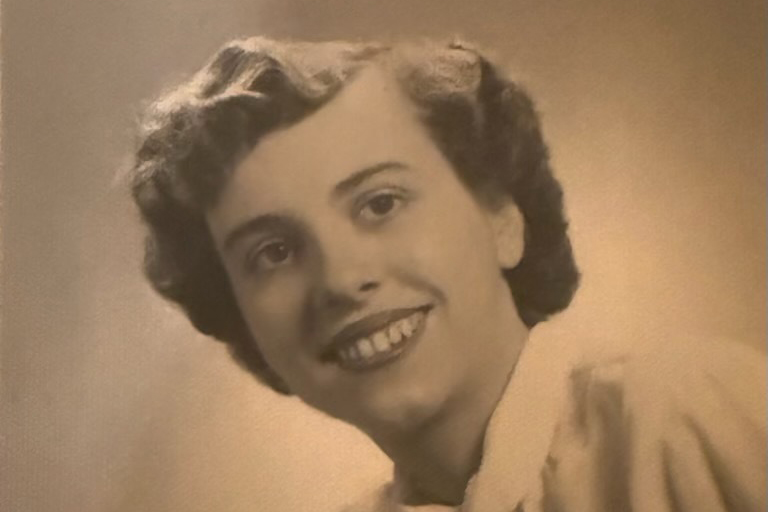
When she became a programmer at the birthplace of the atomic bomb in 1952, Mary Tsingou Menzel’s first assignment was to make a computer do what humans already could: calculate the sine of an angle. Anyone who knew trigonometry could easily get the answer, but to have a machine do it required translating the problem into a foreign language of holes punched on tape.
“I kept checking it over and rechecking it. And then finally I punched the tape, and I put it in, and it worked immediately,” she told an interviewer, Janet Abbate, in a 2002 oral history for the engineering group IEEE. “That was the first and last time I ever had a problem work immediately.”
Mrs. Menzel was one of dozens of service-minded women who joined the Los Alamos laboratory in New Mexico in the early years of the Cold War, first to do mathematical calculations by hand, then to wrangle primitive computers that could do the tasks for them. She went on to play a key role in a landmark computational physics experiment, now known as the FPUT problem, that uncovered strange physical behaviors and helped propel the development of chaos theory and other fields.
But it took more than half a century, physicists said, for her to receive appropriate credit for her work on the project, which was among the first of a new kind of experiment. It helped demonstrate that scientists had a powerful new tool in their arsenal: In addition to examining a phenomenon by taking real, physical measurements or gaming out its behavior with theory, they could ask a computer to numerically simulate it.
“It’s the third component: experiment, theory and computation. And those three components are essential for studying physics in the 21st century and for studying any technical science,” said David Campbell, a Boston University physicist who led a center for nonlinear science at Los Alamos.
Mrs. Menzel, who died Aug. 27 at 97 at home in the town of Los Alamos, was part of a generation of women who quietly performed calculations, programmed computers and developed equations in America’s leading halls of science after World War II. Where NASA’s “hidden figures” like Katherine Johnson worked on the math that sent humans and rockets into space, Mrs. Menzel and her colleagues wrote code for hydrogen bomb simulations, particle accelerators and the proposed “Star Wars” missile defense system.
Those female coders rarely received the same scholarly recognition as the physicists — usually male — they worked with. When the FPUT problem was communicated to the physics community, Mrs. Menzel’s contribution was noted in a footnote thanking “Miss Mary Tsingou,” as she was known at the time, “for efficient coding of the problems and for running the computations on the Los Alamos MANIAC machine.” For more than 50 years, the experiment was known only as the FPU problem, named after its three credited co-authors: Enrico Fermi, John Pasta and Stanislaw Ulam.
Mrs. Menzel’s name became attached to the problem only after the publication of a 2008 paper by French physicist Thierry Dauxois, spotlighting her contributions. “It is time for a proper recognition of her work,” he wrote.
In the “modern day, whoever writes a code for a research paper, one should be a co-author,” said Avadh Saxena, a physicist at Los Alamos. But in the 1950s, “they were not sure whether coding, or writing, a program constituted co-authorship.”
Mrs. Menzel said she didn’t feel slighted by the oversight. She was working with giants of math and physics like Fermi, one of the architects of the atomic bomb, and Ulam, who helped develop the hydrogen bomb after the war. In her words, she was “just a programmer.”
“She kept always wondering why everyone was making such a big deal about it,” said her daughter, Ann Menzel.
‘Felicitously chosen’
Mary Thomas Tsingou was born Oct. 14, 1928, in Milwaukee to poor Greek immigrant parents from Bulgaria. Her father was a factory worker, and she and her older sister, Sally — who also became a mathematician, at the National Bureau of Standards — grew up speaking Greek at home. Her family lived in Bulgaria for several years until war broke out in Europe.
After graduating from high school in Milwaukee, Mrs. Menzel studied math at the University of Wisconsin, hoping to become a teacher. Her differential equations professor suggested she look at Los Alamos, which was searching for “hand computers”: young mathematicians who could perform calculations needed for weapons simulations or nuclear propulsion by hand. With young men being drafted into the Korean War, recruiters were increasingly hiring women — while also telling them, according to Mrs. Menzel, that they would be paid less than their male counterparts, because “men were breadwinners and women were just supplementary.”
“We as women were expected to be second rate,” she recalled in a 2020 interview for Los Alamos, noting that while she enjoyed her time at the lab, “the men always got the more interesting problems, and the women were always relegated to the mundane — keeping the machine going and stuff like that.”
Mrs. Menzel was quickly recruited onto the team for MANIAC, an 8-foot-wide, 1,000-pound early computer that needed people to turn its finicky vacuum tubes and electronics into something that solved equations. The programmers worked in a room with the windows shut to keep the dust out; before air conditioning, MANIAC was cooled by a restaurant vent hood humming overhead.
Mrs. Menzel and her peers had to understand the machine intimately, down to the circuit level, said Nic Lewis, a lab historian at Los Alamos. Adding two numbers together involved identifying where in the computer’s memory they were stored, adding them one by one to an internal scratchpad and then storing the result someplace else. The coders got to know the machine so well they could tell if it had stalled just by the sound; they would tune a radio to the right frequency and pick up on the chatter of the computer’s circuits.
“They had the skill set of taking complex problems and breaking them down into smaller components to make them easier to process,” said Lewis. “And when you have a very limited computer like MANIAC, you have to be really good at that.”
In the mid-1950s, Mrs. Menzel’s team began looking for an interesting problem on which to test MANIAC. The computer could perform about 10,000 calculations per second — less powerful than chips found in today’s thermostats but still enough to perform physics simulations that would’ve taken months or years to calculate by hand.
They settled on a system of weights held together by springs, a convenient way of modeling the movement of phenomena like a vibrating string. Under normal assumptions, if the spring system is plucked, it’ll lapse into some predictable vibration, going back and forth. The physicists thought that introducing a small change to the way the springs responded to stretching would result in random motion through the whole chain.
But when Mrs. Menzel punched the equations into MANIAC’s tape and ran the numbers, something strange appeared: The simulated springs seemed to “remember” the way they were first plucked, vibrating back to the pattern in which they had begun. Out of the chaos came some order.
The problem was “felicitously chosen,” Ulam later wrote in his memoir. The physicists realized that physical systems that seemed random and chaotic could actually have hidden patterns. Out of their observation grew chaos theory and a broader field called nonlinear dynamics, which now help scientists study earthquakes, stock markets, internet cables and the beating of the heart — the movement of things that appear unpredictable.
In 1955, the year the results of the FPUT problem were first published, Mrs. Menzel received a master’s degree in mathematics from the University of Michigan. She married Joseph Menzel, a Navy veteran who worked in security at Los Alamos, in 1958.
Mrs. Menzel later worked on new generations of supercomputers at the lab, including as part of a team that created simulations designed to detect whether missiles launched against the United States were carrying nuclear warheads. She retired in 1991.
Survivors include two daughters, Ann and Carol Menzel; eight grandchildren; and three great-grandchildren. Her husband, with whom she learned to ride a tandem bike in retirement, died in 2022.
Long after she stepped away from lab work, Mrs. Menzel retained a love for mathematics and problem-solving. In 2010, one of her grandsons called her asking for help.
“He had a final, and he couldn’t solve this one problem,” said Ann Menzel. “Like, four days later in the mail arrives seven handwritten pages of how she couldn’t believe he couldn’t get this problem, and here’s what he should have been thinking, and different permutations of this problem.”
The post Her work was key to a landmark experiment. She was credited in a footnote. appeared first on Washington Post.