The colorful array of hand-scrawled Post-it notes formed a hodgepodge of grievances about city life, as requested by D.C.’s all-but-certain next mayor, Janeese Lewis George, who said she was there, at a church in Southeast Washington, to listen.
“The 311 line needs fixing,” read one note on a board headlined, “BUILDING A PEOPLE’S GOVERNMENT, WHAT COULD USE SOME LOVE IN YOUR NEIGHBORHOOD?”
“Empty public trash cans more often,” read another.
“Want the mayor to tell us what she’s going to do,” a third person wrote, adding in smaller lettering: “This feels gimmicky.”
The chance to jot a missive along with a free buffet-style dinner were the icebreakers greeting the hundreds who turned out this week for the start of Lewis George’s self-styled “listening tour,” a familiar variety of political stagecraft that she is employing over the next month to draw audiences in each of the city’s eight wards as she inches toward her quest of succeeding Mayor Muriel E. Bowser (D).
Like any politician, Lewis George, 38, a second-term council member in Ward 4, cannot walk outside without encountering constituents complaining about potholes and rats, President Donald Trump, the presence of immigration enforcement agents and National Guard troops, and whatever else is irking them.
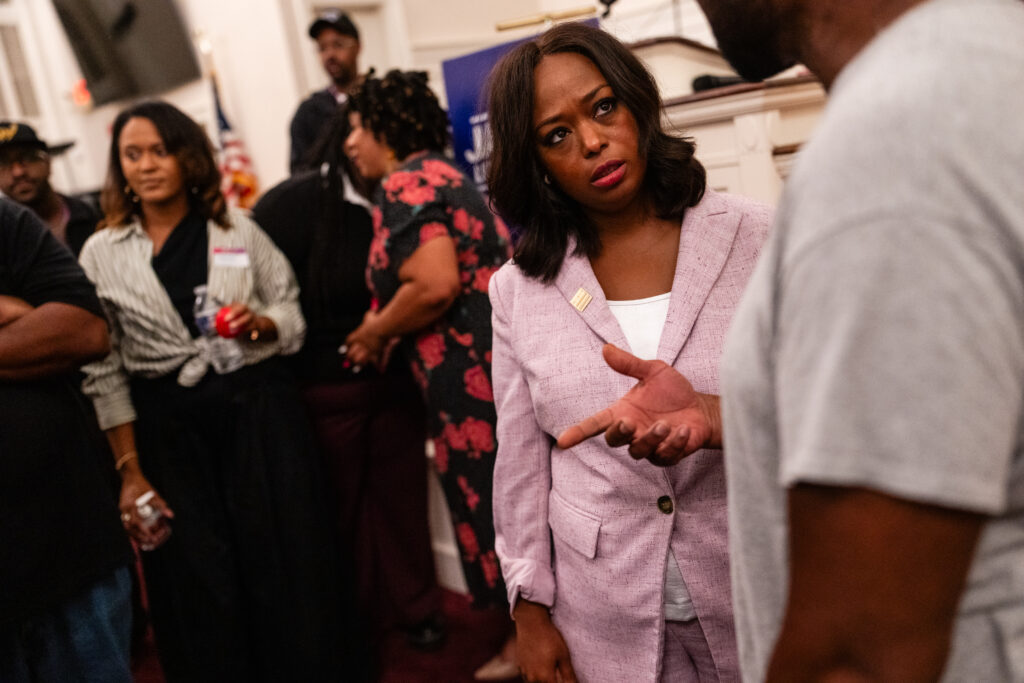
But now she’s hearing about it as the Democratic nominee to lead the nation’s capital, which is tantamount in a deep-blue city to a mayor-in-waiting. As she navigated the throng at Union Temple Baptist Church in Anacostia this week, Lewis George was trailed by an entourage befitting a politician of growing stature — two beefy security guards, a couple of aides, a cluster of reporters and a campaign videographer who recorded her every nod as she listened to Washingtonians complain about everything from inadequate health care to a dearth of affordable housing and unsafe streets.
Lewis George promised the crowd that its input — solicited in smaller groups by moderators and recorded by note-takers — would result in a report and help her administration define priorities and conceive policies.
Yet the three-hour sessions also served as tightly choreographed campaign rallies, a way for the democratic socialist to refresh her candidacy two months after winning the nomination, broaden her support network, ask for contributions and remind voters that she’s on the ballot in November, albeit against nominal opposition.
“Today is about listening,” she told the audiences, signaling that now was not the time to ask her what everyone wants to know — whom she would pick as police chief, what initiatives she would pursue first, and how she would contend with the city’s deepening financial troubles.
At the start of the Union Temple meeting, Markus Batchelor, a supporter who served as an emcee, took the stage to tout Lewis George as a “daughter of the city” and an “organizer on the front lines” whose political future is “fraught with a lot of peril.”
“A lot of special interests want to see us fail,” Batchelor said, as well as “the orange man in the White House” — his shorthand for the president. The onus is on the electorate, Batchelor told the crowd, to ensure “that Janeese Lewis George gets a mandate” in November.
“The highest possible turnout we can muster,” he said.
Before the session’s start, Lewis George hugged people she recognized in the throng, many of whom were community leaders, labor organizers, council staffers and local officials, including D.C. Council member Trayon White Sr. (D-Ward 8), who represents Anacostia and whose bribery trial is set to start later this month.
“Hi, what’s your passion?” Lewis George asked a woman seated in a pew, who cited education.
“Can I get a picture with you?” the woman asked.
“Absolutely!” Lewis George said.
A few feet away, Absalom Jordan, a seasoned veteran of Ward 8 political wars, urged Lewis George to read his paper calling for a commission on poverty and to be “as adamant” about what he referred to as “anti-Blackism” as she has been about Israel’s attacks in Gaza.
“Okay, I got you, absolutely,” she replied.
The crowd split up into smaller groups organized around topics like public safety and housing, child care and schools, most of which Lewis George dropped in on for five or 10 minutes. She appeared to intently listen even if the din of chatter and ambient noise made it difficult to understand what was being said.
“Raise your hand if you’re currently looking for a job,” a moderator asked one group that Lewis George visited. “What makes a good job?”
As participants answered — a livable wage, said one; a job that’s close to home, said another — Lewis George asked, “Can someone use the microphone so I can hear?”
As a political tool, listening tours echo the train-hopping 19th-century whistle-stops favored by William Henry Harrison and later by Theodore Roosevelt and Harry S. Truman, a splashy, populist way to greet large swaths of rank-and-file voters.
Lawton Chiles, a U.S. Senate candidate from Florida in the early 1970s, added his own twist when he walked just over 1,000 miles and talked to voters across his state. It was Hillary Clinton, when she ran for a Senate seat in 1999, who popularized the contemporary form of the listening tour, using the intimate, photo-friendly forums to meet New York voters as she emerged from the Washington bubble she inhabited as first lady.
“It makes a candidate appear to be more interested in the neighborhoods, more interested in local problems, and makes them seem connected to people,” said Hank Sheinkopf, a New York-based Democratic political consultant.
“It’s consistent with the neverending campaign that defines politics today,” he said. “What people are focusing on, instead of governing, is campaigning, and should they fail at particular initiatives, it gives them cover. If you went out to see people, you can say your opponents are defeating what the people want.”
Lewis George is not new to the listening tour as a political device, having used it during her 2020 race for the D.C. Council, when she upset a Bowser-backed incumbent, and two years later as she presided over Ward 4, the expansive array of neighborhoods on the city’s northern border that has produced two out of the last three D.C. mayors.
Now, Lewis George is taking her show citywide, demonstrating the strength of her grassroots network, a large portion of which attended the second night of her tour in Ward 1, at a church straddling the neighborhoods of Adams Morgan, Columbia Heights and Mount Pleasant, where she won 65 percent of the vote.
Aviva Meyer, 83, a retiree who was reading a book about the Holocaust as she waited for the session to begin, appeared to be that rare attendee who was unaffiliated with a political organization or interest group. A longtime D.C. resident, she said she typically ignores local politics.
But she turned out, she said, because she wanted to hear Lewis George speak. “I’m curious who this person is,” she said. “The worst that will happen is I will hate her.”
As she had the previous night, Lewis George bounced between groups, videographer in tow, listening as one man said the mayor should be “naming and shaming” companies that engage in “mass firings” and as another said he did not see “any reason” that would justify a teen curfew.
Afterward, when asked by a reporter to cite something specific she had learned from the session, Lewis George paused and said, “That’s tough,” before adding that the feedback was helping her understand “there’s a crisis in the health sector that no one has tapped into.”
As a result, she said she told her team that “we’re far behind on the health care crisis and we got to catch up.”
“Right now we’re identifying the problems,” she said. “The solutions, and how much the solutions cost, is another conversation.”
‘I want to see action’
On the tour’s third night, at a church in Ward 7, the Post-it notes were back (“More trees!”), as was the buffet (vegan curry, Jamaican chicken) and Ruth Wilcox, a caseworker for the D.C. government who had already attended two nights before.
Wilcox said she was curious, if not somewhat dubious, about the likely next mayor.
“We’ve seen candidates be accessible when they’re campaigning, then you don’t see them again once they’re in office,” she said. “I want to see action.”
The focus of much of that night’s action were all the people trying to get to Lewis George, clogging the church aisles as they reached for her hand or tried to hug her.
“If you need my help, all you got to do is ask,” one man said. Another wanted to talk renewable energy. A third wanted a photo to post on social media.
As she hopped from group to group, Lewis George heard complaints about a lack of dentists in some areas of the city and the poor quality of school facilities compared with more affluent neighborhoods. She also heard a measure of support for city-owned grocery stores, an idea popularized by another democratic socialist to the north, New York Mayor Zohran Mamdani.
“I want what the people want, so I can’t wait to get their feedback,” Lewis George said when a reporter asked her about the idea.
As she eyed Lewis George working the crowd, Barbara Morgan, 93, a longtime Ward 7 organizer, had the perspective of someone who has seen all of the city’s mayors come and go.
Some she liked. Some, not so much.
“Listening and implementing are two different things,” Morgan said. “It’s a wait-and-see situation. That’s all we can do.”
The post Health care, potholes, rats: D.C.’s presumptive mayor gets an earful from her city appeared first on Washington Post.