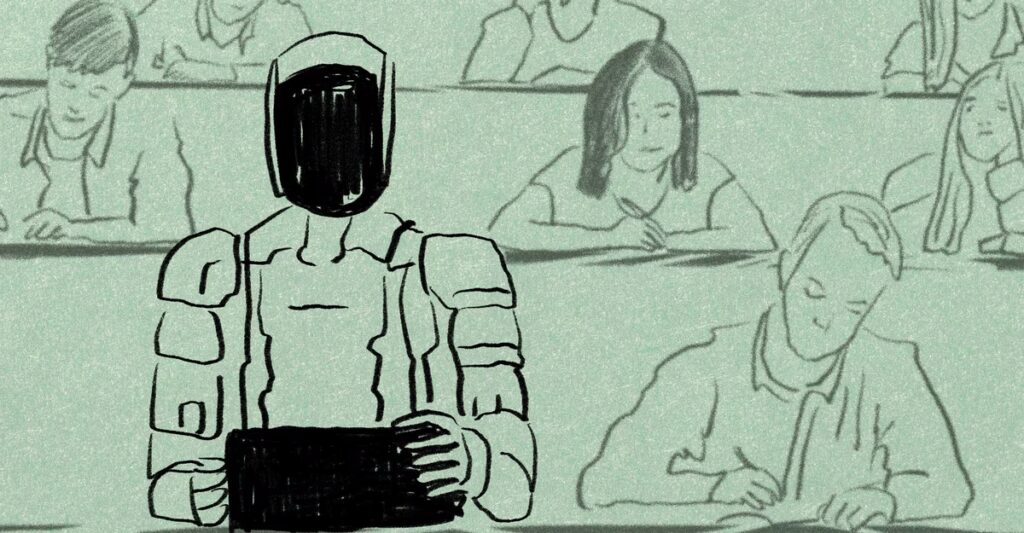
Students returning to campus this semester are arriving with a great deal of anxiety about AI and what it will mean for their lives after college. They are right to be worried. New research from Stanford shows that, even though the much-hyped AI job apocalypse has yet to materialize, the technology has already caused a nearly 20 percent drop in employment for young workers in AI-exposed occupations, such as computer programming and customer-service work.
Anxiety over the looming threat of AI may seem novel, but as a cognitive scientist who has long studied how fear affects learning and performance, I am all too familiar with this kind of unease. This is how I know it is also curable.
Several years ago, my former graduate student Ian Lyons and I invited people who were anxious about math to have their brains scanned while they took a math test. We were surprised to find that it wasn’t the test itself that sent people’s brains into a panic. Rather, the neural signals associated with threat detection and pain were most acute when people were merely anticipating the test.
[John Paul Rollert: A society of cheats]
We are all now living through AI’s waiting-for-the-math-test phase. AI is transforming classrooms, workplaces, and hiring needs—and experts say more turbulence is coming. Teachers and students are struggling to parse the difference between deploying AI effectively and exploiting the technology to cheat. But rather than tackling this disruptive change and the resulting anxiety head-on, many educators are trying to make AI simply go away.
The University of Chicago’s social-science faculty have prohibited most technology and banned the use of AI tools from their core classes. Although law firms are beginning to embrace the benefits of generative AI, the technology apparently makes many law schools squeamish. In May, the UC Berkeley School of Law announced that students are prohibited from using AI in “conceptualizing, outlining, drafting, revising, translating, or editing any work submitted for credit.” The University of Chicago Law School has decided to ban all screens from first-year classrooms entirely.
In an atmosphere of uncertainty—and given prevailing concerns about students using AI to cheat—such bans would seem to make some sense. But draconian mandates and screenless classes can’t be the only ways that colleges deal with AI. If universities hope to remain relevant in a world shaped by artificial intelligence, they should strive to guide students to understand and use these tools productively.
In my research of math anxiety, we found that the best cure was practicing math. This points to a way forward. When we supply students with the space to thoughtfully explore and engage with these tools, we can help ensure that they graduate into an AI-enabled workforce with more confidence and competence than fear, and with an appreciation for how to use AI tools ethically. But if higher education opts for prohibition over practice, we will squander the chance to help shape how this technology gets used in the world—ensuring that the private sector will do this for us instead.
Colleges must start by being clear about what a degree is actually worth in the AI age. At Dartmouth, the Ivy League university where I am president, we believe it’s our job to teach students how to do what AI can’t: decide which questions to ask, exercise sound judgment, navigate ethical complexity, reckon with uncertainty, and take responsibility for their decisions. Then, we have to give them the chance to practice these skills in concert with AI.
Harnessing AI ethically and productively requires understanding what the technology is and where it falls short. This is why Dartmouth, along with other schools such as Johns Hopkins University and Rollins College, has employed a critical AI librarian, an educator who helps students and faculty interrogate these models, recognize their biases, and spot unsupported claims. At our DALI Lab, where students design and create technological products, they can now build and stress-test their own AI models, which elevates their understanding of the risks and rewards at play. Our ambition at Dartmouth is for every undergraduate to experience a team-based AI project that relates to their coursework by the time they graduate.
Practice using AI matters even more when students start to specialize. To help prepare business students for AI use in the real world, Dartmouth’s Tuck School of Business now requires that they use the technology to build and test solutions for clients in their First-Year Project. Thanks to this experience, students who lacked AI expertise when they entered the program reported greater confidence using the technology by the end of their first year. At Dartmouth’s Geisel School of Medicine, our faculty developed an AI Patient Actor to help medical-school students sharpen their communication and interpersonal skills with the benefit of real-time feedback. The tool is now being used by more than 100 medical institutions worldwide.
[Walt Hunter: Bring back the blue-book exam]
Adapting the college experience for the AI era will be an ongoing process, and there is much work to do. But these examples demonstrate what’s both possible and necessary in higher education. Our job as educators is to teach students how to approach AI critically, help them see what AI can’t answer, and practice using these tools effectively. When these students graduate and are out in the world, employers will certainly expect that they have these skills already.
Globally, jobs that require advanced AI skills are growing eight times faster than the job market overall, according to an analysis from the professional-services network PwC. At the same time, entry-level roles in AI-exposed fields are more than seven times likelier than other entry-level jobs to require the human skills once reserved for senior executives, including discernment, creativity, and leadership. Never before has the ability to harmonize critical thinking and technology mattered more for graduates.
There will not—and should not—be a one-size-fits-all solution to the challenges of supplying this education. One professor may decide that students should write their essays in a blue book in class, while another may ask them to use an AI tool and audit every step of this work. Both choices will serve students when faculty are clear about their ambitions and standards. But outright bans or vague curbs afford no opportunities for students to better understand how to work ethically and effectively with AI.
Seventy years ago, pioneering computer scientists launched the field of artificial intelligence on Dartmouth’s campus. That history gives our institution some responsibility for what comes next—not just to prepare students for a future defined by AI, but to give them the tools to help shape that future themselves. If colleges and universities sit out this revolution, we abdicate a sacred commitment that has guided American higher education for centuries: to prepare the next generation of leaders to navigate an ever-changing, always complicated, and frequently perilous world. In a world that promises to be defined by AI, universities that fail to produce graduates who can use it productively will consign themselves to irrelevance.
The post Don’t Ban AI on Campus appeared first on The Atlantic.