NEWBERRY SPRINGS, Calif. — Two of the ostriches died instantly, hit with .22-caliber slugs fired through the fence of Mike Matson’s desert ranch. The third suffered, bleeding out then collapsing some 40 feet away.
That’s the body his wife Arcelia found first, one Sunday morning in June.
Matson was angry but he wasn’t surprised. Months before, a bullet had ended the life of his beloved Pebbles, who left behind a nest with eggs.
Detectives are investigating the two shootings but have made no arrests, according to the San Bernardino County Sheriff’s Department.
But Matson believes he knows who is responsible.
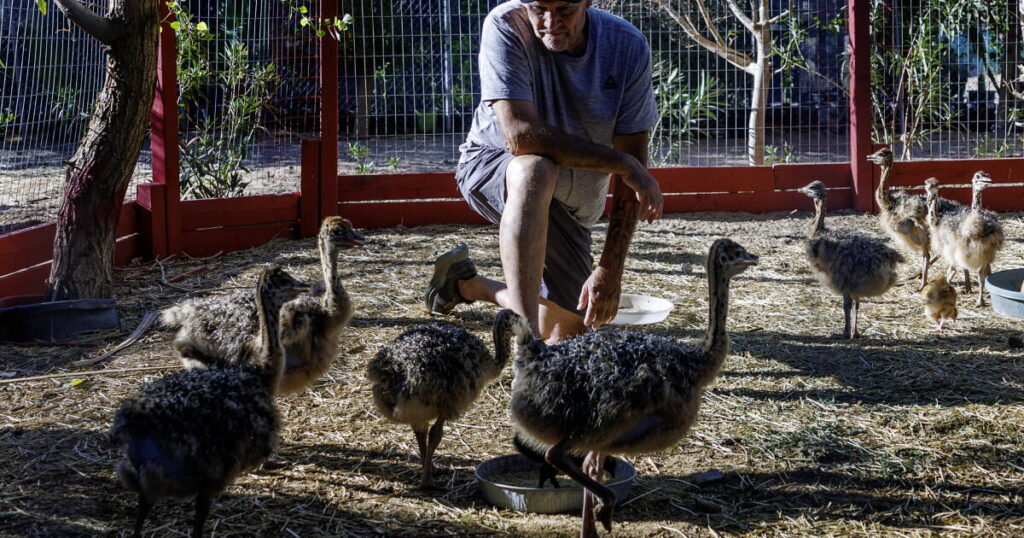
A longtime pet breeder, Matson moved to Newberry Springs about nine years ago to raise ostriches and other exotic animals, selling their chicks and eggs. The sun-washed stretch of Mojave Desert sits at the base of a volcanic mountain range roughly 20 miles east of Barstow.
The unincorporated community was once known for its plentiful water supply — so much so that in 1919, the Santa Fe Railroad renamed the town Water, according to John Wease, a local journalist and history buff.
Shallow groundwater stores supported fruit orchards, alfalfa fields, livestock ranches and, at one point, a water park and dozens of manmade lakes where people could fish, sail and water ski. A 1968 advertisement published in The Times beckoned investors to purchase their own two-acre lake for less than $12,000. “The water is so pure you can drink it,” it read, “so clean even rainbow trout will thrive in it.”
The abundance didn’t last. Aquifer levels sank, lakes dried up and most of the large farming companies departed amid water restrictions in the late 1990s. Sand dunes swallowed an entire neighborhood.
In recent years, residents have struggled with blight and property crime, according to Matson, who sits on Newberry Springs’ local government. As board vice president of the community services district, he and four other directors oversee the volunteer fire department, parks and recreation and street lights using a slice of tax revenue that typically amounts to less than $275,000 a year.
Abandoned cannabis grows have attracted squatters and trash, Matson said, and he’s caught people climbing his fence seeking to steal eggs, which can fetch up to $100 each. There are roaming packs of dogs, one of which severely mauled a teenager as she jogged near his home last year.
Still, he doesn’t believe the shootings of his ostriches were random crimes. Because in his time as a resident and elected official, he’s ruffled some feathers.
First off, there’s Matson’s relationship with his neighbors. He calls it a feud.
Matson traces its roots to one night three years ago when, he claims, a pit bull dug under his fence and killed an ostrich as she slept. And not just any ostrich — Fiona was the first ostrich Matson acquired when he moved to town, his biggest egg producer and a beloved family pet.
According to an animal control report, Matson said his neighbor’s young son told him their dog was responsible.
Matson called authorities.
It wasn’t the first time his neighbors had put his birds in danger, he alleged to both The Times and an animal control officer who took his report. Beer cans, bottles and other trash have blown from their property into his yard, he claimed, posing an aspiration risk because ostriches are attracted to shiny objects. And someone has launched fireworks from the property on multiple occasions, once causing a terrified bird to run into a fence and break her neck, he said.
One of Matson’s neighbors declined to comment when reached by phone. In response to a text message sent to a number listed for the address, someone replied that Matson’s claims are false. “I am writing to formally state that I decline and dispute all accusations made against us,” the person wrote.
“The continued contact and ongoing harassment by Mike Matson must stop,” wrote the person, who declined to confirm their identity.
Matson‘s neighbors told an animal control officer that Fiona had been killed by coyotes and their dog had dug under the fence only to eat her carcass, according to a redacted report provided by San Bernardino County Animal Care in response to a public records request.
The incident drew scrutiny from county code enforcement, Matson said. An inspector later visited his neighbors’ property and found unpermitted manufactured homes and outbuildings, according to a notice of violation ordering the owners to obtain permits or tear down the structures. A follow-up inspection resulted in a notice of violation for a mobile home that had a failed septic system, county records state.
“They blamed me for them having to clean up their property,” Matson said. “That started the snowball effect.”
Since he filed the report, Matson alleges, his neighbors’ dogs have killed two more of his ostriches, Shrek and Stella, while a third, Betty, choked on plastic trash that he claims came from their yard. The neighbors deny Matson’s allegations.
He said he recently confronted a man who lives at the property and accused him of shooting his ostriches, as well. The neighbors deny Matson’s claim.
Matson is also locked in conflict with a colleague on the community services district board, Jack Unger. Earlier this year, the board took the unusual step of voting to seek a workplace restraining order against Unger. An attorney ultimately advised members they didn’t have a strong case, according to both men.
The animosity dates back to the board’s decision last year to purchase 20 acres where they hope to eventually build a new fire station and civic hub.
The land is directly across the street from Matson’s ranch. Unger felt that Matson should recuse himself from the purchase decision, saying it represented a conflict of interest because the sale and development could boost his property value. Matson disagreed, and he continues to deny the existence of a conflict.
“I’m just working for the community,” he said, “trying to get a new fire station.”
After Matson voted in favor of the deal, Unger filed a complaint with the California Fair Political Practices Commission. “Director Matson has, in the opinion of this complainant, engaged in and continues to engage in prohibited conflict of interest/self-dealing activities,” he wrote.
Unger also claimed in the FPPC complaint that the board overpaid for the land, and that an earthquake fault running through it calls into question the feasibility of building there.
The FPPC recently opened a case to investigate the allegations but said it has not made a determination about their validity.
Unger said that he tried to raise his objections to the deal at board meetings, but that his fellow directors refused to discuss them. He grew frustrated at what he perceived to be attempts to sweep the matter under the rug. So he went public with his allegations against Matson on Facebook, in fliers distributed outside a board meeting and over the airwaves of the Newberry Friends Radio Network, an emergency preparedness group Unger chairs that transmits over General Mobile Radio Service channels. It’s a group of 10 to 15 people who meet in person once a month and over the airwaves once a week.
“I’ve had to become the whistleblower on the board because they’re wasting public monies — and we don‘t have a lot to begin with,” Unger said. “For me to remain silent would make me complicit.”
According to Matson, some of the communications stated that he lives across the street from the property at issue, publicizing his address. He claims that people have thrown bottles at his fence as a result, causing him to fear for the safety of his two young grandchildren, who live with him.
The community services district board in September voted to censure Unger, claiming his “malicious accusations” had put Matson’s family at risk, according to meeting minutes. Unger also refused to recuse himself from a special meeting, forcing its adjournment, and then shouted threats at Matson as he left the building, the minutes allege.
Amid the escalating tension, someone shot Pebbles.
Unger denied threatening Matson, killing his ostriches or putting his family at risk. He noted that he’ll soon be 79, while Matson is some 15 years younger and a foot taller. “Compared to me he’s a giant.”
Unger was also skeptical that his actions prompted someone else to target Matson’s home. Most residents aren’t engaged enough to come to board meetings, which typically draw about 10 attendees, let alone be galvanized by allegations of a conflict of interest, he said.
He claimed that Matson convinced the board to seek a restraining order against him “in an apparent attempt to shut me up,” and that Matson is “using” the deaths of his ostriches to exact revenge on him for filing the FPPC complaint.
“Director Matson now blames me for his ostrich troubles and his conflict of interest troubles,” he said. “In other words, I have become the lightning rod for his complaints.”
The killings have drawn renewed attention to a long-standing issue in Newberry Springs. The town is served by the Sheriff’s Department’s Barstow station, which has 25 deputies and supervisors to cover more than 9,200 square miles.
As a result, response times can be sluggish, and criminals sometimes have the perception that they won’t face consequences, Matson said.
Local officials once mulled over installing a resident deputy to patrol Newberry Springs exclusively amid a rise in drug-related crime in the early 1990s, but the cost would have emptied the community services district’s coffers. Some residents reportedly bought shotguns instead.
Matson is hopeful that things will change when a new $4-billion rail facility is built in Barstow. He envisions young workers moving to Newberry Springs from the city to raise families on generous plots of land.
Then, he said, they’ll get more law enforcement officers. Better amenities. Higher attendance at school.
But for now, it can be tough serving as an elected official in such a small and isolated place. The position pays a stipend of just $75 a month — essentially volunteer work. And the desert is unforgiving.
Days before a Times reporter visited Matson’s property, a pack of wild dogs dug under his fence and fatally mauled his only surviving adult ostrich, Bam Bam.
On a summer morning before the heat set in, he pointed out the spot where his flock of over a dozen birds once roamed, strutting across the sand like remnants of the Jurassic era.
“This was full of life two years ago,” he said. The corner of the yard, shaded by mesquite and shoestring willows, had fallen conspicuously quiet. A few large black feathers fluttered in a gentle breeze.
On his fence he’d hung a banner. “Reward — $1,000,” it read in boldface capital letters, “for the arrest of the a— that shot my ostriches!”
The post Bullets, blood and ostrich feathers: Why are they killing Mike Matson’s beloved desert birds? appeared first on Los Angeles Times.