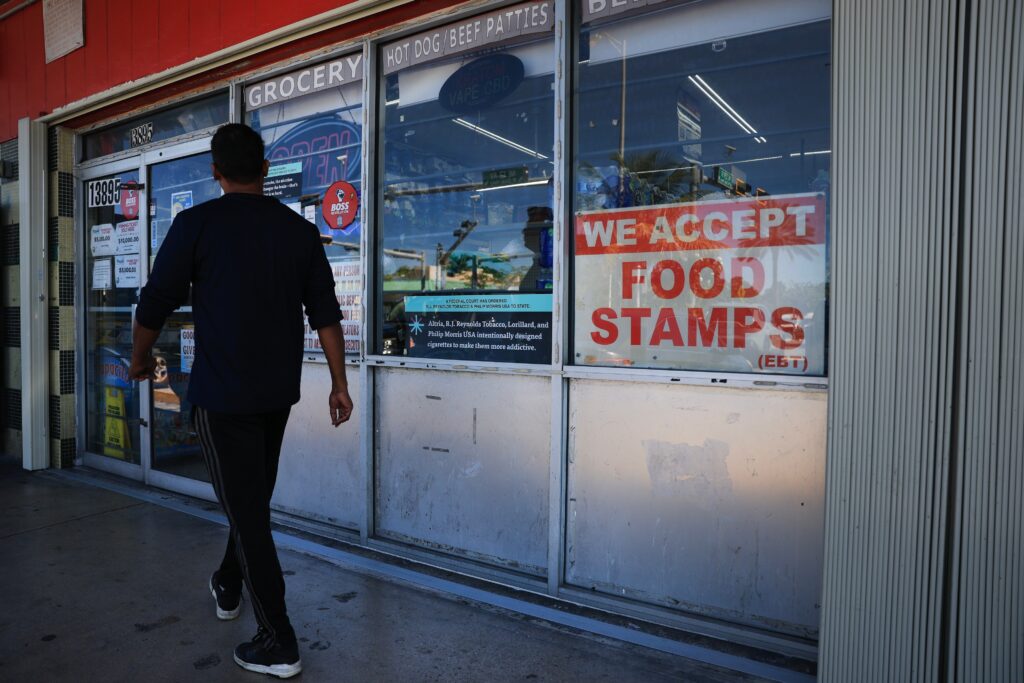
Readers raised detailed questions in response to my column last week about new research showing that restricting soda purchases through the Supplemental Nutrition Assistance Program is reducing purchases of sugary drinks. This week’s edition of The Checkup addresses their questions and examines some of their counterarguments.
“I don’t know why anyone would be surprised that soda restrictions [are effective],” wrote Jerry from Virginia. “It’s common sense: If you tell people they can’t use their benefits to buy something, then they’ll buy less of it.”
The way SNAP works doesn’t lend itself to such a straightforward prediction. As Matthew Notowidigdo, an economist at the University of Chicago and co-author of one of the new studies, explained to me, SNAP benefits do not cover the full cost of most families’ groceries. Recipients are already accustomed to using their SNAP payment cards alongside cash, credit cards and debit cards at checkout.
In economic terms, money is fungible, meaning that SNAP benefits and other funds should be interchangeable, and that recipients could just use other payment methods to buy the soda they are no longer able to access through SNAP. “A standard economic prediction would be that these policies would have no impact,” Notowidigdo said. In fact, he told me that when he and his colleagues surveyed economists, most predicted no impact.
The reality was more in line with what psychologists might predict: Not every dollar is treated the same because people consider where the money comes from. “I think it’s a good win for behavioral economics over standard economics,” Notowidigdo said.
The implications go beyond academic debate. One of Notowidigdo’s co-authors, Stanford economist Hunt Allcott, told me the findings suggest policymakers should think of SNAP as a subsidy for eligible groceries. “Because unhealthy groceries like sugary drinks will increase health care costs paid by other people, policymakers may not want to be subsidizing them,” he said.
Notowidigdo and Allcott are sympathetic to the argument raised by opponents of the restrictions that low-income people should have the same freedom to choose their groceries as everyone else. Another finding in their research was that SNAP recipients in states that imposed restrictions reported feeling greater stigma after the policies took effect. This was why, in a subsequent revision, they sought to put a monetary value on this stigma, just as they had modeled the potential monetary savings in health care costs.
A couple of readers wanted to know more about this finding, which my column alluded to. Rachel from Maryland questioned how stigma could be measured. “Did [the researchers] measure depression or anxiety caused by stigma?” she asked.
Not quite. The researchers asked SNAP recipients how much they would be willing to pay to avoid hypothetical situations that would make using their benefits more stigmatizing, such as having to use a separate checkout line or a payment card that prominently identified them as SNAP recipients. They used these responses to estimate a dollar value for the perceived loss of that stigma, such as feelings that they are judged and perceived loss of freedom.
It turns out that the stigma costs are not insignificant. The researchers estimated that SNAP households would be willing to give up roughly $20 to $30 per year to avoid the additional stigma associated with soda restrictions. On a population level, this adds up, though it doesn’t top the projected $800 million in annual health care savings because of the policy.
“I don’t understand why stigma is a negative outcome,” wrote Dave from Connecticut. “Isn’t the goal to get people to rely less on societal subsidies?”
It is certainly true that some policymakers may see stigma as a positive effect and use it as twisted justification to “reform” SNAP. But others may care, as Allcott puts it, “if the government implements a policy that makes people feel bad” about using the program. If the goal is better nutrition and lower health care costs, it is worth asking whether there are other ways to achieve those outcomes without increasing stigma.
For instance, states could expand incentives that reward SNAP recipients for buying healthier foods. Louisiana has such a program, which offers an additional 30 cents in benefits for every dollar spent on fresh fruits and vegetables at certain retailers, though only up to $25 a month. States can also require retailers accepting SNAP to stock a wider selection of fruits, vegetables and whole grains, and they can provide grants to corner stores for refrigeration equipment to carry fresh produce.
Another approach is a soda tax, which William from Massachusetts raised: “Wouldn’t a soda tax work better [so that] poor people don’t have to face the burden of restrictions alone?”
William is right that a soda tax would be more equitable because it would apply to everyone, regardless of income. Studies have shown that such taxes work and can discourage purchases of unhealthy beverages. Allcott offered another reason to consider this approach: Stigmatizing soda purchases amounts to a psychological tax, but unlike a retail tax, it generates no revenue for the state. “If you could choose between a financial tax and a psychological tax, you would always want the financial tax because it brings in revenues,” he said.
Of course, taxes on sugary drinks may be a nonstarter politically. Meanwhile, dozens of states across the political spectrum are moving ahead with SNAP restrictions, some that target only soda and others that address a broader range of sugary drinks. Some advocates want policymakers to go further and restrict ultra-processed foods or even narrow SNAP coverage to a list of approved foods.
As these approaches take effect, researchers have a valuable natural experiment to study how restrictions change what people buy and, over time, their effects on health and personal choice. Considering that roughly 1 in 8 Americans rely on SNAP benefits, the findings could have far-reaching implications for shaping a healthier food environment.
The post Many economists doubted SNAP soda restrictions would work. They were wrong. appeared first on Washington Post.