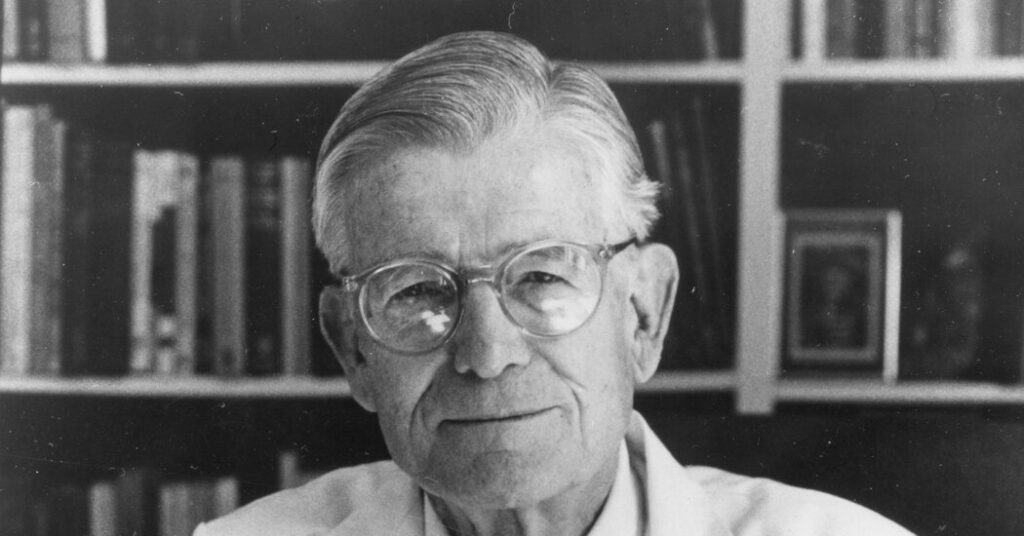
Dr. Paul S. Russell, who was born before the discovery of penicillin and who became a leading transplant surgeon, adapting scientific breakthroughs in the laboratory to help make the miracle of a new kidney or liver a relatively common procedure, died on Aug. 22 at his home in Westwood, Mass. He was 101.
His death was confirmed by Dr. Richard N. Pierson III, a son-in-law.
Well into his 90s, the gentlemanly Dr. Russell drove each Wednesday from his residence in an assisted living community to Massachusetts General Hospital in Boston to attend Russell Rounds — discussions of medically interesting patients by transplant doctors in training — which were named in Dr. Russell’s honor. He often asked the most probing questions in the room.
His association with Massachusetts General spanned more than seven decades, and he was a professor at Harvard Medical School for nearly as long.
He was appointed chief of surgery at Mass General in 1962, and he performed its first kidney transplant the following April. He was director of the hospital’s transplantation unit from 1968 to 1990.
In the 1960s, transplants were often fatal. Most donated kidneys came from close relatives with similar genetics to the patient, to improve the chances that a recipient’s immune system would not reject the new organ.
Dr. Russell was able to bridge the gap between laboratory studies, which pointed the way to suppressing the immune reaction, and clinical practice.
“Paul had this unusual talent of being able to recognize early on when something was discovered that, this is important,” Dr. A. Benedict Cosimi, who succeeded Dr. Russell as head of Mass General’s transplant program, said in an interview. “Most of those early discoveries were in mice, but that was a long way to bringing it to humans.”
At Mass General, Dr. Russell founded a laboratory in the 1960s to study transplantation biology, which has evolved into the hospital’s Center for Transplantation Sciences, with 80 specialists working in 19 labs.
Gradually, survival rates improved.
“The early results, as he himself said in retrospect, were terrible,” said Dr. Pierson, who is himself a transplant surgeon. Dr. Russell learned from each operation. “As the decade ended, the success rate went from 20 percent or less to 40 or 50 percent,” Dr. Pierson said.
As more desperately ill patients sought transplants and more hospitals offered the surgeries, matching donors to recipients became an organizational challenge.
In 1968, Dr. Russell founded the Boston Interhospital Organ Bank, now New England Donor Services, to procure organs and match donors and recipients. Today, it works with nearly 200 hospitals in six states and Bermuda.
Beginning in 1962, Dr. Russell was a professor at Harvard Medical School, where he trained surgeons and scientists for decades. He was named the John Homans distinguished professor of surgery in 1998.
In 2024, physician-scientists performed the world’s first transplant of a pig kidney into a 62-year-old human recipient at Mass General, a step toward easing the critical shortage of human donors. Dr. Tatsuo Kawai, the surgeon who led the operation, said at the time, “The success of this transplant is the culmination of efforts by thousands of scientists and physicians over several decades.”
Paul Snowden Russell Jr. was born on Jan. 22, 1925, in Chicago, the second of five children of Paul S. Russell and Carroll (Mason) Russell. His father was a star quarterback for the University of Chicago who became a banker. His mother, who was an early financial backer of the dancer Martha Graham, also danced herself and lectured about modern dance.
Dr. Russell received a Bachelor of Arts in philosophy in 1944, a Bachelor of Science in chemistry in 1945, and his M.D. in 1947, all from the University of Chicago.
He came to Massachusetts General Hospital in 1948 to commence his surgical internship and residency. His long tenure at the hospital was interrupted for military service in the Air Force in Texas during the Korean War and for research at University College London in 1954-55, where he first became committed to transplant medicine.
There, he worked in the laboratory of Peter Medawar, called the “father of transplantation.”
At first, Medawar, a zoologist, was puzzled that Dr. Russell, a surgeon, was interested in working in his laboratory. What excited Dr. Russell was research that Medawar was pioneering in how to create a tolerance for tissue grafts in animals — basic research that paved the way for human organ transplants.
“It was so really exciting to me,” Dr. Russell recalled in a 2020 interview for Massachusetts General. “I had a wonderful time there for a little more than a year and I learned a lot about science.”
In 1960, Medawar shared a Nobel Prize with Frank Macfarlane Burnet for work showing how an organism’s immune system could be taught to tolerate, rather than reject, foreign tissue. It led to the first successful transplant of a human organ in 1954, a kidney donated by the patient’s identical twin at Peter Bent Brigham Hospital in Boston.
Dr. Russell finished his residency in 1956 at Mass General, where he was chief surgical resident. After he taught for two years at Columbia College of Physicians and Surgeons in New York, Mass General recruited him to return in 1962 as its chief surgeon.
Dr. Russel married Allene Lummis in 1952. She died in 2010. He is survived by their four children, Katherine Russell McCurdy, Paul Snowden Russell III, Allene Russell Pierson and Laura Russell Malkin; 11 grandchildren; and 22 great-grandchildren.
He served on the board of Warner-Lambert from 1974 to 1995, where he was an advocate of the drug Lipitor for people with high cholesterol. The statin achieved $1 billion in sales in its first year on the market, in 1997. Warner-Lambert earlier funded a Harvard professorship in Dr. Russell’s honor.
In his later years, Dr. Russell became interested in the history of Massachusetts General, which was founded to serve the public in 1811 at a time when rich patients had private doctors visit their homes and the poor were treated in almshouses.
For its 200th anniversary, the hospital opened a four-story, copper-clad museum of medical history. It was named the Paul S. Russell, MD Museum of Medical History and Innovation.
The post Paul S. Russell, an Innovator in Transplant Medicine, Dies at 101 appeared first on New York Times.