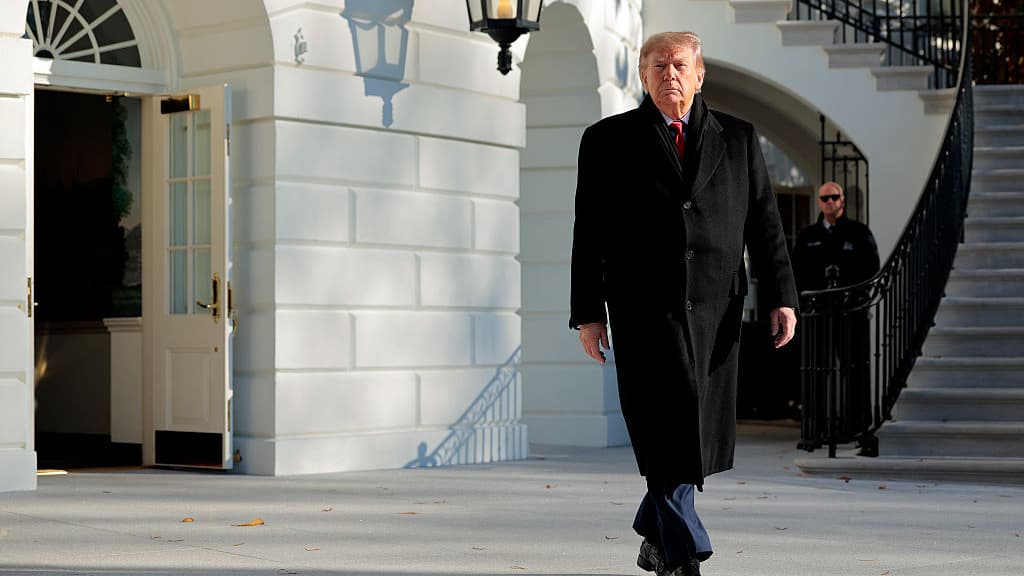
President Donald Trump is pushing for Congress to pass a sweeping federal tax incentive for the film and television industry, arguing that foreign tax incentives have driven American productions overseas and hollowed out the domestic entertainment business.
In a Truth Social post on Nov. 13, Trump said the support has been “unbelievable” for the Motion Picture, Television, and Entertainment Revitalization Act, a bipartisan bill introduced by Republican Senator Tim Scott in September to establish a base 20% federal tax credit on qualifying U.S. labor costs.
Republican Senator John Cornyn and Democratic Senator Adam Schiff are among the lawmakers on both sides of the aisle lauding the bill’s potential to retain production spending, create jobs, and make the U.S. industry more competitive.
In his post, Trump pointed out that much of entertainment production is being outsourced to countries where television and movies are cheaper to produce.
“Hollywood, and so many other places, have been virtually ‘emptied out’ by the Tax Incentives, and much more, given by other Countries,” he wrote, noting that Australia, Canada, and the United Kingdom are all attracting entertainment production.
Read more: Carney Sets Target for E.U. ‘Associate’ Membership Amid U.S.-Canada Trade Standoff
The President also expressed confidence that the bill would create jobs and help drive the economy, writing: “Importantly, hundreds of thousands of Blue Collar Workers will be positively affected, BIG TIME, by the passage of this Bill.” He did not explain the calculations behind the figure that he cited.
Similarly, he wrote that “the amount of money spent on these Tax Incentives will be made up tenfold by the money pouring into the Treasury’s coffers,” without providing evidence to that effect. TIME has reached out to the White House for comment.
Policy analysts, however, have expressed concerns about the price tag involved.
In her analysis of the proposed credit from Nov. 4, Tracy Gordon of the Tax Policy Center questioned whether there was meaningful evidence that the revenue generated would outpace the program’s costs. She also flagged that the bill does not currently include a spending cap.
Adam Michel, the director of tax policy studies at the Cato Institute, estimated that the program could cost taxpayers between $3.3 billion and $4.9 billion each year.
“Film tax incentives like this don’t work,” Michel tells TIME.
“They don’t lead to more jobs, they don’t lead to stable industries,” he says. “It’s just a waste of taxpayer resources.”
The bill represents an opportunity for Congress to demonstrate a cooperative spirit ahead of a massive shift of power, with Democrats poised to take control of both the House and Senate in January.
Trump urged lawmakers to move the bill forward amid concerns that it might otherwise languish during Congress’s “lame duck” period—referring to the session between November’s elections and the start of the new Congress in January.
“Hopefully Republicans and Democrats will get together and finalize this already very actively negotiated Legislation,” Trump wrote. The bill is currently under consideration in House and Senate committees, but Congressional leadership has not yet advanced it toward a vote.
Speaking with Politico on Nov. 13, Democratic Representative Don Beyer of Virginia said that while he supports the subsidy, the chances of passing any tax bill during the lame-duck session were “pretty low.”
What would the federal film tax credit do?
The Motion Picture, Television, and Entertainment Revitalization Act introduces a federal subsidy for movie studios and production companies to keep projects in the U.S.
The bill would establish a new federal tax credit for qualifying film and television production, supplementing existing state incentives and echoing similar efforts in 65 countries worldwide.
The conditions of those subsidies vary widely, but the most competitive outpace even what legislators are proposing in the U.S.
Other countries offer a range of production incentives. In Ontario, Canada, combined federal and provincial credits can provide an effective rate of 34.1% on qualifying labor costs. The United Kingdom’s standard film credit provides 34% of qualifying expenditure, or 25.5% after corporation tax, subject to spending limits.
The proposed tax credit in the U.S. would cover 20% to 30% of workers’ pay on qualifying projects, supplementing existing state credits. Projects would be eligible if they cost more than $1 million, with at least 75% of principal photography days occurring in the U.S.
Why do supporters want a federal film tax credit?
Lawmakers supporting the tax credit argue that the subsidy would help repatriate some of the money that has been lost in the film industry as production moves away from the U.S.
Schiff said in March that 45% of all American-made films and scripted television shows were shot internationally in 2025, up from about 33% in 2022.
According to Scott, the film and television production industry “supported nearly 2.74 million jobs and generated $242 billion in wages” in 2022. By 2024, “those numbers dropped to 2.01 million jobs and $202 billion in wages.”
A 2026 report by consulting firm EY documented the shift, but noted that there were factors in play beyond competitive international tax credits. The report said that declines in domestic production coincided with several changes in the film industry, including the rise in streaming services and trickle-down effects from the pandemic.
For Schiff, this demonstrates that existing U.S. tax credits—offered by more than half of the nation’s states and territories—are not enough.
“State programs cannot simply substitute for the kind of global, federal, and competitive tax incentives that are needed to bring production back to American soil and stop its offshoring,” Schiff said at a news conference in March.
Industry leaders tend to agree with Schiff. Representatives of large industry unions like SAG-AFTRA, the Writers Guild of America, and Directors Guild of America joined a rally in October supporting the bill.
They pointed to studies done on the potential effectiveness of job growth, including one by consulting firm Olsberg SPI, commissioned by the Motion Picture Associated. It claimed that a federal incentive program could lead to an additional 143,500 full-time-equivalent jobs every year through 2035.
But Michel says that to say these film productions are moving overseas is “misleading.”
He points to the EY study, which documented a substantial decline in the U.S. share of production budgets for films and television episodes made by major studios over the last 25 years. Proponents of the bill have pointed to this report as evidence of its necessity, but Michel cautions that the figure does not paint a full picture.
A declining share of production budgets does not, by itself, establish that the domestic industry is shrinking, he argues: In fact, more productions are being made today than a quarter-century ago.
“It’s important to keep in mind that these industries are still growing,” he says.
Would the film tax credit pay for itself?
One of the greatest potential barriers to the bill moving forward is concern about its price tag.
Supporters argue that the credit would boost jobs and economic activity. The Olsberg SPI study projects $133.1 billion in additional labor income from 2027 through 2035. But those earnings would not flow directly into government coffers. For the credit to pay for itself, the additional tax revenue it generates would need to cover its cost.
Michel pointed out that in some places where jobs were created in response to localized filming, the states and territories often wound up capping or repealing their programs, and those jobs promptly disappeared. One 2015 analysis by the Maryland Department of Legislative Services found that in looking at credits in states like Michigan and Louisiana, the economic benefits couldn’t be sustained “in the absence of continued annual funding.”
Whether that risk would persist with a federally backed program remains to be seen.
Michel believes, however, that the potential for industry growth is not all that it seems. He points to a review of existing state-level tax credits that he did in October for Cato, which found that “subsidies mostly don’t create new production, don’t meaningfully increase jobs or wages, don’t build an industry that survives without the subsidy, and are fiscally costly.”
“Policymakers should certainly think twice about whether or not these types of incentives are worthwhile,” he says, adding that tens of billions of dollars would be a “steep fiscal cost” to wager on what is essentially an uncertain outcome.
The post Why Trump Is Throwing His Weight Behind a Hollywood Tax Credit appeared first on TIME.