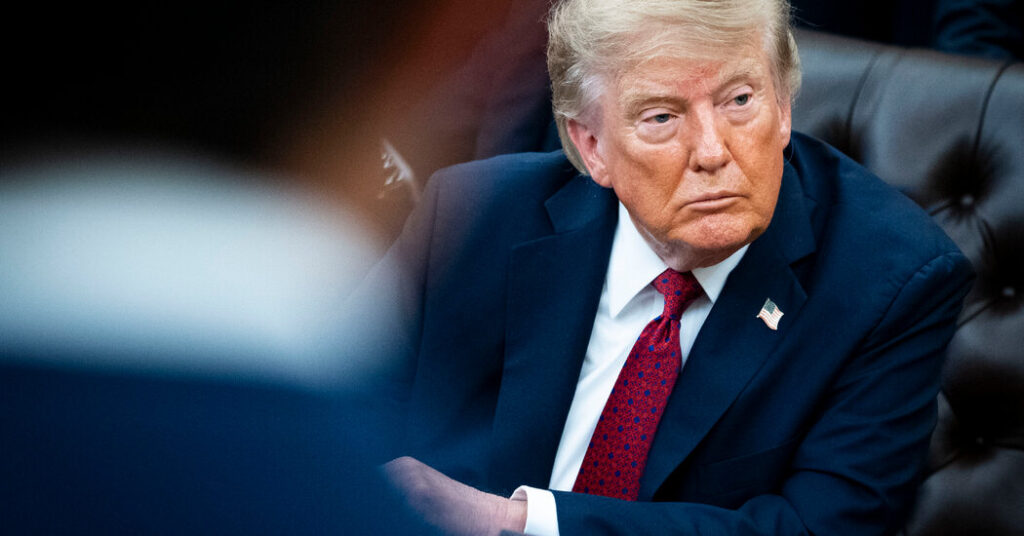
If you want to understand the moment we’re in, you have to understand Donald Trump. That’s easier said than done; Trump thrives on drama — ideally in ALL CAPS on Truth Social — and prides himself on being unpredictable (although some would argue it’s all part of a strategy).
The flood of missives and missiles, of hyperbolic threats (“a whole civilization will die tonight”) and morphing deadlines coming out of the White House can seem surreal. But two of my colleagues have written a book full of riveting, granular detail that makes it feel, well, very real.
In “Regime Change,” Maggie Haberman and Jonathan Swan take you into the room for the key moments of the president’s second term. I spoke to Jonathan about some of them.
Trump’s world
Jonathan, let’s start with Iran. A lot of people were baffled by Trump’s decision to go to war. What swayed him? Was it Iran’s plots to kill him? His success in Venezuela? Israel’s war pitch?
It was all those things. But also, Trump has always been hawkish about Iran.
In Term 1, he pulls out of the Iran nuclear deal. He orders the assassination of this very senior Iranian general, Qassim Suleimani. Then, when he’s out of office, he learns that the Iranian regime is trying to get hit men to kill him. Iran hacks the emails of his campaign manager. So, for Trump, this is also personal.
How important was that meeting in February you guys describe in such incredible detail, when Prime Minister Benjamin Netanyahu persuaded Trump to actually go to war?
It was very important. I’m not aware of any historical parallel for a foreign leader going down to the White House Situation Room and pitching the American president on going to war.
That war hasn’t gone to plan. How has that affected the Trump-Netanyahu relationship?
It was always a very up-and-down, fraught relationship. Trump views Netanyahu as a strong leader but also as someone who needs to be restrained. A couple of months ago Trump started to view Netanyahu as a problem — an obstacle to getting out of this war.
He became very agitated about what Netanyahu was doing in Lebanon. And so the U.S. cut the Israelis out of their negotiations with Iran. Right now, it’s not a good relationship at all.
You write that Netanyahu, President Xi Jinping and President Vladimir Putin were all better prepared to deal with Trump during his second term than his first. How so?
Yes, and on that list, Xi Jinping might have been the best prepared.
In April last year, when Trump essentially declares a trade war with the whole world, Xi Jinping doesn’t negotiate. He just raises tariffs himself and implements a whole bunch of restrictions on rare earths and magnets and things that the Americans need. He had this all lined up — he was fully prepared to wage economic supply chain war against the United States. And he won that skirmish.
Trump sends his Treasury secretary to Geneva to negotiate an off-ramp with China. Which he does; the tariff rates go down. And ever since then, Trump has taken a very dovish posture with Beijing.
Are there lessons for the rest of the world in this approach to dealing with Trump?
There’s this whole conversation in the international diplomatic community: How do you deal with Trump? I’ve always thought that conversation is sort of absurd. The Europeans talk about this playbook — you flatter him, bring him gifts and what have you. That might get you something, for a day or two. But what Xi Jinping showed is the way to deal with Trump is through strength.
Trump really understands leverage. He likes picking off countries one at a time so he can use the leverage of the U.S. military and economy and technology to squeeze that other party. And China — unlike some of the struggling small and middle powers — had leverage to force Trump down, in a very effective way.
What does that mean for Trump’s commitment, say, to defend Taiwan?
We have a scene in our book where he’s talking about Taiwan and he holds up a little teaspoon, basically, as a means of saying, Why would we fight over this little speck of land?
He hasn’t formally changed U.S. policy on Taiwan, but I’m not aware of anyone around him who thinks that Donald Trump would use the American military to fight for Taiwan’s independence.
Does that suggest NATO is dead, too? If the Russians march into Estonia, would the U.S. intervene?
At this point, you would have to be smoking something to think that Article 5, the mutual defense clause that is the bedrock of the alliance, is ironclad when it comes to Donald Trump. I wouldn’t want to predict one way or the other, but the notion that you could rely on him to defend a small nation against Russia is obviously questionable at best.
All this considered, how ideological is Trump, really?
Trump has never viewed the world the way American presidents of the last 50 years have viewed it, in terms of a post-World War II order and an alliance of liberal democracies. He basically sees the world as a bunch of countries that owe America money.
At a sort of cellular level, he’s attracted to strongmen and has contempt for Europeans and multilateral institutions defending human rights and international law. But that doesn’t come from a deeply held consistent worldview. If there’s an ideology, it’s “Might makes right.”
This conversation has been condensed and edited for clarity.
MORE TOP NEWS
See why the Nepal glacier collapsed
The deadly landslide and flash floods in Nepal last week were most likely caused by weakened bedrock in the glacier. My colleagues used a combination of satellite imagery and 3-D terrain models to visualize what happened.
Still standing: It’s become known as the “miracle” house. The home of the Pyakurel family survived as its surroundings were swept away by floodwaters.
OTHER NEWS
-
U.S. strikes on Iran killed five people who were celebrating a wedding, according to Iranian officials. The U.S. military said it had not targeted civilians.
-
The world has failed in its goal of limiting global warming to 1.5 degrees Celsius above preindustrial times, the U.N. said. The organization set a new target.
-
Xi Jinping made his first visit to Egypt in a decade, challenging U.S. influence in the Middle East.
-
Joshua Wong, the prominent Hong Kong pro-democracy activist, pleaded guilty to colluding with Western lawmakers. He faces life in prison.
-
The U.S. oil giant Chevron will invest $7 billion to more than double its production in Venezuela.
-
Our Pentagon reporter John Ismay explains how the U.S. Navy is facing a logistical nightmare in the Middle East to support operations against Iran. Watch the video.
WHAT ELSE IS HAPPENING
-
King Charles III will view the Bayeux Tapestry in London, 40 years after he saw it in France with Diana.
-
Ariana Grande wrapped up her world tour and prepared to step back from public life.
-
A baby boom among kakapos, a critically endangered parrot species, has resulted in a record number of chicks this year.
TOP OF THE WORLD
The most clicked link in your newsletter yesterday was about the luxury Gleneagles hotel in Scotland.
TENNIS STAR OF THE DAY
Alex Eala
A short subway ride from the U.S. Open, excitement is building in New York City’s Little Manila over Alex Eala, the breakout tennis star who has reached icon status among the Filipino diaspora. For her first-round match, supporters wore floppy hats that featured the Filipino flag and T-shirts with images of a popular Eala internet meme. “This is not Rihanna,” one post on social media said. “It’s Alex Eala.”
Aryna Sabalenka and Carlos Alcaraz headline Day 4 of the U.S. Open. Follow our live updates.
MORNING READ
For thousands of years, we have shaped our canine companions through selective breeding. Now, dog engineering is entering a new era.
A U.S. biotech start-up said it had used the technique known as CRISPR to create gene-edited, hypoallergenic dogs. Thanks to a single genetic tweak, the pups, two adorable beagles, appear unable to produce a protein that can leave some people wheezing. It will take more research before such dogs can make their way into homes from the lab, but the development is already raising ethical questions. Read more about the concerns.
AROUND THE WORLD
Two Asian nations. Two approaches to gun violence.
Active shooter drills are common practice in U.S. schools and universities. Now the drills are in the spotlight in Thailand and the Philippines, where recent outbreaks of gun violence have sent officials searching for solutions — searches that have veered in different directions.
The drills are not new to Thailand, which has one of the highest rates of civilian gun ownership in Asia and where a 14-year-old boy fatally shot six people at a school last month. But they are now being rolled out in primary schools. In the Philippines, the drills were piloted by some school administrators and then paused. Some say they may do more harm than good. Read more and find out why.
RECOMMENDATIONS
Discover: The actor Wagner Moura shares his favorite spots in his hometown in Brazil.
Pick: Which house in Costa del Sol, Spain, would you choose for 1.2 million euros?
Read: Andrea Bajani’s latest novel, “The Anniversary,” takes aim at dysfunctional Italian families.
Plan: We have tips for traveling while pregnant.
RECIPE
In Catalonia, escalivada, similar to a vegetable stew, is traditionally prepared in the fireplace. Raw vegetables are nestled in the coals and cooked slowly until soft. These days, cooks use a sheet pan in the oven or a covered grill. The dish tastes best when aged at least a day.
WHERE IS THIS?
Where is this rooftop art exhibition?
TIME TO PLAY
Here are today’s Spelling Bee, Mini Crossword, Wordle and Sudoku. Find all our games here.
That’s it for today. See you tomorrow! — Katrin
We welcome your feedback. Send us your suggestions at [email protected].
The post Inside Trump’s Second Term appeared first on New York Times.