Rescue workers were only just starting to assess the scope of loss and destruction from deadly Himalayan floods last week when Chinese authorities turned to another challenge: unapproved narratives of the devastation.
Censors quickly deleted videos and eyewitness accounts from social media. Journalists working for state media and social media influencers were warned not to report on casualties or missing people unless their reports aligned with official announcements. People who questioned the official death toll were given “administrative penalties,” punishment that typically involves either a fine of up to $150 or up to ten days in prison.
When some foreign news outlets noted the contrast in coverage between Tibet, where no foreign journalist is allowed to report, and Nepal, where international media have been able to travel freely, the Chinese government called the reporting “malicious speculation.”
The immediate and widespread crackdown on speech reflects two challenges facing China’s ruling Communist Party, which tightly controls information across the country.
The crisis has focused attention on Tibet, a region with a history of unrest and protest centered around demands for more autonomy that are sensitive to Beijing. And it has hit both China and its neighbor, Nepal, where just across the border dozens of journalists have arrived to report witness accounts and talk to families and local residents. That difference has raised questions about what is happening in China.
“With this one, even if the Chinese side has information control, on the Nepal side there is a lot of information coming out,” said Xiao Qiang, the editor in chief of China Digital Times, a nonprofit that collects data on censorship and archives work that has been censored on China’s internet. “It makes the Chinese government feel that controlling information around this event is harder.”
Tibet, which was annexed by Beijing in the 1950s, is rigidly governed and has been a place of protest, including self-immolations by Tibetans. Foreign journalists are not allowed to travel there unless invited on heavily monitored and choreographed official tours. Tibetans risk detention for speaking to reporters.
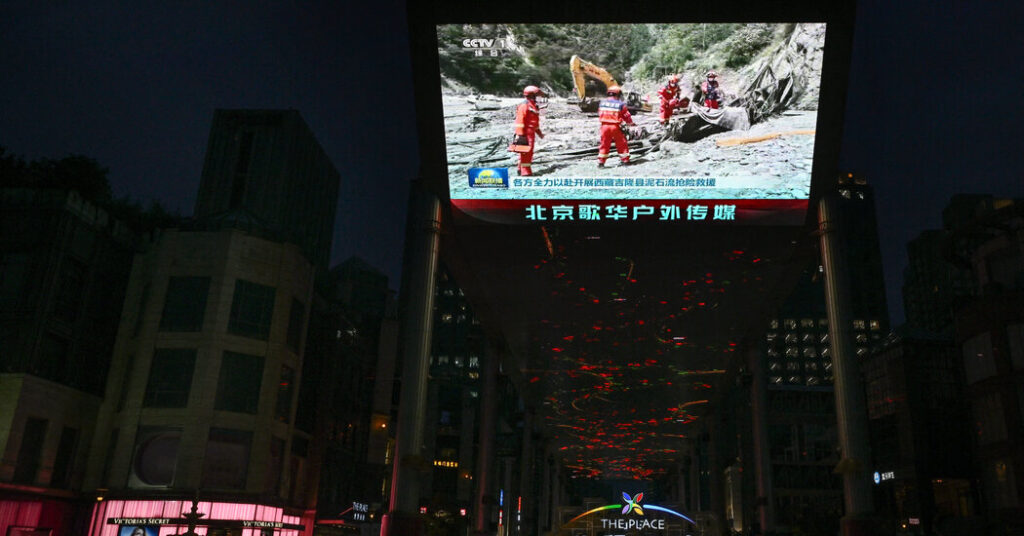
When official memorials were held on Tuesday in Gyirong County, Tibet, as workers continued to clear roads and search for bodies, China’s state media showed images of doctors, police officers, emergency workers and officials standing in mourning.
“Throughout the rescue efforts, cadres and party members stood on the front lines, stepping up to take full responsibility,” the state-controlled People’s Daily wrote in a front-page article last week. “United as one, braving all perils,” the article went on.
Largely absent from the reporting have been images of the injured, the dead and their families.
The flooding killed at least 987 people in Nepal and 16 in Tibet, according to official tallies. Nearly 4,000 people were missing in Nepal as of Tuesday, according to the country’s disaster agency. In Tibet, 546 people were still missing, according to Chinese state media, which did not publish any names. China’s most recent figures are from Aug. 29.
“Search and rescue and emergency relief work in the disaster area are being carried out in an intense and orderly manner,” said Guo Jiakun, a spokesman for China’s foreign ministry. “Our release of information is public, transparent, and timely.”
One day after floodwaters ravaged villages around the Himalayas, government censors were already removing videos from social media platforms. The cybersecurity department of China’s Ministry of Public Security quickly tracked down people posting specific numbers of dead and missing and accused them of spreading false information online. The department announced 10 cases in five different provinces. In one case, a user was penalized for posting that the disaster was “not that severe, probably around 500 people, and the missing might all be dead.”
This week, the authorities in Tibet issued a notice to social media influencers, warning them not to go to the disaster zone or to spread rumors, in order to “support the overall rescue and relief efforts and jointly create a rational, orderly, and clean online public opinion environment.”
Journalists accredited to work at Chinese state media were ordered not to interview survivors or their families, said Maya Wang, the deputy Asia director at Human Rights Watch.
“What authoritarian governments fear most are questions,” she said. “The playbook is to control other narratives, extinguish any questions which inevitably lead to seeking accountability.”
The trumpeting of rescue efforts and the exclusion of stories of death and injury is part of China’s playbook when it comes to major disasters.
The crackdown in Tibet echoes the government’s response to other crises, like the Covid-19 outbreak and a huge earthquake in the southern Chinese province of Sichuan in 2008 that killed thousands. In both cases, officials moved fast to blot out public comments about the government response and punish people who tried to expose lapses in it.
The true scale of devastation from the latest flooding in Tibet is expected to be far worse than official state accounts, according to the International Campaign for Tibet, a nonprofit advocacy group.
China has not said which villages have been affected on the Tibetan side. But the group, citing sources on the ground, said some of the hardest hit included Sale, Serchung, Labi and Rizi, where some 300 homes have been destroyed and many people were still missing.
Some survivors have been moved to Gyirong Town and are being held under supervision and tight security, said Ryan Fioresi, the executive director of the International Campaign for Tibet.
“Almost any unrestricted information from Tibet can become politically sensitive because it challenges the Party’s monopoly over the global narrative over how Tibet is represented and governed,” Mr. Fioresi said.
“Even during a humanitarian disaster, spontaneous relief efforts or independent reporting can show that Tibetans have their own networks, leadership and sense of collective responsibility outside Party structures,” he added.
The post Punishment and Silence: China Pulls Out the Disaster Playbook in Tibet appeared first on New York Times.