“Tosca” is probably the opera I’ve seen the most. It isn’t my favorite, but I never get tired of Puccini’s exquisitely lurid score: a riptide of music drama that grabs you by the heart for two pulse-pounding hours of passion, intrigue and tragedy.
I’m far from alone. “Tosca” first came to the United States in 1901, a year after its premiere, and has been an audience favorite ever since. It comes around often, and last weekend in Manhattan, it was even possible to see two versions of it within 24 hours: the New York Philharmonic’s concert performance at Carnegie Hall on Friday night, and the Metropolitan Opera’s latest revival, with the debut of a phenomenal soprano, on Saturday afternoon.
The Philharmonic’s “Tosca” was the start of a five-year project for the orchestra and Gustavo Dudamel, its new music and artistic director, to present operas in concert at Carnegie Hall. In future seasons, they should really think about what they can add to this city’s opera scene; “Tosca” is not an imaginative choice. (Somehow, last weekend was also the second time this year that the Philharmonic and the Met have programmed the same thing.)
It was nevertheless worth hearing how the Philharmonic performed “Tosca,” as if showing an X-ray of the score. Partly, this was an effect of taking the music out of the pit and onto the stage. But Dudamel’s interpretation also had a remarkable sense of detail. The opera opens with Puccini’s theme for the villainous Scarpia, a series of chords that land like hammer blows. At the end of Act II, when Tosca kills Scarpia, the theme returns as a ghostly shadow of itself, and in Dudamel’s reading it was a heavy vapor, suffocating as much as it haunted.
The opening of the third act was pleasantly shapeless, a collection of pastoral sounds and the clashing church bells of a Roman morning, leading to a moving cello solo that introduced the big aria “E lucevan le stelle.” It was a well-deserved spotlight for Matthew Christakos, who has been filling in and continuously impressing as the Philharmonic’s principal cellist since the retirement of Carter Brey last season.
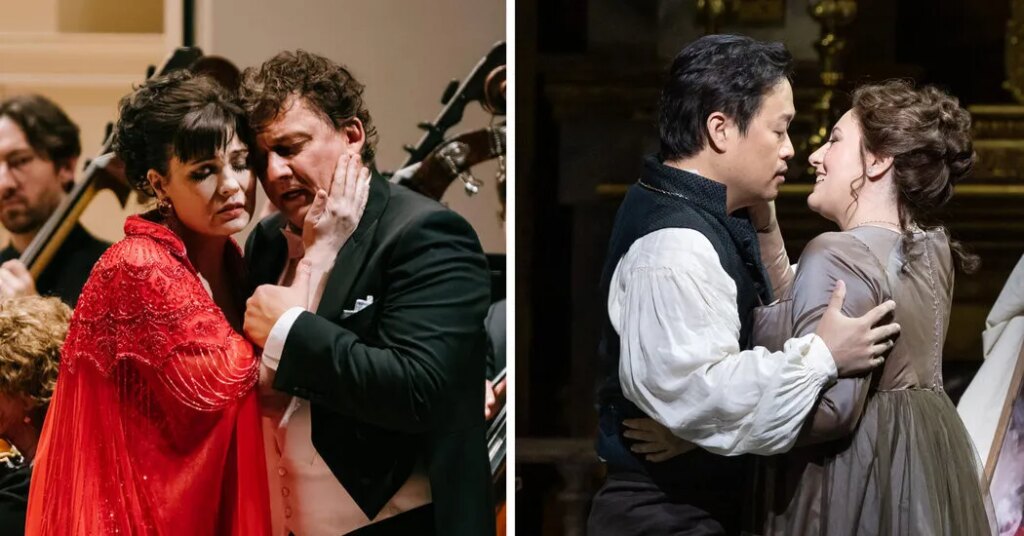
Dudamel was especially skilled at supporting the singers, quickly resolving misalignments and delicately balancing the orchestra with solo voices. The tenor Jonas Kaufmann, a dimming star whose New York appearances are only in concert these days, was more vocally secure as Cavaradossi than in his worryingly unstable performance with the Berlin Philharmonic at Carnegie Hall last month. His signature sound, shadowy and plush (with an occasional kind of howling yawn), is still intact but clearly requires effort.
The soprano Marina Rebeka, in her first and already fully formed outing as Tosca, lent the role a brightness, even a slight metallic edge, that you don’t often hear. Ludovic Tézier, an experienced Scarpia, was as lyrically seductive as he was ferocious; his treatment of the text was so attentive and transparent, a non-Italian speaker could grasp the meaning of his every word.
At times, Dudamel’s way of illuminating the score’s rhythms and textures came at the cost of the drama. “Tosca” is an opera of breathless momentum and extreme economy, each act shorter and more focused than the one before it. But the Philharmonic’s performance seemed full of breaths and lulls, its push and pull of tempos generating moments of passing intensity rather than propulsive flow.
The Met’s “Tosca,” by contrast, was hot-blooded from beginning to end. With Oksana Lyniv in the pit, Scarpia’s opening theme conveyed not only the “tutta forza” (“full force”) marked in the score, but also the “tutta Roma” that Tosca later says trembled before him. If Lyniv’s base-line tone was riskily grand, she had the cast to support it.
Saioa Hernández, in her under-the-radar Met debut, was an ideal Tosca: creamy at the top and weighty at the bottom, with hairpin turns from charming elegance to hissing fury. She held the enormous stage with ease, whether spinning the long and heartfelt melodies of “Vissi d’arte” or recounting, with an earthy plunge, the moment she put a knife into Scarpia’s heart.
Her confrontation with Scarpia, sung by the baritone Quinn Kelsey, made for an edge-of-your-seat thriller. Kelsey has a hulking presence, with a voice that resonates as if in a cavern; his Scarpia was ruthlessly commanding yet made weak by Tosca, seductively warm and later desperate and brutal. As Cavaradossi, Tosca’s lover, the tenor SeokJong Baek was irrepressibly ardent. He delivered his Act II cry of “Vittoria!” like a carnival act, superhuman and sensational.
No artist had a better showing, though, than Puccini. Italy’s opera tradition is built on artful entertainment, and “Tosca” is a perfect example. Its story may be melodramatic and ankle-deep, but it is beautifully, exhilaratingly told by a master of music theater. Last weekend, you could also see how elastic the score is, its effects holding firm through varied interpretations. After two outings in rapid succession, I was ready for more. I always will be.
The post The Philharmonic and Met Opera Duel With Back-to-Back ‘Toscas’ appeared first on New York Times.