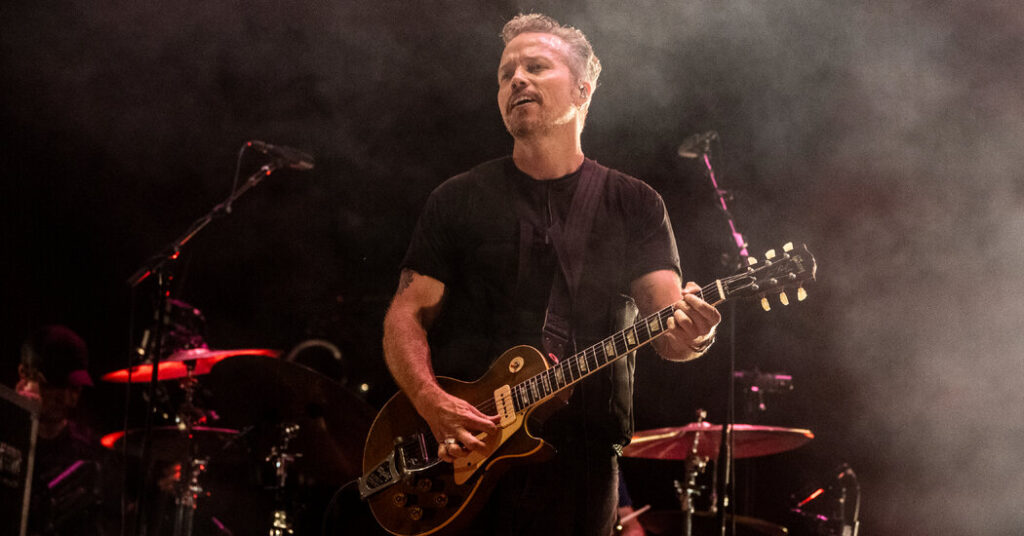
Four musicians, including the acclaimed independent singer-songwriter Jason Isbell, sued the music A.I. company Suno on Monday, accusing it of imitating their voices and distinctive styles without permission.
The musicians who brought the case — who also include Guy Forsyth, Eduardo Calle and David Lowery, an outspoken advocate for artists’ rights in the digital age — were seeking class-action status from the court.
Suno, which was founded in 2022, is one of a number of platforms that allow online users, whether professional musicians or total amateurs, to create songs by entering a few descriptive words or phrases into a text box. Within minutes, or even seconds, Suno generates a tune based on the user’s prompt. In a crowded field of A.I. music, Suno has become a leader, with investors valuing the company at $5.4 billion, far more than any independent competitor.
But like other A.I. music companies, Suno has faced a series of lawsuits from the music industry over how its machine-learning model was trained. Record companies and music publishers have said the company has violated copyright on a massive scale by using millions of songs without their permission. In court papers, Suno has defended its model by saying that the training is allowed under fair use, a legal principle that offers a defense against copyright infringement claims in limited circumstances.
The latest suit, filed in U.S. District Court in Massachusetts, opens up a new legal front against Suno, focusing not on copyright but on what the plaintiffs say is an unlawful imitation of the personal styles and voices of specific artists.
According to the musicians’ complaint, Suno “encoded musicians’ identities into its A.I. model to create its commercial product without consent, and now exploits those identities by publicly using musicians’ names to Suno’s considerable commercial benefit.”
They cited state privacy and right-of-publicity laws in more than a dozen states, including Massachusetts, New York, Tennessee, California and Texas. (Mr. Isbell, as the suit notes, lives in Tennessee; the other plaintiffs, the suit says, reside in Georgia, Texas and Florida.) The suit seeks unspecified damages.
Some major music companies, in an effort to set commercial terms and earn money from licensing, have settled their suits with A.I. companies. Last year, Warner Music settled with Suno and another A.I. company, Udio, and said it is working with both companies to develop new, licensed models. But many artists have been skeptical of artificial intelligence, expressing worries about a future in which music made primarily by human beings will compete against vast numbers of A.I.-generated songs.
“No suno for me thanks,” Mr. Isbell, an Americana artist with six Grammy Awards, wrote in July on social media.
A representative of Suno said the company believed the claims were “without merit and we intend to defend against them,” and pointed to a recent blog post by Mikey Shulman, the company’s co-founder and chief executive. In it, Mr. Shulman said the company had “never allowed prompts for specific artists or copyrighted works.”
The suit notes that Suno says users are blocked from using specific names in their prompts, but calls that false. It says that when the name “Jason Isbell” was entered into the system, it produced “an Americana song called ‘Paper Bell,’ imitating Isbell’s characteristic clean male vocals and country twang.”
The suit says that Suno can also imitate songs by superstars like Taylor Swift and Bruno Mars if users simply type in those artists’ names with spaces separating each letter (“t a y l o r s w i f t”). The suit may test just what degree of similarity to an artist’s voice or style is fair, and what crosses a line into unlawful imitation.
In a recent test of the service by The New York Times, a request for a “1970s folk-rock ballad in Neil Young style” yielded a pop-up message that read: “We don’t reference artists directly, so we’ve replaced your prompt with similar styles you might like.”
In his blog post, Mr. Shulman said the company used certain “training strategies” to reduce the risk of the system generating “unauthorized reproductions.”
“For example,” he continued, “we intentionally chose not to use artist names in our training metadata because our goal is to help people create original songs — not music that sounds like existing artists.”
The post Musicians Sue A.I. Music Company for Imitating Their Voices appeared first on New York Times.