When the Academy of Natural Sciences in Philadelphia first opened the doors of its museum, John Quincy Adams was president.
Twenty-four states had been admitted to the union.
And the first skeletal remains of a Tyrannosaurus rex were decades away from being discovered.
But just two years shy of its bicentennial, the venerated museum, which has been affiliated with Drexel University since 2011, is going the way of the dinosaurs.
At the end of September, the facility known for its Dinosaur Hall and its extensive collection of fossils and other specimens will permanently close, a casualty of struggling attendance and rising costs, the academy and the university said in a joint message on Tuesday.
The message was signed by Antonio Merlo, Drexel’s president, and Suzanne Biemiller, chairwoman of the academy’s board, who wrote that the museum had achieved mixed results in trying to rebuild attendance after the Covid-19 pandemic.
“Over time, it became clear that these were not temporary pressures, but fundamental changes in the economics of the academy’s operational model, costs that have imperiled the academy’s ability to discharge its overall mission and preserve its legacy,” they wrote.
The message noted that the academy, which was started in 1812 by seven naturalists, would continue to operate and “to identify new and financially sustainable opportunities for the public display of elements from its collections and engagement with the natural sciences.” On its website, the museum described itself as the “oldest natural history museum in the Americas.”
Drexel, a private institution, has grappled with declining enrollment and budget deficits in the millions. During the past decade, the total number of students has fallen by nearly 21 percent, according to the university, which The Philadelphia Inquirer reported in April had been facing a $20 million budget deficit.
At the same time, the university contributed nearly $17 million total to the academy during the 2024 and 2025 fiscal years, according to audited financial statements on the university’s website. The academy also had a $5 million line of credit from the university, from which it had drawn $2.4 million as of June 30, 2025, those records showed.
The difficulties experienced by the academy, which is a nonprofit subsidiary of the university, also reflect the pain that is being felt by many museums in the current political and economic climate.
Trump Administration: Live Updates
Updated
- Hegseth is said to have targeted 7 more Army officers.
- The House clears a stopgap bill to avoid a shutdown before the midterms.
- The U.S. launches airstrikes on Iran for the second time in three days.
At more than half of museums in the United States, attendance totals have not returned to prepandemic levels, according to a 2025 survey by the American Alliance of Museums. That erosion has overlapped with economic uncertainty and a pressure campaign on museums by the Trump administration, which has tied federal funding and tax-exempt status to the rejection of diversity initiatives and exhibits it perceives as un-American.
Last year, the museum scaled back its hours of operation.
In response to questions on Tuesday from The New York Times, a Drexel University spokesman, Britt Faulstick, said that 27 of the academy’s 80 employees would be affected by the museum’s closure. He did not elaborate on their employment status.
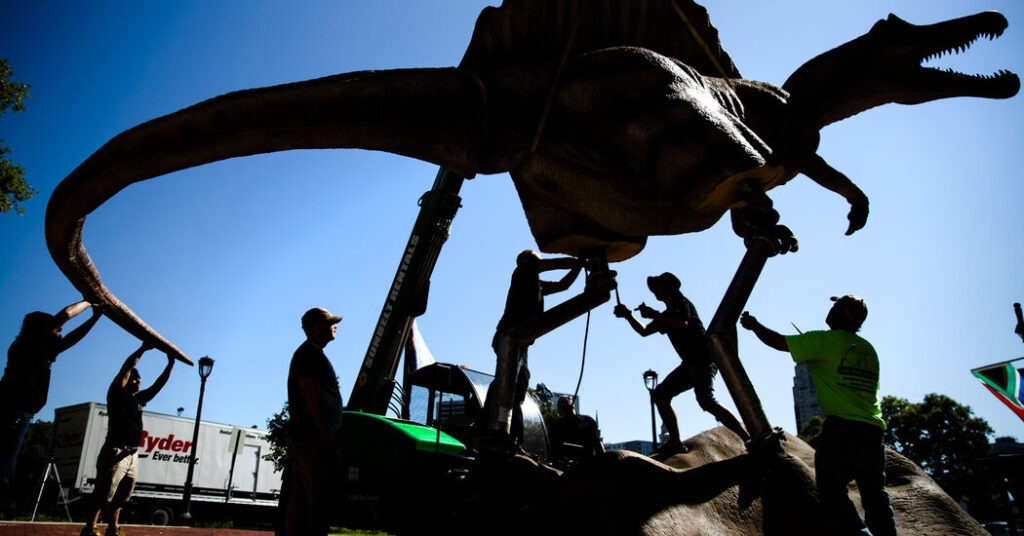
As Philadelphians began to grasp a future without the museum, people in the community lamented the closure. Some recounted sleepovers among the exhibits with scouting and other youth groups, including the Camp Fire girls. Others wondered what would happen to its life-size dinosaur replicas, including a cast of a Tyrannosaurus rex.
“This is crazy and needs to be rectified,” Daniel Pearson, an editorial writer and columnist for The Inquirer, wrote on social media on Tuesday. “It is genuinely hard to believe that the city cannot sustain a museum that’s been around since before the Civil War.”
Asked about the museum’s dinosaur collection, Mr. Faulstick said he could not confirm any specific plans while noting that the university and the academy were “identifying new opportunities to ensure access to its collections and public engagement in the natural sciences.”
The offices of Mayor Cherelle Parker of Philadelphia and Gov. Josh Shapiro of Pennsylvania did not immediately respond to requests for comment on Tuesday about the museum’s plans to close.
The post A Nearly 200-Year-Old Museum Known for Its T. Rex Faces Extinction appeared first on New York Times.