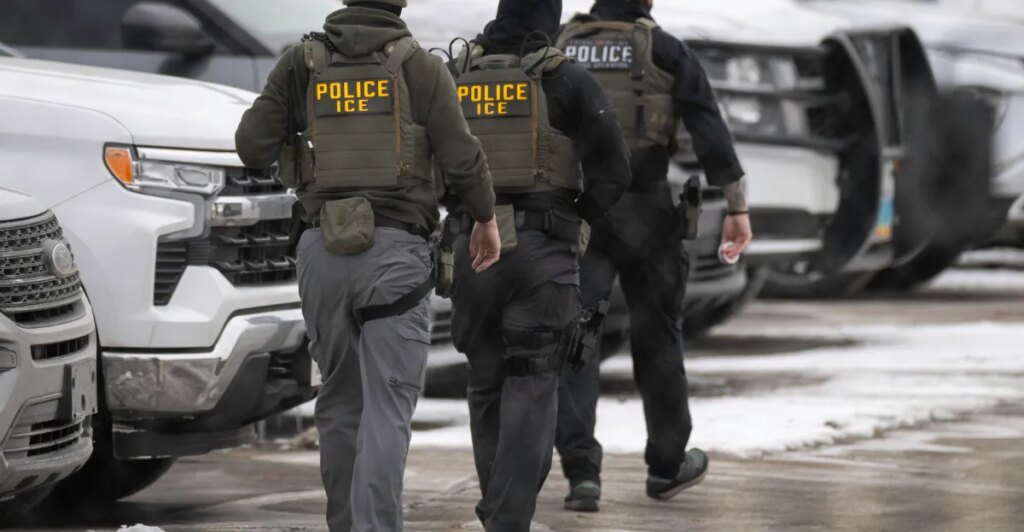
For a brief moment last week, it appeared that an ICE officer, who allegedly shot a man during the early 2026 occupation of Minneapolis and then lied about it, might actually face legal consequences for his actions.
Christian Castro, the now-suspended ICE officer in question, was confined to a Texas jail and potentially faced two sets of criminal charges. Minnesota prosecutors charged him with four felony counts of assault and one count of falsely reporting a crime, and sought his extradition from Texas, where he ordinarily lives, to Minnesota. Federal prosecutors, meanwhile, were reportedly planning to charge Castro with a criminal violation of a federal civil rights law.
Castro’s case was on track to become an encouraging example of how the American system can bring rogue law enforcement officers to account — a federal officer facing clear consequences for allegedly breaking the law in the unpopular and violent wave of ICE raids in Minnesota.
But all of that now appears to be in limbo. According to the New York Times, the federal charges, which had to be approved by officials in Washington, DC, “fell apart in the final hours for reasons that remain unclear.” Castro, meanwhile, may never return to Minnesota — and may even flee to Mexico — thanks to a federal court decision permitting Texas’s Republican Gov. Greg Abbott to effectively sit on Minnesota’s request to extradite Castro until after a state law required Castro’s release.
It’s the latest chapter in an ongoing saga where Trump administration officials, federal courts eager to shield federal law enforcement officers from justice, and now Texas state officials all work together to ensure that ICE and other law enforcement personnel involved in Trump’s violent crackdown in Minnesota face no legal consequences for their actions.
If Castro gets off scot-free, he will owe his freedom to an unusual combination of federal and state officials who appear to have taken extraordinary measures to shield Castro from accountability. But while his case is unusually dramatic, it is hardly unique. An array of MAGA sympathizers and movement conservatives in state governments, the federal judiciary, and the Trump administration have all pushed to place ICE and similar agencies above the law.
What is the legal fight over Castro about?
Castro allegedly fired his gun through the door of Julio Sosa-Celis’s Minneapolis home in January, striking him in the leg. Although the Trump administration initially claimed that Sosa-Celis and his roommate attacked ICE officers with a broom and shovel, that allegation fell apart after prosecutors viewed video of the incident. Castro was suspended from his job at ICE without pay.
In May, a Minnesota prosecutor filed charges against Castro, and Castro was later arrested in Texas pursuant to an arrest warrant arising out of those charges.
That arrest should have guaranteed that Castro would be returned to Minnesota for trial. The Constitution provides that “a Person charged in any State with Treason, Felony, or other Crime, who shall flee from Justice, and be found in another State, shall on Demand of the executive Authority of the State from which he fled, be delivered up, to be removed to the State having Jurisdiction of the Crime.” Minnesota Gov. Tim Walz formally sought Castro’s extradition on June 2.
Rather than comply with this request, however, Abbott took two actions that may prevent Castro from ever being tried for his alleged crimes. Abbott initiated an investigation, claiming, on dubious legal grounds, that he may not be able to extradite Castro because Castro does not meet the legal definition of a “fugitive.” Abbott also sent his lawyers to federal court to argue that the court could not order Texas to comply with the Constitution’s mandatory extradition provision.
Meanwhile, a deadline loomed over Minnesota’s request. Though Castro was incarcerated in a Texas jail, Texas law only permitted the jail to hold Castro for 90 days, at least without an order from Abbott saying that Castro must be extradited. During his incarceration, Castro also made several phone calls to his romantic partner in Mexico, and they discussed Castro’s desire to move to that country.
So Minnesota quite reasonably feared that, if the 90 days were allowed to expire, Castro would flee the country.
Nevertheless, last Wednesday a Trump-appointed Judge Fernando Rodriguez Jr. backed Abbott’s play. His opinion in Walz v. Abbott rests on an extraordinarily credulous interpretation of Abbott’s treatment of Castro.
Briefly, Rodriguez’s opinion claims that it is too soon for a court to order Abbott to extradite Castro because Abbott has not yet formally “denied the request for a rendition warrant.” Instead, Rodriguez notes that Abbott asked Texas’s secretary of state to investigate whether Castro should be surrendered to Minnesota, and suggests that Minnesota must wait for that “investigation” to play out.
Oddly, Rodriguez’s opinion also includes a footnote indicating that he believes Abbott’s supposed investigation is baseless. The premise of that investigation is that Castro may not count as a “fugitive” because he moved to Texas after ICE directed him to do so. But, as Rodriguez notes, the Supreme Court defined who counts as a fugitive more than a century ago, and the Court’s definition does not exclude people who move because of a job, federal or otherwise.
So, to summarize Rodriguez’s decision, he ruled that Texas may delay complying with Minnesota’s extradition request, based on an investigation into a legal question that the Supreme Court has already resolved, and that it may delay compliance until state law requires Texas to release Castro. Castro was released on Thursday.
Thanks to this decision, it is now unclear whether Castro will ever face charges. Even if he remains in Texas, and even if Abbott eventually decides to comply with the extradition request, Texas authorities will now have to find Castro again and rearrest him. And Castro may flee to Mexico. While Minnesota can formally request Castro’s extradition from Mexico, that process could take years.
And, in case there is any doubt, there’s now strong evidence that Abbott’s “investigation” was a sham, and that Abbott was always motivated by hostility toward Minnesota’s attempt to prosecute Castro. One day after Rodriguez issued his decision, Abbott posted on X mocking Minnesota Attorney General Keith Ellison, which said that Ellison and his legal team “are such bad lawyers.”
The post also labeled Minnesota a “sanctuary state” and threatened to bus immigrants from Texas to Minnesota.
Even if Abbott had complied with the Constitution, Minnesota prosecutors faced an uphill battle in their case against Castro
Even if Castro had been delivered to Minnesota authorities without incident, or even if he is arrested in Minnesota at some point in the future, it’s far from clear whether state prosecutors may bring charges against a federal law enforcement officer who allegedly violated Minnesota’s criminal law while carrying out his official duties. And the biggest obstacle standing against such a prosecution is a fairly sensible Supreme Court decision that long predates modern political fights over immigration enforcement.
The Court’s decision in In re Neagle (1890) arose from a wild incident where a former chief justice of the state of California attempted to kill a sitting Supreme Court justice. David Terry, the former state justice, married a woman who claimed that she was entitled to a share of a US senator’s fortune. After Justice Stephen Field ruled against Terry’s wife, Terry threatened Field’s life, and so Field was assigned a deputy US Marshal named David Neagle as his bodyguard.
Some time after Field’s decision against Terry’s wife, the justice was traveling by train in California, and he was attacked by Terry. Neagle shot and killed Terry. And California attempted to charge Neagle, the federal bodyguard, with murder.
The Supreme Court tossed out this prosecution, and that decision has long been read to limit state governments’ power to prosecute federal officers who commit a state law crime while engaged in their official duties.
That said, the Court’s more recent decision in Martin v. United States (2025) suggests that Neagle may not be a total bar to state prosecutions of ICE officers. Martin read Neagle fairly narrowly, to say that federal officials are protected from state prosecutions only when their actions “were ‘necessary and proper’ in the discharge of their federal responsibilities.”
So that suggests that, if Castro is tried for violating Minnesota law, the question of whether he is immune from prosecution is likely to turn on whether courts determine that his alleged decision to fire a shot through Sosa-Celis’s door (and, potentially, to lie about Sosa-Celis’s actions) was a “necessary and proper” way for Castro to carry out his responsibilities as an immigration enforcement officer.
It’s hard to predict, however, how the courts would rule on this question. The Martin decision is fairly new, and the rule Martin seems to apply to federal officers charged with state crimes is vague.
Federal law also provides that Castro’s trial, should it happen, must occur in federal court — although this federal court may still hear a state-law prosecution. And that means that any decision allowing Castro’s prosecution to move forward would appeal to the US Court of Appeals for the Eighth Circuit, which is one of the most conservative appeals courts in the federal system.
Of course, if Minnesota lost in the Eighth Circuit, it could potentially bring the question of whether Castro may be charged with violating a Minnesota criminal law to the Supreme Court. But, while the Martin decision suggests that Minnesota may have a chance of prevailing before the justices, several of the Court’s other precedents indicate that this Court is unlikely to rule against a federal law enforcement officer.
The slow death of Bivens
Separately from the legal question of whether someone like Castro can be charged with a crime, there is also the question of whether the victim could sue. It used to be the case that people who are victimized by federal law enforcement officers could sue those officers directly, but the current Supreme Court has virtually shut down these suits. The Court’s treatment of this question is a window into their expansive view of immunity for federal law enforcement.
More than five decades ago, the Supreme Court established in Bivens v. Six Unknown Names Agents (1971) that federal officers who violate the Fourth Amendment’s ban on “unreasonable searches and seizures” may be sued and potentially ordered to compensate their victim.
But the Court’s current majority is extremely hostile to Bivens, and has walked right up to the edge of overruling it. In Hernández v. Mesa (2020), the Court’s Republican majority held that a Border Patrol agent who allegedly fatally shot a Mexican teenager in the face was immune from a lawsuit brought by the teenager’s family. More recently, in Egbert v. Boule (2022), the Court declared that federal law enforcement officers are immune from suit if there is “any rational reason (even one)” to justify giving them immunity.
In November, the Court will hear the Nielsen v. Watanabe that could potentially overrule what little remains of Bivens.
The Supreme Court’s Republican majority, in other words, has spent the last several years immunizing federal law enforcement officers like Castro from civil lawsuits. That doesn’t necessarily mean that it will also immunize Castro from criminal charges brought under state law, should his case somehow wind up before the justices, but it isn’t a hopeful sign for Minnesota prosecutors.
And that’s, of course, assuming that Minnesota law enforcement somehow manages to take custody of Castro. Abbott’s gamesmanship, and Rodriguez’s decision to bless that gamesmanship, may ultimately mean that Castro is never apprehended by Minnesota officials.
The post A federal judge just discovered a whole new way to place ICE above the law appeared first on Vox.