After months of European leaders calling for a seat at the table in talks on Ukraine, Washington says they will get one. But first, they had to agree on who speaks for Europe.
The challenge of getting a continent to speak with one voice is tricky, as the European Union has grown into a bloc of 27 countries whose national interests can clash just as often as they coincide. It is such a cliché that there is an urban legend that Secretary of State Henry Kissinger once asked, “Who do I call if I want to speak to Europe?”
Pressure mounted in recent days for European leaders to come up with an answer as the White House and the Kremlin engage in talks on the continent’s future.
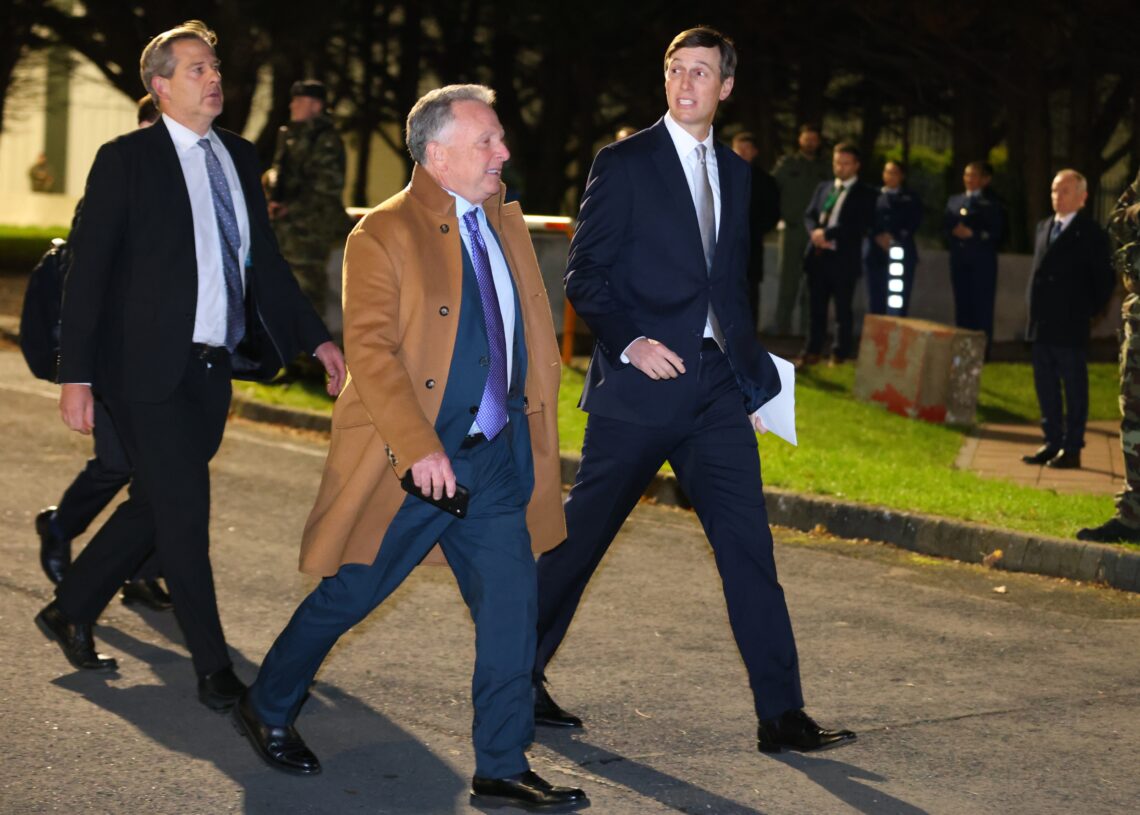
President Donald Trump’s son-in-law Jared Kushner, one of two envoys leading talks on Russia’s war in Ukraine, had quipped dryly this week that: “If Europe could identify one person to speak on their behalf, that would be a bigger achievement than getting the Russians to include them in the negotiation.”
On Friday, the European Union’s 27 heads of state and government made a decision after gathering in Dublin — choosing not one person but a team from Britain, France, Germany, Italy, Poland and the European Union.
“Our European team will continue to act in close coordination, in full unity,” European Council President António Costa said in an announcement that did not name specific negotiators.
“Europe must speak with one clear and united voice in all discussions that shape the future of Ukraine and the security of our continent,” he said. “And this is ultimately a team effort.”
Costa, responding to questions, denied a contradiction in picking five countries joined by E.U. officials. “It’s normal,” he said, noting that Trump also has two envoys. “It is essential to have a team and to speak with only one voice.”
Kushner and Trump envoy Steve Witkoff have in recent days pushed to include the Europeans as Moscow demands to make the continent’s security architecture part of the negotiation.
Witkoff said European officials will join the next talks after he traveled to Moscow, along with Kushner, to meet Russian President Vladimir Putin on Thursday. They did not specify what format the next round might take.
European officials contend that it is a feature, not a bug, of the European project to find common ground and forge consensus despite the differences.
“For me, the substance is the most important thing. Rearming Europe and helping Ukraine is the most important task,” Danish Prime Minister Mette Frederiksen told reporters ahead of Friday’s summit. “We will figure out who will represent Europe. And by the way, we are 27 countries. … Always in democracies, there will be discussions.”
Until now, the White House and the Kremlin have intermittently sidelined Europeans from negotiations since Trump’s return to power, even as European governments became Kyiv’s chief providers of cash and weaponry.
Moscow has called for an end to Western weapons for Kyiv and an overhaul of wider European security arrangements as part of conditions to end the war. European leaders have rebuffed Kremlin demands to dictate security arrangements or roll back NATO’s posture, maintaining that talks on a postwar settlement must start with a ceasefire in Ukraine.
The Kremlin said earlier Friday that it would make a decision about bringing the Europeans into talks “after we understand their real intentions and readiness to help the peace process.”
Spokesman Dmitry Peskov said Putin “is open to any form of contact, provided there is indeed someone on the European side who is at least authorized to speak.”
Last year, when U.S. allies worried that Trump might make concessions to Russia, seven European leaders rushed to the White House in a show of solidarity with Ukrainian President Volodymyr Zelensky. Critics seized on a photo of them crowding into chairs around the Resolute Desk like students facing Trump.
European leaders have noted that the optics of multilateral morass over an envoy does a disservice. In a letter asking to discuss this at Friday’s summit, Italian Prime Minister Giorgia Meloni said the E.U. needs to stop looking like it’s “all over the place.”
But the bloc has juggled differing priorities.
Its more powerful nations, such as France and Germany, are reluctant to relinquish too much influence to the E.U. executive branch.
Smaller countries, such as eastern nations bordering Russia, fret that Europe’s power brokers don’t always convey their interests. Britain and Norway, meanwhile, help arm Ukraine but are not part of the E.U.
Some capitals supported being represented by Europe’s big three ― Germany, France and Britain. Senior officials from those three have been present for talks on the war, including this week in Abu Dhabi, capital of the United Arab Emirates, but they have not joined the direct meetings with Russia.
Others pointed out that the E.U. already has a council president, Costa, and a foreign policy chief, Kaja Kallas, to represent it. Estonian Prime Minister Kristen Michal, advocating for the two, said they would be accountable to all member states.
Costa, a former prime minister of Portugal, chairs E.U. summits and is tasked with consensus-building. He has suggested he could lead the negotiating team.
Kallas, the E.U.’s top diplomat and a former Estonian prime minister, has presented herself as a natural pick, although she has faced questions about whether the job should go to one of the Kremlin’s harshest critics in the bloc.
“I know the Russians don’t want me, but do we have a say in who is representing Russia? No,” Kallas told reporters Friday. “They don’t want anybody strong on the other side.”
“We can’t just send any person that has no institutional role like the Americans are sending,” she added.
Several European leaders have cautioned that the E.U. could be distracted with the debate over an envoy and led into a trap of negotiating over the continent’s security in return for a role in Ukraine talks.
“Without Europeans, there is no support for Ukraine. Let’s be honest,” French President Emmanuel Macron said upon arrival in Dublin. “There is no more U.S. support,” he said. “So there is some mediation, fine, but at the end of the day, we will be the ones to define and decide for our future security as Europeans.”
The post Europeans decide on thorny question of who will speak for bloc in Ukraine talks appeared first on Washington Post.