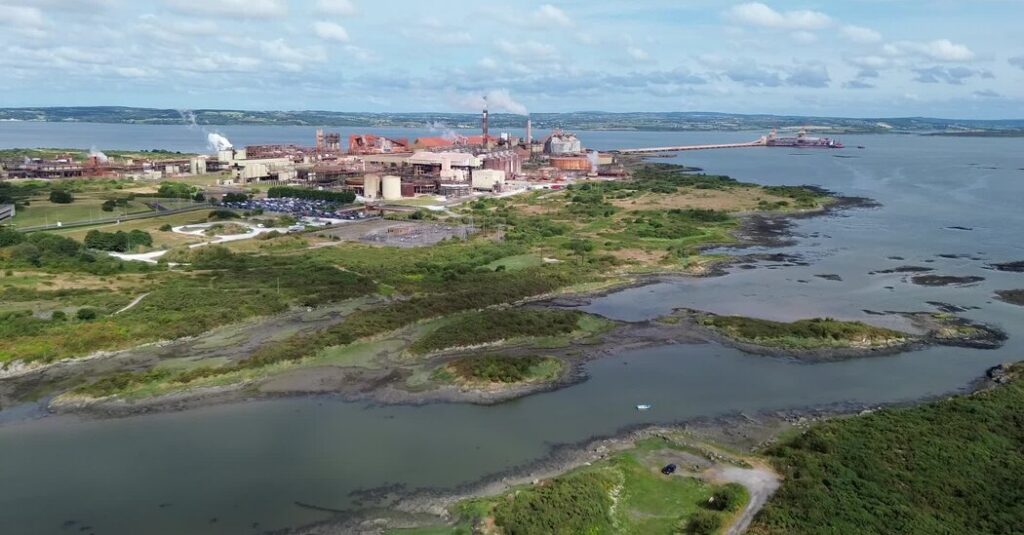
The industrial plant rises over a flat stretch of the Shannon estuary in County Limerick, Ireland, a harsh silhouette against an otherwise picturesque landscape. Tall chimneys jut skyward, puffing plumes of white smoke.
Much of the ground is stained a rusty red, the residue of bauxite ore that is refined into alumina here before being shipped off to be smelted into aluminum.
The Aughinish Alumina plant, currently owned by the Russian company Rusal, has stood here for more than four decades and employs hundreds of local people. It is Europe’s largest alumina refinery. But it has come under scrutiny after The Irish Times and an investigative consortium reported that a large quantity of the alumina processed here was being shipped to Russian smelters, which sell finished aluminum to a company that supplies Russian weapons manufacturers.
The findings ignited a heated debate in Europe, casting this small place on Ireland’s west coast into the center of a dispute over how member states could avoid feeding Russia’s war in Ukraine. Some European lawmakers questioned whether the alumina produced here should be sold to Russia at all, even if that would come at a cost to local industry and to the European supply chain of an essential raw material.
The Ukrainian Embassy in Ireland said in June that it had “serious concern regarding the continued export of alumina from Ireland to the Russian Federation.” And President Volodymyr Zelensky of Ukraine made a veiled reference to the plant during a visit to Dublin the following month, saying “raw material that ends in Russia is used against us” and should be halted.
In Ireland, a country with a tradition of military neutrality, the accusations struck a nerve. Kirsty Griffin lives on a hillside overlooking the plant, and its chimneys are visible from her upstairs windows.
“We are a neutral nation, so it’s a bone of contention,” she said, standing in her garden, where wildflowers blossomed. She added that there were other issues with the plant, saying locals didn’t know how big it would become when it was first proposed and had raised concerns in recent years about the bauxite residue pools.
“It did bring a lot of jobs, but we are trying to mind this place, and we have all this just over the hill,” she said, gesturing to the landscape. “If the Russians have to leave there in the morning, what happens to the mud pools?”
For others, the sudden focus on the plant’s links to Russia has felt like an unwelcome spotlight on their quiet corner of the country.
Michael Keane, who owns an organic dairy farm nearby, was hesitant to discuss the situation, he said, partly because the site had been a boon to the local economy and created employment. He recalled how, in the decades before the plant’s arrival, there had been few opportunities for work and many locals had emigrated. Then construction began.
“It was like a gold rush — they came from everywhere, all over Ireland and around the world, as well,” Mr. Keane said of the workers taking part in the construction. “And they just plopped it in the middle of this green island.”
The alumina plant was built by Alcan, a Canadian mining company, and was sold in 1999 to a Swiss company that merged with Rusal in 2007, placing the plant under Russian ownership.
Raw bauxite from mines in Brazil and Guinea is brought here for processing into a fine white powder. Just over half of the finished alumina is then shipped to Russia, and the rest to smelters across Europe. The plant also operates a power station that exports surplus electricity to the national grid, and it employs 475 people and an additional 400 contractors.
Rusal is one of the world’s largest aluminum companies, founded by the oligarch Oleg Deripaska. The United States, Britain and the European Union imposed sanctions on him for his close ties to the Kremlin. Mr. Deripaska officially resigned as the company’s director in 2018 but owns 45 percent of En+, the majority shareholder of Rusal. After lobbying by Ireland and several other European nations, U.S. sanctions against Rusal and other companies linked to Mr. Deripaska were lifted in 2019.
After The Irish Times published its report in March, the Irish government conducted a formal investigation, which it has shared with E.U. officials and has briefed Ukraine on, but has not made public. Micheál Martin, the Irish prime minister, said on a visit to Kyiv that the government “has not found concrete or definitive evidence linking the alumina to a weapons manufacturer in Russia.”
But he added, “That said, neither has it found definitive evidence that alumina may not be going to weapons manufacturers.”
In a statement, Aughinish Alumina said it took the accusations “with the utmost seriousness” and had cooperated fully with the government’s investigation. It said that the plant and its parent company “have developed a framework to provide further enhanced traceability of Aughinish’s alumina” that would provide “verifiable evidence” that its alumina had no link to Russia’s military.
Some 52 percent of Aughinish alumina goes to Russia and 34 percent to France, Sweden and the Netherlands combined, according to The Financial Times. Potential trade restrictions on the plant could prove consequential for Ireland and Europe. Aughinish supplies two of Western Europe’s largest aluminum smelters, which get the majority of their raw material from the Irish plant.
Ricardo Cardoso, an E.U. spokesman, said that the European Commission, the executive arm of the bloc, was reviewing the Irish government’s report and that “we will continue our close engagement with the Irish authorities on the appropriate follow-up.”
Niall Collins, an Irish lawmaker who represents Limerick, said he felt confident that the government report would ease concerns about the plant. If Europe decided to take measures to curtail operations, he said, he was afraid the damage would be felt locally and across the continent.
“It’s not going to close down Russia,” he said. “It would close down Limerick, and it would deny Europe its alumina supply.”
Many in Europe, however, have argued that action should be taken. Pina Picierno, an Italian politician and vice president of the European Parliament, wrote in May to the European Commission, “It is unacceptable that, while the E.U. funds Ukraine’s defense, a Russian-owned company operates undisturbed within a member state, supplying the Kremlin’s military industry.”
The European Union did not include alumina in its most recently passed sanctions package, though some nations could push for its inclusion in the future, analysts said. Yet, obstacles could prevent that — most notably, the effects on Europe’s own supply chains.
“The biggest obstacle isn’t any misplaced political sympathy for Russia; it’s European industrial policy,” said Mujtaba Rahman, managing director for Europe at the consultancy Eurasia Group.
Mr. Rahman noted that Europe had been pushing to cut dependencies on other nations and that disrupting its largest alumina refinery could leave the continent more dependent on trading partners.
The post A Factory in Rural Ireland Is at the Center of a Dispute Over Russia appeared first on New York Times.