In today’s edition … superstitions abound … Trump is championing an unpopular position on data centers … but first …
Why a candidate leading in North Carolina is running like he is behind
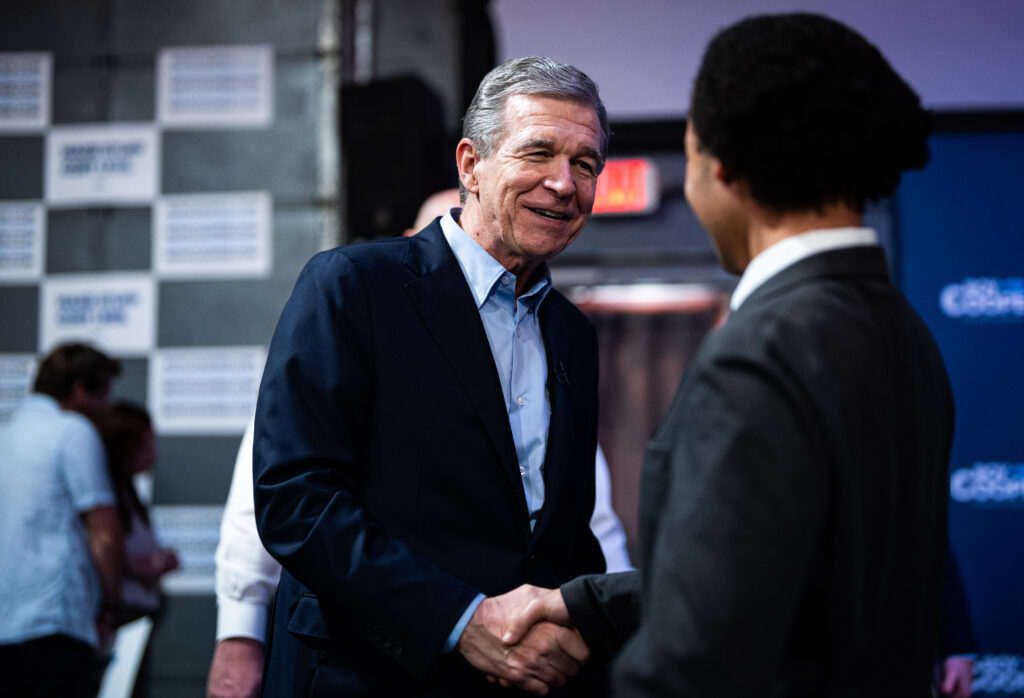
Roy Cooper, a Democrat running for Senate who has won four statewide races in North Carolina over a nearly four-decade career, finds himself in an enviable position — at least on paper:
- Polls have consistently shown the former governor leading his GOP rival, former chair of the Republican National Committee Michael Whatley, and hovering above or around 50 percent.
- Cooper has over $20 million in his campaign war chest, compared to Whatley’s $3.4 million.
- Voters statewide have already elected Cooper four times, and he enjoys near total statewide name recognition.
But in conversations with a number of Democrats in the state, including some close to Cooper, I’ve found a campaign that has been urging caution, warning that polls will tighten, if they haven’t already, and predicting that Whatley is about to enjoy a surge of outside money.
“It’s been almost 20 years since a North Carolina Democrat won a Senate race,” said Andrew Bates, a Democratic operative who is from North Carolina. “So for Cooper, it’s smart to play like they’re down and keep the focus on Whatley being a cost-raising political insider.”
That is Cooper’s strategy. The Democratic Senate nominee released a new ad this morning, obtained first by the Early Brief, that targets the biggest Republican vulnerability in these midterm elections: affordability.
“I’m going to show you something. No AI. No special effects. Just Michael Whatley in his own words,” Cooper says, direct to camera.
“Grocery prices are down, gasoline prices are down, housing prices are down, inflation is down,” Whatley says, in footage from an interview he did as committee chair in 2025.
“Unbelievable,” Cooper exclaims before tossing to Whatley, saying on a podcast this year, “There is no inflation.”
“Seriously,” Cooper says, before approving the message and acknowledging, “costs are way up, and it’s a senator’s job to do something about it.”
DJ Griffin, a spokesman for the Whatley campaign, responded to the attack by noting Cooper has been in office for four decades and argued, “If Candidate Cooper wants to address higher costs in NC, he should look in the mirror.” The response echoes an ad from the National Republican Senatorial Committee arguing Cooper did the “opposite” of his “make stuff cost less” campaign slogan while governor.
“Prices were down considerably in 2025 from the record-setting inflation caused by Joe Biden’s reckless spending policies endorsed by Roy Cooper,” Griffin said. That point is not entirely correct: Inflation was lower in 2025 than the highs in 2022, but prices did not fall.
Cooper’s ad is simple — just the candidate and a few quotes from his opponent, meant to tie Whatley to the affordability crisis voters keep saying is their most important issue this election cycle.
It’s the sort of accountability ad you will see from many Democrats this cycle. And that reflects the reality that, Cooper’s good polling aside, Republicans have dominated North Carolina at the federal level in recent years, so candidates like Cooper aren’t about to take chances with complex or risky attacks.
President Donald Trump has won the state every time he has been on the ballot. And, historically, North Carolina voters have had a clear split between how they feel about statewide Democratic candidates and those running for federal office. The last Democrat to win a North Carolina Senate seat was Kay Hagan in 2008, while Democrats like Cooper and Josh Stein, the current governor, have represented the state at the gubernatorial level for years.
It has also been difficult for governors of either party in North Carolina to move into federal office. Former Republican governor Pat McCrory lost the 2022 Republican primary. Jim Hunt, a Democrat who served for four terms as governor of North Carolina, may be the clearest cautionary tale for Cooper. After serving two terms as governor, Hunt lost to Republican Jesse Helms in 1984 in what was, at the time, one of the most bitter Senate campaigns.
(Shout out to my editor, John Wagner, who covered North Carolina “eons ago” and clued me into Hunt’s history.)
Then there is the money.
While Cooper has a huge campaign-side advantage over Whatley, the Republican Party has a huge financial advantage over Democrats, and many believe Whatley, a fixture in Republican politics for years, could benefit.
The Senate Leadership Fund, the primary Republican super PAC working on Senate races, pledged to spend over $70 million to support Whatley and released an ad earlier this year casting Cooper as a career politician and hitting him on crime.
“Forty years is enough,” the ad’s narrator says.
Democrats’ outside Senate group, Senate Majority PAC, has — by comparison — pledged to spend $42 million for Cooper. That’s a significant difference, and that’s without figuring in spending from groups like the Republican National Committee, now free to do more because of a recent Supreme Court case, and Trump’s super PAC, MAGA Inc.
So yes, while Cooper has a lot going for him, the Democratic trepidation is not unfounded.
But that may ignore the Trump of it all.
The same polls that show Cooper with a consistent lead over Whatley also show Trump’s approval rating in a state he won less than two years ago hovering in the 30s, bogged down by concerns about the economy and rising prices. An Elon University poll this month — which found Cooper with an 11-point lead — found 54 percent of North Carolinians disapprove of the job Trump is doing, compared to 36 percent who approve, an 18-point gap.
Whatley is uniquely tied to Trump. The president tapped him as Republican National Committee chair, and Whatley’s campaign website features “Endorsed by Trump” and a photo of the two smiling together on the home page.
“Cooper is hitting on the sore point of every Republican on the ballot right now,” Doug Heye, a longtime Republican operative who is from North Carolina, said of Cooper’s ad focusing on prices. “Cooper has been elected repeatedly statewide, so voters are comfortable with him, and Trump’s approval is an albatross on every Republican candidate.”
So could Whatley shake that image? Heye says no, and he recalls when he worked for Republican Michael Steele’s Maryland Senate campaign in 2006.
“Any time we would try to create separation” with the White House, Heye recalled, “all the Ben Cardin campaign would do is show a photo of Michael Steele with George W. Bush or Dick Cheney.”
Steele went on to lose by 10 percentage points.
Want this in your inbox?
Start your day with The Washington Post’s flagship political newsletter. Sign up here.
Our picks
- He brought a guillotine to D.C. He didn’t expect to face a felony, from Ben Conarck.
- As more colleges surpass $100K price tag, here’s the true cost, from Danielle Douglas-Gabriel.
- Postal Service plans may keep voters from getting ballots, whistleblower says, from Patrick Marley.
- Supreme Court clears way for White House ballroom construction to continue, from Justin Jouvenal, Dan Diamond and Julian Mark.
- Kalshi suspends GOP House candidate for betting on her own race, from Mariana Alfaro.
- At least 80 people rescued after Grand Canyon flash flooding; one is unaccounted for, from N. Kirkpatrick, Brianna Sacks and Jake Spring.
- Army secretary submits resignation to Trump after repeated clashes with Hegseth, from Dan Lamothe, Noah Robertson and Alex Horton.
What we’re watching
Donald Trump is really trying to make data centers happen.
And that’s despite polls showing the physical manifestations of artificial intelligence becoming incredibly unpopular. The Republican president took to Truth Social on Monday to lambast communities that are protesting planned data centers, cementing his role as the data center industry’s biggest champion.
“The only reason that communities throughout the U.S.A. should not want Data Centers is if they want to end up being backwards and poor,” Trump wrote. “If they want to be successful and rich, with far lower taxes and jobs all over the place, let Data Reign.”
He added: “If we kill the Golden Goose, you will only have yourselves to blame. China could not be happier with this anti Data Center movement. Actually, they can’t believe it is happening!”
This is not exactly new from Trump. My colleague Cat Zakrzewski published a really insightful piece last week about the ways Trump is “putting him[self] increasingly at odds with members of his own party” on the topic of data centers. Cat goes on to write that encouraging the proliferation of data centers has become “a signature priority” for the president.
We have covered this a lot, but as a reminder: Few political issues spur the bipartisan anger that data centers do. A Gallup survey in May found “seven in 10 Americans oppose constructing data centers for artificial intelligence in their local area, including nearly half, 48%, who are strongly opposed.” Sixty-three percent of Republicans said they were either somewhat or strongly opposed to the construction, compared to 75 percent of Democrats.
Trump’s position on this is fascinating. The president’s political rise has shown him to be an adept political strategist, someone who can jump onto the direction of political travel on a host of issues and use it to further his career. On this, Trump is doing the opposite, championing an unpopular position on a wholly unpopular issue.
In your local paper
Stateline: The end of protected status for over 300,000 Haitian immigrants has rocked Springfield, Ohio, causing city leaders to say, “Springfield is under siege right now.”
Texas Tribune: Texas’ attempt to change how students are taught high school social studies lessons has been divisive. But the process could conclude this week, with the state attempting to alter how students learn in a move that critics have labeled political. The changes include mandated Bible stories in reading lists.
Georgia Recorder: The price for healthcare under the Affordable Care Act will rise as much as 20 percent this year, on top of the increases that happened last year after President Donald Trump allowed pandemic-era health care subsidies to expire. This trend has been seen nationwide.
From you
It seems most of you are not superstitious — when we asked you to share your superstitions, many of the responses we received were about other people’s.
“Then there was the time in early 1991 I flew with Russian Air Force pilots on a very frosty Russian morning,” wrote Bob Miller. “A small bottle of vodka passed between pilot and copilot. After seeing this, I could have used a shot as well! We did make it safely to our destination.”
David Olsen, a reader in England, remembered observing his Russian grandmother following “the convention that one sits down for a short while before departing on a long journey. Russian Orthodox believers — as she was — may take this opportunity for silent prayer. But with or without religious overtones, taking a moment for contemplation to settle oneself before the stress of travel cannot be a bad thing.”
And Don Crisafulli adds: “My longstanding superstition goes to the number 13 and there’s a story behind that. Apollo 13 lifted off from FLA’s Cape Kennedy on 4/11/1970 at 2:13 PM Cape time, which was 1:13 PM at Houston’s Mission Control, which translated to 1313 in military time. And then the spacecraft’s service module exploded two days later on 4/13/1970. … The preceding sequence made a major impression on the 6th-grader that I was at the time, so if the preceding means that I’m irrationally superstitious that way, then so be it.”
As for me, I am not superstitious, but I am a little stitious.
Send a reply
Lionel Messi, arguably the greatest soccer player of all time, announced Monday he is retiring from international play after more than two decades. Amy B Wang and Mariana Alfaro have more on that here.
I was lucky enough to see Messi play this summer. So I wanted to ask all of you: It doesn’t have to be in person, but what sports memory do you cherish? Let me and your fellow Early Brief readers know at [email protected].
Thanks for reading. You can follow me on X at @merica.
The post Why a candidate leading in North Carolina is running like he is behind appeared first on Washington Post.