DUBAI — President Donald Trump vowed Monday to hit Iran “hard” following Iranian attacks on U.S. forces in Jordan, as signs of U.S. economic pressure on Tehran — which he ramped up last week — grew increasingly evident.
Trump told Fox News that the United States, which had transitioned largely to economic warfare after facing concerns from within the Pentagon about dwindling munitions stocks, would respond militarily to the Iranian attack on Jordan.
This flare-up in military action, following weeks of relative quiet, started Sunday when U.S. Central Command said that it hit Iranian launchers that it said were preparing to fire rockets into the Strait of Hormuz.
In retaliation, Iran then said that it had targeted U.S. bases in Jordan and the United Arab Emirates. The UAE denied that a base was targeted but said that it had responded to a drone over its waters, coming from Iran.
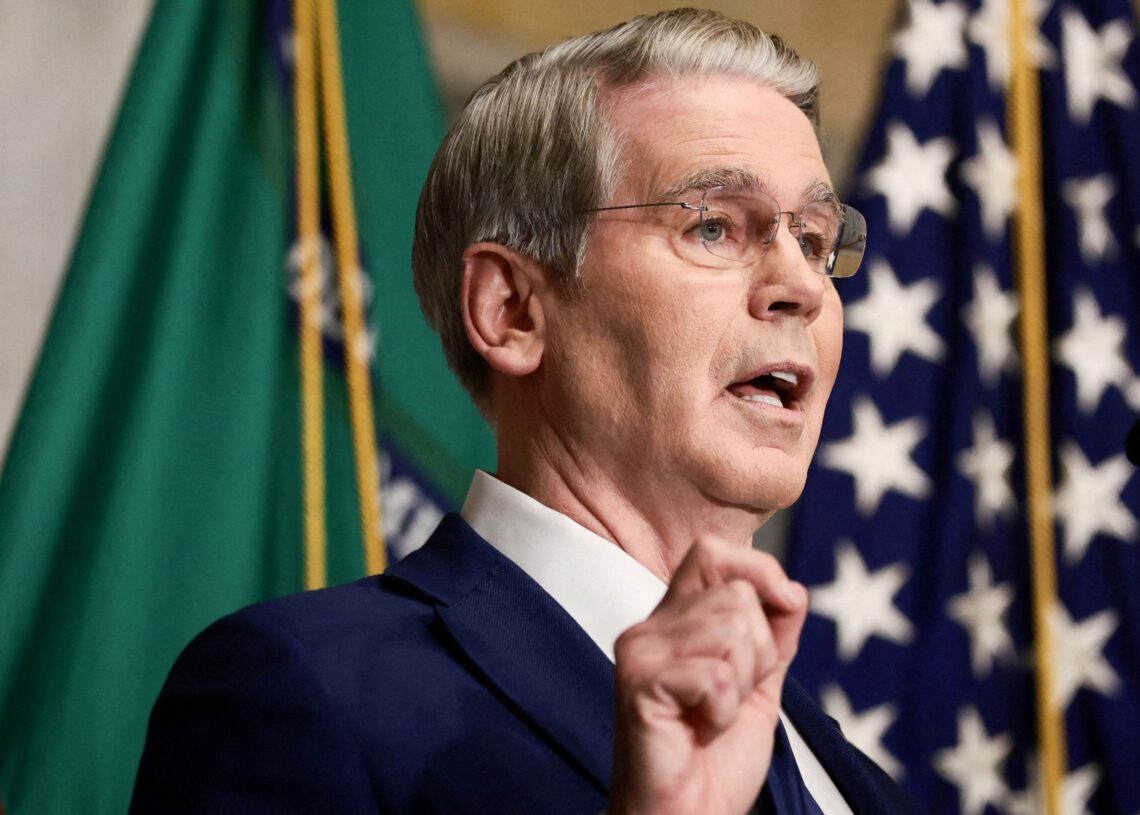
The strikes occurred days after Treasury Secretary Scott Bessent announced a new economic pressure campaign, and amid signs that suffering in Iran is mounting, with increasing lines at gas stations and complaints about rising food prices.
President Masoud Pezeshkian has conceded that U.S. sanctions have increased prices and cut trade. And the nation’s supreme leader, Ayatollah Mojtaba Khamenei, has called on the government to address “economic and livelihood challenges.”
Pezeshkian said Monday that Iran wants the war to end.
“We continue to strive for a path of agreement and understanding, and we believe that continuing the war is neither in our interest nor in the interest of the region,” he said during a meeting with Indian Prime Minister Narendra Modi ahead of a Shanghai Cooperation Organization summit in Kyrgyzstan.
Bessent said that new U.S. measures, called “Operation Economic Outcast,” would bring “unprecedented economic isolation” for Iran.
But after decades of punitive measures on Tehran by the United States and its allies, experts said that it is unlikely the latest sanctions will wring concessions from the regime and that the pressure may have sparked the new attacks.
Ali Vaez, deputy program director for the Middle East and North Africa at the International Crisis Group, said that the Trump administration had miscalculated if it believed that sanctions “were an alternative to military conflict.” Instead, he said, “They ended up being a prelude.”
“Pressure has never worked in forcing Iran to capitulate to U.S. terms and never will,” Vaez said, adding that Iranians do not trust Trump, and the government believes that if it caves to him, “there will be no end to further pressure.”
“Undoubtedly the Iranian economy is in dire straits,” he said. “But the more the sanctions regime sharpens the pain for Iran, the more the regime will try to externalize that pain.”
Iran’s economy was struggling before the war and in the past six months has been battered by heavy U.S.-Israeli bombing of infrastructure and also a naval blockade that, according to Iranian and American officials, has sharply reduced oil exports.
Experts said the short-term impact of the new measures will be felt mainly by Iranian civilians, whom Trump previously pledged to help. But concessions are unlikely, they said.
“The economy in Iran is horrible, but it’s not the Weimar Republic,” Alan Eyre, a former diplomat who served on the U.S. negotiating team that secured the 2015 Iran nuclear deal, said referring to early-1920s Germany, when inflation was so high that paper money became virtually worthless.
“The point at which Iranian leaders say, ‘Ouch, stop it,’ isn’t when they make concessions but when they start attacking stuff,” Eyre added. “They know they have an incentive to attack before the midterms to hurt Trump.”
Iran has survived under some form of sanctions since the establishment of the Islamic republic in 1979.
During the first Trump administration, the country was placed under a “maximum pressure” campaign. Then and now, Eyre said, a major stumbling block has been China, which is Iran’s top trade partner and unwilling to bend to pressure from Washington.
“We have been milking the sanctions cow for decades,” Eyre said, adding that Iranian leaders often benefit financially from sanctions because they control the means to circumvent them.
China aside, the Trump administration may also be overestimating the ease with which it can isolate Iran from its neighbors in the Persian Gulf, U.S. allies that have voiced concern about damage to their own economies.
The UAE said Aug. 19 that it was halting all trade ties with Iran because of Iranian targeting of UAE tankers.
But Alex Vatanka, a senior fellow at the Middle East Institute who focuses on Iran, said that it is hard to imagine countries such as the UAE — which is Iran’s second-largest trading partner after China — “just turning a switch, and turning off decades and decades of economic integration.”
In Dubai on a recent day, fruit and vegetables sellers at one of the biggest markets said that the vast majority of their products — including cucumbers, tomatoes and peppers — still came in containers from Iran.
A rug seller at a Persian carpet store said he was still getting rugs from Iran — now arriving via Turkey instead of coming directly into Dubai’s port. An Iranian spice merchant said that shipments of saffron were still arriving by plane.
While some shipments to and from Iran have stopped amid the war, others have continued, said a Saudi wholesaler who spoke on the condition of anonymity because of the sensitivity of the situation.
“There are almost 90 million people in Iran,” he said. “If they need food, we need to give it to them.”
Among Iranian officials, there has been a range of reactions to the Trump administration’s threat of “economic asphyxiation.”
Pezeshkian, in an interview Friday, said that imports and exports were down as much as 35 percent. “Some say sanctions have no effect at all; to those people, I really don’t know what to say,” Pezeshkian told state TV.
“We are in a war situation,” he added. “And we must accept these wartime conditions.”
Economy Minister Ali Madanizadeh, meanwhile, said that Iran has years of experience circumventing sanctions. “We have our own tools, and we also know the game,” he said in an interview on state television last week.
On Saturday, Iran’s parliamentary speaker and top negotiator, Mohammad Bagher Ghalibaf, hit back at Bessent, calling the U.S. treasury secretary a “liar.”
Bessent had said that the blockade and new sanctions would “crush the failing Iranian economy” and that the U.S. had guided 130 million barrels of oil out of the Strait of Hormuz, while Iran had exported none.
“Liar liar pants on fire,” Ghalibaf wrote, posting on X. “For real 130s, tell your staffer to pull Moody’s showing $130+ billion in war costs.”
Regardless of the rhetorical jousting, Iran’s leaders are publicly acknowledging the hardship, with Iranian government spokesman Fatemeh Mohajerani saying last week that citizens should not expect conditions to improve in the next year.
Pezeshkian urged residents to reduce their energy consumption.
In Iran, people “are losing hope and very destabilized,” said Djavad Salehi-Isfahani, an Iranian professor of economics at Virginia Tech. “The situation feels intractable, and there are 87 million Iranians being held hostage to it.”
Salehi-Isfahani said that despite the Trump administration’s hopes, it seems unlikely that Iranians will turn against their government at this moment. “They are the ones keeping the lights on right now,” he said.
Vatanka also said economic pain is “unlikely” to bring down the regime. Iranians, he said, saw that when they rose up in mass protests beginning late last year, no one came to their aid. Instead, the United States and Israel went to war.
Now, after the killing of many top officials, the surviving regime is even more hard-line, and repercussions of protest probably would be even more intense. “The thought among many,” he said, “is, ‘Why should we risk it at this point?’”
The post Trump vows to hit Iran hard as strikes and economic pressure ramp up appeared first on Washington Post.