Back in the spring, when the World Cup was just a few weeks away from descending on the New York region, there was real concern in the hospitality industry that no one would come. The host committee’s prediction of a multibillion dollar financial windfall seemed a stretch. Vijay Dandapani, the president of the Hotel Association of New York City, was skeptical of the bold predictions.
“It’s not like the U.S. Open,” he said at the time. “That’s an economic machine every year.”
The World Cup, which came to the region for only the second time in its 96-year history (with games played in New Jersey, not New York City), ended up providing a bit more of an economic boost than Mr. Dandapani originally expected. But in a follow-up conversation this month, he said he still sees the U.S. Open as a far more reliable driver of economic activity.
“This is far and away the best sporting event the city has,” Mr. Dandapani said earlier this month. “In fact,” he added, “the country has, in a concentrated period of time.”
So, how much money does the U.S. Open bring to New York City? The figure that has been tossed around most frequently over the last few years is $1.2 billion annually. The number comes from a study commissioned by the United States Tennis Association, which runs the U.S. Open out of the Billie Jean King National Tennis Center in Flushing, Queens and has an interest in demonstrating its financial value to the city, especially since the tournament sits on parkland owned by New York City.
Assuming all the figures are accurate (which is open to interpretation — the $1.2 billion might actually be low) the U.S. Open produces every three years what the World Cup does once in a generation. (The World Cup’s New Jersey and New York host committee recently upgraded its projected impact to $3.5 billion for the entire area).
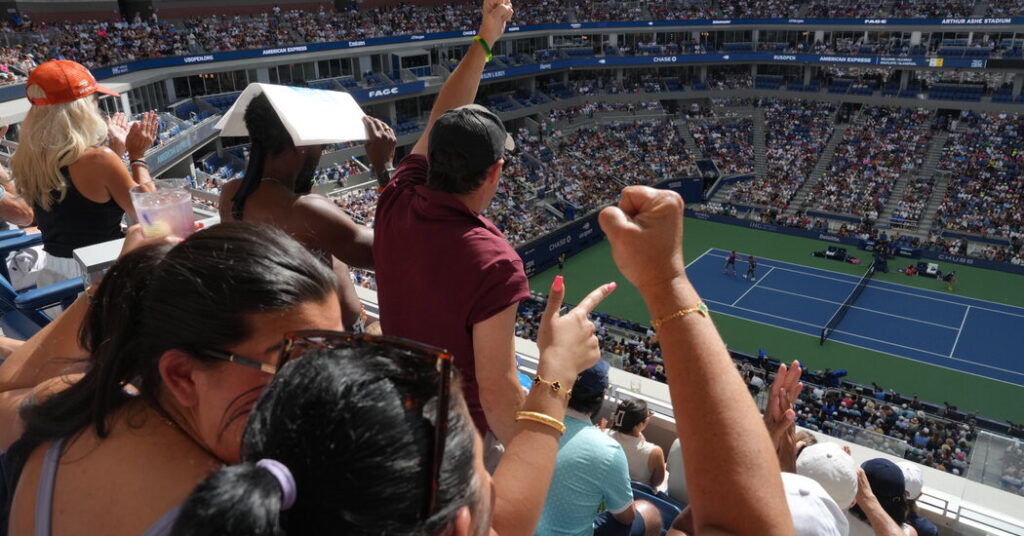
But tennis is every year. With its unique combination of high-end clientele and huge attendance — a record 1.14 million fans went last year — the U.S. Open boasts both the aristocratic spending power of a polo match with the populist volume of an N.F.L. franchise.
In fact, the tournament generates almost double the attendance of the average football team. The U.S. Open had virtually the same number of fans last year (a mere 8,000 fewer) than both the Giants and Jets had combined over 17 football games at MetLife Stadium.
And the U.S. Open gets a lot more out-of-town visitors, who provide the fuel that drives a city’s economic engine the fastest: New money, or cash brought in from out outside the city and spent there. Based on its own customer surveys, the U.S.T.A. estimates that 43 percent of U.S. Open visitors come from outside the New York area, including 8 percent from other countries. Many travel experts agree that international travelers stay longer and spend up to four times more than domestic travelers.
According to John Neill, director of an advisory group for the consulting firm the U.S.T.A. paid to analyze the economic impact of the U.S. Open, the $1.2 billion could even be an undercount.
“On a year over year basis, it’s a major economic driver for New York City,” Mr. Neill said.
For the study, his firm, AKRF, measured things like visitor spending, wages paid to workers and purchases from suppliers to track how money circulates through the economy. A visitor spends money on hotel, restaurants, local transportation, tickets and perhaps a few trinkets. The hotel and restaurant workers, the Uber driver and shop clerks then presumably spend some of that money in New York and the cycle continues.
The analysis was based on 2023 U.S. Open data and with attendance and revenue going up every year, Mr. Neill said it is likely that a new study would show an even higher figure.
Some are skeptical of these kinds of projections. Andrew Zimbalist, a professor emeritus of economics at Smith College and an expert on the economics of sports, has not seen the study. But he cautioned that there are ways to make data fit a narrative.
“It’s quite possible that there is some positive impact,” he said, adding that money spent by New Yorkers at the tournament is money that most likely would have been spent elsewhere in the city — on Broadway, at a Yankees game, at a restaurant — and now won’t be. “In that sense it’s a net negative,” he said.
Restaurants have already had a championship summer, even before the U.S. Open starts in earnest on Sunday. Andrew Rigie is the executive director of the New York City Hospitality Alliance, a trade association representing restaurants, bars and nightclubs. Yes, he said, the U.S. Open helps restaurants, especially the ones on site and many more in Manhattan. But he says the impact is muted in his industry, which reaches into the far corners of all five boroughs, where Open fans mostly don’t go.
For most of Mr. Rigie’s constituency, the World Cup and the championship run of the New York Knicks provided a far bigger economic jolt. Over the course of several weeks, bars and restaurants were packed for World Cup and Knicks watch parties.
His organization conducted a study showing that 87 percent of its businesses reported increased sales during the Knicks’ finals run, and 65 percent said that sales increased “significantly.” The World Cup did well for them, too.
“It’s been an incredible summer for New York City restaurants and bars,” he said. “The U.S. Open is important for hospitality, too. It’s just not on the scale of those other events.”
But those events have a less direct effect on the city’s finances. Unlike Madison Square Garden, which does not pay property taxes, or MetLife Stadium, which is in New Jersey, the U.S. Open pays the city directly. The lease agreement for the tennis center calls for a $400,000 lump sum to the city every year, plus 1 percent of revenues over $20 million. That was roughly $405 million in 2024, according the U.S.T.A.’s public tax filing that year, and the city got about $4.4 million.
Rachel Meltzer, a senior research fellow of urban economics at Harvard University, said Queens residents also deserve a cut of the pie. Especially the residents who endure the crowds, traffic, heightened security and lost park space.
“OK, you made the stadium pretty,” she said, “but maybe you should also improve the local subway station, for example.”
Shanel Thomas-Henry is the City Council member whose district includes the tennis center, and she likes a lot about the U.S. Open, including how it creates 7,000 seasonal jobs, some of which are filled by her constituents.
“It’s a consistent economic boom for the city, and what’s not to love about that?” she said. “They’ve made some investments, but we’d like to see more.”
She stressed that the U.S.T.A. could do more to support small businesses, particularly local restaurants. She would also like to see more in the way of scholarships and internships for young residents, and more free tennis programs, so that, as she put it, the next Venus or Serena Williams might come from her district.
Many of her residents are immigrants and working families of color who see Flushing Meadows Corona Park as their backyard, she said. With that $1.2 billion floating around every year, she would like the U.S.T.A. to do more for the big park they all share.
“It’s public land,” she said. “And it needs a lot of T.L.C.”
The post Is the U.S. Open More Valuable to New York Than the Knicks? appeared first on New York Times.