When a high-rise project became dangerously unstable last month, prompting the shutdown of two Midtown Manhattan blocks, it revealed just how much the city had come to rely on converting old office buildings to deal with its housing shortage.
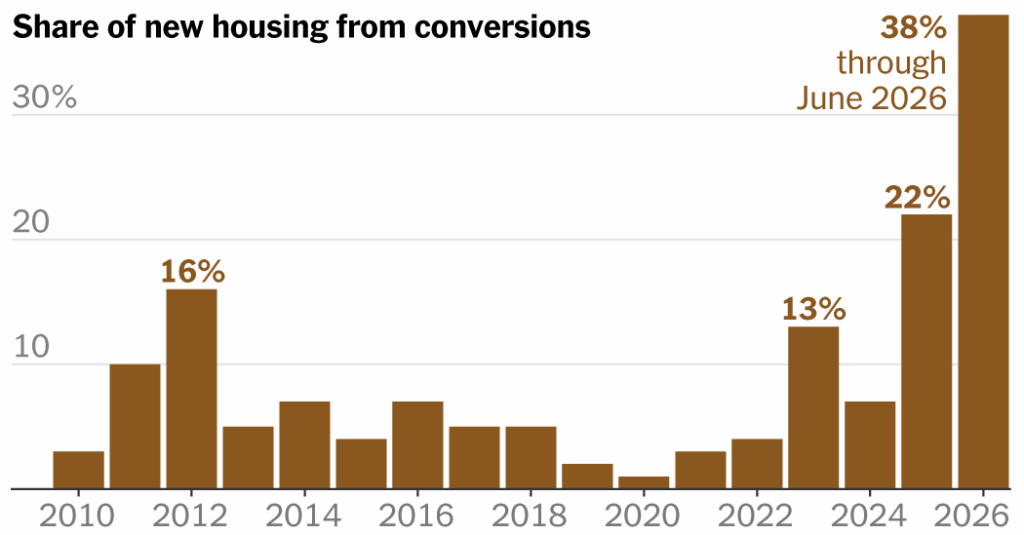
So far this year, the city has issued permits for 74 such projects that will create roughly 10,100 new homes, according to an analysis of city data by The New York Times. That amounts to a third of all of the new housing permitted in the city during that period, showing how quickly New York is embracing residential conversions.
The Times analysis is the first to account for every single conversion and compare them with the total number of housing units in the city.
Developers rushed to start work by the end of June to take full advantage of a tax abatement designed to encourage the creation of more affordable housing. Eligible residential conversions that began construction by then received a 35-year tax break. Another 15 projects were in planning stages at the end of June, qualifying for a smaller tax benefit.
Since 2023, the city has permitted at least 19,700 units to be created through conversion projects, more units than were approved in such projects between 2010 and 2022, according to data collected by The Times. Many of the homes added in recent years are in large-scale projects across Manhattan.
This surge comes as New York City faces the worst housing crunch in decades. Earlier this month, the city estimated it needed some 700,000 homes to be built in the coming decade to help meet demand.
Conversion projects can be relatively quick to complete compared with new construction. But they are also notoriously complicated, involving the reconstruction of entire floors, the demolition of building interiors to create courtyards and more light, and the addition of new stories on top of aging structures.
The buckling on July 7 of two steel columns at the former Pfizer building on East 42nd Street was something of a reckoning for conversions, raising questions about whether they would remain key features of the cityscape.
The city has recently moved to fully or partially shut down work at other conversion projects, and it conducted an enforcement sweep this month of construction projects involving the firms that are converting the former Pfizer building. A Times analysis of violation data for conversions that have started since 2023 shows that those projects are not more prone to violations when compared with construction work for new buildings in the same time frame.
Mayor Zohran Mamdani, who campaigned on an affordability agenda, has said that the conversion projects are safe and must continue in order for the city to make a dent in the housing crisis.
The pace of residential conversions in the city took off after the coronavirus pandemic laid bare the diminished demand for older office space. The projects have been bolstered by a lucrative incentive created by New York State in 2024, which cut property tax bills by 90 percent for conversions in Manhattan south of 96th Street.
City officials have also lauded the ability of conversions to add more affordable housing to pricier parts of Manhattan, the city’s most expensive borough. To receive the tax exemption, developers must agree to make a quarter of the homes affordable. While the exact rent levels may vary, a one-bedroom apartment created under this system could cost an average of about $2,430 a month (less than half the typical rent for a one-bedroom in Manhattan in July, according to the rental platform StreetEasy).
The city does not release data on how much housing is added by conversion projects. The Times used public data from the city’s Department of Buildings to examine all the alteration projects approved since 2010, then determined how many were residential conversions. The analysis was supplemented by data provided by Latent Urban Ventures, a new real estate investment and advisory firm, a list of conversion projects released by the city after the enforcement sweep on Aug. 4, and data from Cushman & Wakefield, a commercial real estate firm.
Nate Bliss, the founder of Latent Urban Ventures and a former City Hall housing official, said that office-to-residential conversions had gone from “kind of a niche idea to being a mainstream significant component of our multifamily pipeline.”
“These projects are delivering significant affordable housing and housing in parts of the city that could really use it,” he said.
Ahmed Tigani, New York City’s buildings commissioner, said in an interview that the city had long dealt with similar projects that added floors to buildings or demolished buildings entirely to make way for new development. But he acknowledged that the Pfizer episode had prompted a moment of reflection.
“We are going to do a deep dive from soup to nuts, top to bottom, of every aspect of this,” he said. “And if there’s something to be learned, to adjust, that can help improve the safety and construct-ability and feasibility of projects in our work, we’re going to look at it and we’re going to dig into it.”
The Pfizer project was at one point going to be among the biggest conversions in New York City. Today, it remains stalled, as city officials investigate what might have gone wrong.
About the data
The conversions included in this analysis were compiled from city data on alteration projects that added at least six dwelling units and began in 2010 or later. The data was supplemented by a list of conversion projects published by the Office of the New York City Comptroller in July 2025; data provided by Latent Urban Ventures, a real estate investment and advisory firm; a list of conversions that were part of an enforcement sweep by the city on Aug. 4; and data from Cushman & Wakefield, a commercial real estate firm.
To determine whether an alteration was a conversion project, The Times inspected building permits, which list existing and proposed uses, and included only alterations in which a nonresidential building was converted into a residential building. The Times also used historical photography to determine if the existing structure was preserved in the conversion. Instances where much or all of the pre-existing structure was demolished were excluded.
The start date of the conversion was determined by the issuance date of the first conversion-related permit, or by the approval date of the conversion-related job application, if permit data was not available. Conversions were classified as “completed” if they were issued a certificate of occupancy that showed that added residential units were cleared for use as of the end of June 2026. A conversion’s end date was derived from when the certificate of occupancy was issued. Conversions were classified as “not started” if the New York City Department of Buildings had not issued or approved a conversion-related permit for them as of the end of June 2026. Conversions were classified as “underway” if conversion-related permit records existed, but the projects did not yet have a certificate of occupancy reflecting an increase in residential units as of the end of June 2026.
Unit and story figures were determined through the city’s Building Information System and NOW Public Portal by reviewing the certificate of occupancy and zoning information associated with the conversion-related job filing. The original construction year of each building was obtained from the Primary Land Use Tax Lot Output database compiled by the Department of City Planning.
The post New York Is Relying on Office Conversions to Address Its Housing Crisis appeared first on New York Times.