Sliman Mansour, who has died at the age of 79, was a giant of Palestinian art, a painter whose work was reproduced in prints and posters, distributed through refugee camps and hung in homes across the region. In works that were by turns personal and political — vividly realistic and unsettlingly surreal — he captured and uplifted Palestinian life and history, creating art that served as a form of preservation as well as resistance.
Many of his paintings featured orange trees and olive groves, evoking Palestinian farmland that was lost during the Nakba, or “catastrophe,” in which hundreds of thousands of Palestinians were displaced during the creation of Israel. Other pieces incorporated watermelons, now a common symbol of Palestinian resistance. Mr. Mansour said that he and other artists began depicting the fruit in the 1980s, after an Israeli official prohibited them from painting in red, green black and white, the colors of the Palestinian flag.
“Anything that is Palestinian, even just being here, breathing and thinking, is a sensitive matter to the Israelis because they built their narrative around denying our existence,” he said in a 2023 interview with Hyperallergic, an online arts publication. “Our work not only as painters but as intellectuals — in culture, in everything — is to express that we are here.”
Across a half-century career as an artist, Mr. Mansour became what the Palestinian Museum in Birzeit, which holds two of his large-scale works, called “a beloved face of Palestine and one of those who taught us to see it.”
“For generations of Palestinians, including those who had never seen Palestine and those kept from it, his work helped form their image of the country, keeping present what had been lost while leaving open what it might yet become,” the museum said in a tribute.
A Notable Life
This article is part of A Notable Life, an obituary feature telling the stories of remarkable people every Saturday. Read more from the series here:
She set aside the fiddle to raise nine children. At 99, she made her Opry debut.
A faith leader and martial artist, he fought for Black gay men with AIDS
Mr. Mansour had grown up in Birzeit, a Palestinian town north of Ramallah, where as a boy he swam in natural pools and ate fruit straight from the tree. Many of his paintings highlighted the region’s beauty and showcased ordinary people, picking olives, gathering fruit, tending to children and working the land.
Others were more overtly political. His best-known work, the 1973 painting “Jamal al-Mahamel,” or the Camel of Hardships, shows a haggard and barefoot older man walking alone through the wilderness. On his back he carries an eye-shaped vessel containing the city of Jerusalem, including the gold-capped Dome of the Rock. A rope is wrapped around the load and runs to the man’s forehead, keeping the city in place on his back.
Created six years after Israel captured East Jerusalem in the 1967 war, the painting was printed “thousands of times” and became “a symbol of resilience,” Palestinian scholar Khaled Farraj wrote in a 2023 essay. One version of the painting was acquired by Moammar Gaddafi. By some accounts, it was destroyed in 1986 during U.S. airstrikes on the Libyan leader’s compound. (Mr. Mansour completed a larger version of the piece in 2005, which sold at auction a decade later for more than $250,000. Proceeds went to art initiatives in the region.)
In addition to his work as a painter, Mr. Mansour taught at Al-Quds University and helped cultivate younger generations of artists. He co-founded the League of Palestinian Artists in 1973, at a time when he and his peers faced military censorship; helped launch the New Visions group, a Palestinian art collective that bridged the traditional and contemporary art worlds; and joined his fellow artists in creating an East Jerusalem art center, al-Wasiti.
“He became an activist for Palestinian painting, encouraging and stimulating young painters in all corners of Palestine and internationally,” Samia Halaby, a Palestinian American artist, said in an email.
Grieving a loved one? Tell us what made them special.
The Post is publishing short reader-submitted obituaries as part of a new series, What We Remember, about everyday but extraordinary people.
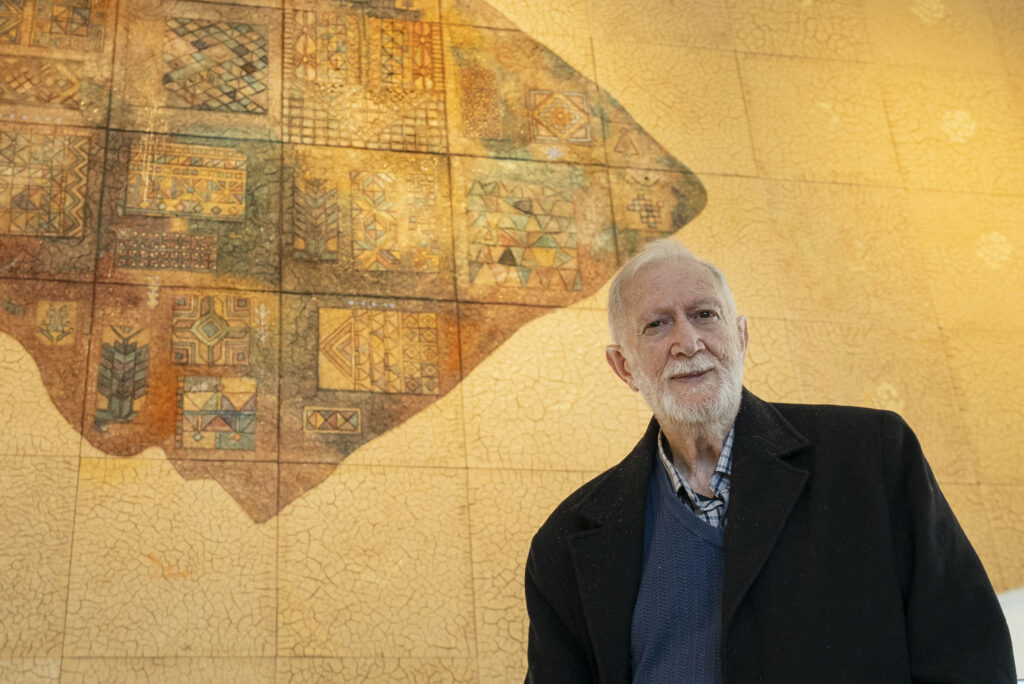
He also reinvented himself, turning from painting to sculpture and mixed-media. During the first intifada, a years-long uprising that began in 1987, Mr. Mansour joined other New Visions artists in boycotting Israeli art supplies and adopting local materials. Inspired in part by memories of his childhood, when he helped his grandmother build beehives out of mud and hay, he began using clay and straw, mixed together like dough. Inevitably, the clay would crack as it dried. Mr. Mansour tried to fill in the seams but soon realized, as he put it, “that these cracks held their own beauty. They became the essence of the artwork.”
Over the coming decades, Mr. Mansour created crack-covered mud and clay works such as “Peace,” a fractured depiction of a dove holding an olive branch, and “Land,” a portrait in which he painted the top half of a woman’s face while rendering the bottom half in mud.
“The Palestinian geography was fragmented,” he explained, discussing his process in an interview for the Palestinian Museum. “And the clay, with all its cracks, mirrored these fragments.”
Art for a fig tree
Mr. Mansour was born July 27, 1947, in Birzeit, in what was then the British Mandate of Palestine. He was not yet 1 years old when Israel declared its independence, setting off the first Arab-Israeli war.
His father, a farmer, died when Mr. Mansour was 4. His mother took up sewing to support the family, and sent Mr. Mansour and his siblings to a boarding school for orphans, where a teacher encouraged his interest in art.
Although he had hoped to study in the United States, his plans were dashed by the onset of the 1967 war, and he enrolled instead at the Bezalel Academy of Arts and Design in Jerusalem. His work grew increasingly political, he said, after he was interrogated and briefly jailed by Israeli security forces.
“They didn’t tell me that I was arrested because I was an artist, but I think they wanted to intimidate me,” he said in the Hyperallergic interview. “They put a bag on my head; I was handcuffed behind my back; I was beaten, the same as what everyone else who is imprisoned goes through. I didn’t pose any threat in terms of security — they just didn’t like what we were doing.”
Mr. Mansour’s death, on Aug. 24 at a hospital in Jerusalem, was confirmed by his son Fares S. Mansour, who said the cause was respiratory failure. Survivors include his wife, Hanan, who served as a model for some of his paintings; his children Fares, Bassel, Sahar and Abeer; two brothers; three sisters; and five grandchildren.
Even after he suffered a stroke in 2021, Mr. Mansour kept busy in his studio in Ramallah. In 2024, he unveiled “On the Wing of an Angel,” a monumental work in clay, straw and henna that he created for the Palestinian Museum, in collaboration with artist Alaziz Atef and volunteers from Birzeit University.
The piece stretches nearly 40 feet — it was the biggest work of his career, he said — and depicted Jerusalem in the abstract, with motifs drawn from traditional Palestinian embroidery.
Mr. Mansour did not want any money for the piece, according to Amer Shomali, the museum’s director. Instead, he had just one request: “Plant a fig tree for me in the museum garden, in my name.”
The post Sliman Mansour has died. His art became a symbol of Palestinian resilience. appeared first on Washington Post.