For the past two weeks we have worked closely with our Washington colleagues to get the most detailed, corroborated account of what happened when weeks of trade talks between Canada and the United States broke down late last Friday night.
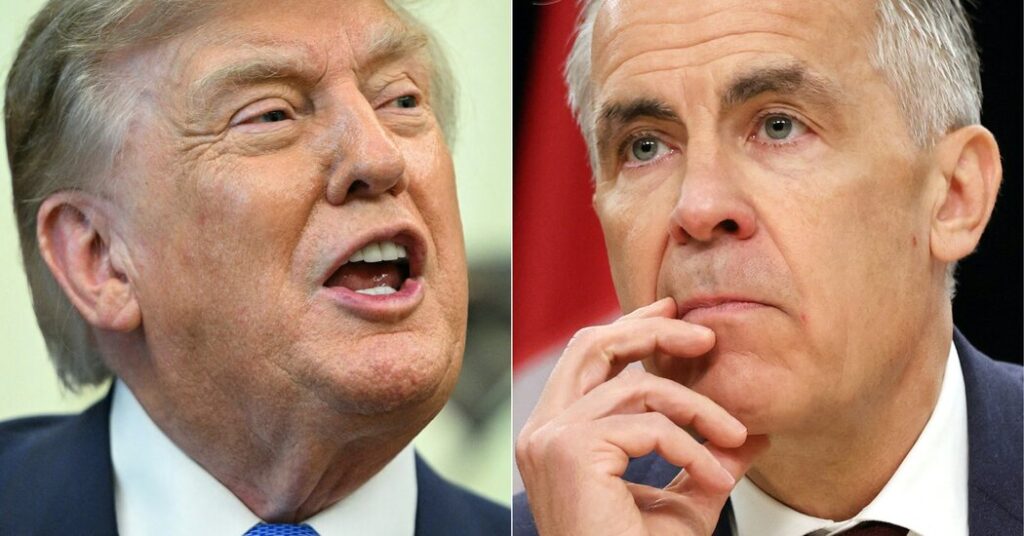
Saturday morning brought a rallying speech from Prime Minister Mark Carney, and the two countries are now locked into a trade war. President Trump restarted his rhetorical attacks on Canada’s sovereignty and signed an executive order renaming Lake Ontario to “Lake America,” a decision derided, mocked and shrugged off by Canadians and others. What comes next?
We worked with The Times’s trade reporter Ana Swanson in Washington, and between us we spoke to two U.S. government officials and three Canadian officials with direct knowledge of the talks, as well as two former U.S. officials and five industry leaders on both sides of the border who were briefed throughout.
We put each side’s claims to the other and found that, fundamentally, there were no major discrepancies between the two narratives, despite the heightened political tensions in the days after.
Our key findings, corroborated by officials on both sides of the negotiating table:
-
Talks were positive up until Tuesday night. Mr. Carney offered to collaborate on the Keystone XL pipeline, which delighted Mr. Trump. By the end of the week that was off the table.
-
Commerce Secretary Howard Lutnick was a factor in destabilizing the talks as he intervened repeatedly, including on Wednesday and Friday, to push for tariffs on steel, autos and auto parts, all of which fall under his purview.
-
The United States insisted on maintaining the freedom to change its tariff policy on Canada without a dispute resolution mechanism or warning built into the new agreement. It also asked for Canada to notify and coordinate with the U.S. on steel tariffs that Canada enforces on other trading partners.
-
Mr. Carney spoke with Premier Doug Ford of Ontario minutes before he pulled the plug on the talks.
-
Much has been made of the French-language issue as a dividing line in the talks. Our reporting shows that the U.S. side did advance a demand for Canada to amend or repeal laws that protect Canadian content by asking streaming platforms to surface it more prominently for Canadian users. The U.S. side said that it wasn’t a red line for them.
-
The U.S. trade representative, Jamieson Greer, told Ana Swanson that, in terms of stable and official concessions, the United States was offering the best deal of any country in the world.
-
Canada’s Conservatives are pressing Mr. Carney to release the text of the agreement he refused to sign. Our reporting shows that the two negotiating teams signed confidentiality agreements (a requirement that is apparently standard in Trump administrations). Additionally our sources told us that the text was constantly changing, meaning that a draft would not necessarily reflect exactly where the latest point of agreement was, even if the confidentiality agreement was to be ignored.
Here’s a gift link to the story, and a link directly below if you already subscribe to The Times.
To help you make sense of a dizzying week in the trade war, we’ve pulled all our coverage into the Canada Letter as a special report.
Canada’s economy and retaliation
Economists this week expect that the new measures won’t shrink Canada’s economy very much. But for individual businesses that depend on exporting to the United States, the 50 percent tariffs may be a disaster. The economy is sheltered because Mr. Trump left some of Canada’s most valuable exports off his hit list, including oil, gas and potash. What’s on the U.S. list? Some odd things.
Canada retaliated with tariffs on about 700 American products. But that quickly underscored how difficult it is to make sure that trade revenge doesn’t backfire. The government was quickly forced to pull dozens of fish and fish products off the list after Canadian fishing groups, whose industry is closely integrated with the United States, warned that the measure would hurt them equally.
Then, on Friday, came data that indicated Mr. Trump had failed to cripple Canada’s economy: About a year and a half after he put tariffs of up to 50 percent on Canadian steel, aluminum and autos, the Canadian economy grew by an equivalent one-year rate of 3.3 percent in the second quarter of this year. Statistics Canada said that was driven by a boost in exports and increased auto production.
Canadians dig into the resistance
The first wave of tariffs against Canada last year provoked a grass-roots effort to support all things local and shun the United States. Since then, Canada has inked new deals, notably on autos and energy, with countries in Asia and Europe that have put it on a stronger economic footing.
Still, business owners in areas targeted by Mr. Trump’s tariffs expect to hurt financially. Some are embracing the show of resistance. Here’s how a trendy Canadian retailer is dealing with the tariffs, and the origins of the “elbows up” movement.
Also, some Canadians want the government to get out of its deal with the U.S. to buy as many as 88 F-35s. And why not? This week, Vice President JD Vance called Canada “a state” during a speech in Maine.
Analysis and opinion
When Mr. Carney ordered his negotiators to walk away, he did something that no other world leader has been able to do: stand up to Mr. Trump despite the risks.
Tuesday’s episode of “The Daily” explored why Canada is done with the U.S. president.
The Times’s chief White House correspondent, Peter Baker, wrote that while the president remains the most dominant figure in the world, other leaders and institutions are pushing back more vigorously than at the beginning of his second term.
Send us your questions
As journalists, we’re always asking questions, especially during a relentless news cycle. We’re inviting you to send us your questions about the trade war, and our reporters will answer a selection in next week’s Canada Letter. Please email us at [email protected] and include your full name and where you live.
We won’t publish your question without following up with you first, verifying your information and hearing back from you. And we won’t share your contact information outside the Times newsroom or use it for any reason other than to get in touch with you.
The conversation
Thousands of Times readers shared reflections on the escalating trade war throughout the week. Here are just a few:
More on the U.S.-Canada trade war
Trans Canada
-
Jane Bradley, The Times’s new investigative reporter in Canada, and Michael Schwirtz, our global intelligence reporter, published an investigation this week showing that Russia is the largest destination for stolen Canadian cars, and how smugglers are meeting the demand of a booming black market.
-
Canadian universities announced the hiring of 64 international researchers, most of them from the United States, as part of a federally funded push to attract the world’s top academic talent, wrote Vjosa Isai, our reporter in Toronto.
-
Artemis Ghasemzadeh, who had escaped religious persecution, was deported to Panama under Trump’s immigration crackdown. Now, Canada has given her asylum.
-
Two rock climbers in British Columbia were rescued by helicopter after one of them was attacked by wasps and stung more than 100 times.
-
The police in Toronto are investigating after two cars were burned at the residence of a Liberal politician.
-
An airport services worker died after an accident at Montréal-Trudeau International Airport.
How are we doing? We’re eager to have your thoughts about this newsletter and events in Canada in general. Please send them to [email protected].
Like this email? Forward it to your friends, and let them know they can sign up here.
The post Elbows and Chin Up: A Whirlwind Week in the U.S.-Canada Trade War appeared first on New York Times.