One of the only compliments I can offer the new Chinese animated film Niu Lai is that it certainly qualifies as a film. There is sound. The pictures move. But beyond the basics of what makes a movie a movie, Niu Lai, which translates to “The Ox Comes,” contains little artistic merit. The plot, about a calf coming of age with the help of a leopard, a bird, and his mother, is thin, and the characters have been so nightmarishly rendered on a rudimentary computer program that they might as well be sleep-paralysis demons.
Yet Niu Lai has become a bona fide box-office hit in China. Since a small distributor unceremoniously dumped it in theaters in early August, the film has become one of the most lucrative movies in Chinese history, making more than $7 million off a reported budget of no more than $500 and outperforming recent blockbusters such as The Odyssey and Spider-Man: Brand New Day. Much of its success is thanks to Chinese social media, where clips of it first went viral: Some users have embraced Niu Lai as a meme, purchasing tickets so they could ridicule the baffling work with an audience. Others have championed the project as anti-AI art, arguing that it deserves to be appreciated as a purely human creation. As flawed as Niu Lai may be, to the fans, it’s at least better than AI slop.
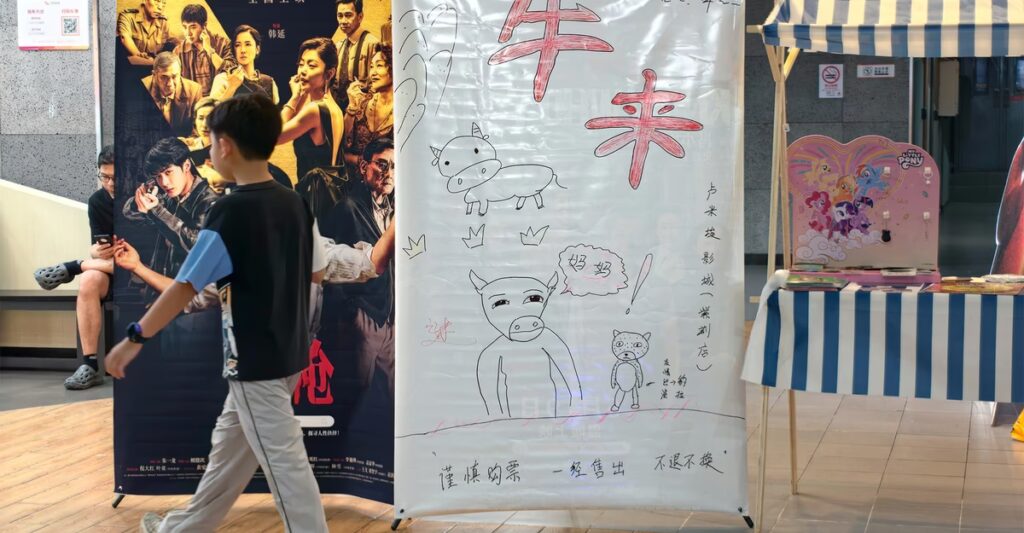
I’m not so sure about that. Watching a bootleg version of Niu Lai felt painful but apt: What better way was there to see a jankily made film than in potato quality on my computer at home? Instead, what’s distinctly human about Niu Lai comes from everything around it: how it was made, how it became a sensation, and how it has inspired further creativity in turn. Theater workers have drawn posters by hand to help advertise the movie. Businesses have made plush toys of the bovine hero. Fans have donned cow masks for screenings, and although the film isn’t available in the United States, underground viewings have popped up in major cities. As such, Niu Lai is the rare passion project that has attracted audiences not because it’s so bad that it’s good, but because it’s an occasion to celebrate the ability to have an original idea at all.
[Read: Why a Chinese animated film has made more money than any Star Wars sequel]
Never mind that the idea was apparently underdeveloped from the start. The first-time director, Xin Yumeng, explained in an interview that he wanted to write about an ox because that’s his father’s zodiac symbol; the year he began working on it also happened to be 2021, the year of the ox. Production took five years, as the then-29-year-old Xin and his mother, Sun Lifang, wrote the screenplay together and made up the entire crew and cast: Sun sang the theme song, and Xin animated the 86-minute film frame by frame on SketchUp, an architectural-modeling program. The process was grueling, Xin said, adding that he kept going in part because he saw the story as a way to inspire viewers to not tang ping, or “lie flat,” referring to a societal trend in 2021 where young people in China rejected overworking by cheekily glorifying the act of lying down.
In some ways, the movie is a deeply Chinese phenomenon: Fuzzy cartoon characters tend to become popular in the country—Zootopia 2 is the highest-grossing Hollywood film ever released there—and the words niu lai could also refer to the coming of a bull market, which has led some Chinese stock investors to purchase tickets for good luck. Plus, Niu Lai’s threadbare plot is rooted in the principle of filial piety, as the titular protagonist learns to respect and care for his mother.
The Niu Lai phenomenon also seems to embody a phrase that’s gained traction lately in China: huo ren gan, which, translated literally, means “alive-human feeling.” The film expresses this quality, but not only because Xi didn’t use AI to help create it. What makes Niu Lai stand out most is its unabashed sincerity. It is an earnest attempt to tell a fable about a naive cow, and the story of its making is deeply charming: Here is a mother-son duo, total outsiders to the entertainment industry, trying their best to turn their quixotic idea into reality. Making a movie anywhere requires overcoming so many hurdles that have nothing to do with art or creativity; there are budgets to be balanced and business expectations to be met. But Niu Lai is a modest reminder that any film simply begins with an idea and an irrepressible urge to see it through.
The post The Real Appeal of the Internet’s Favorite Terrible Movie appeared first on The Atlantic.