Andrew O’Shaughnessy, a history professor at the University of Virginia, is the author of “The Men Who Lost America: British Leadership, the American Revolution, and the Fate of the Empire.” He is a visiting fellow at the Rothermere American Institute and Oxford University.
On Aug. 27-29, 1776, George Washington suffered a defeat that nearly resulted in his capture, along with much of the Continental Army, at what locals insist upon calling the Battle of Brooklyn but is more commonly known as the Battle of Long Island.
It was one of the largest battles of the Revolutionary War and the first fought after the signing of the Declaration of Independence. Washington and his 10,000 inexperienced troops lost the battle and were trapped on an island with 20,000 to 22,000 British and Hessian soldiers. Their miraculous escape owed more to good luck and freak weather than to leadership.
It is understandable that many contemporaries as well as later generations would regard Washington’s eventual triumph as the work of divine providence, a popular theme in the new movie “Young Washington.” As the film reminds us with regard to his command in the French and Indian War, this was not the first time Washington made a terrible military miscalculation, nor the first time he rebounded to defy his enemies. His stoicism and ability to withstand defeat while maintaining his optimism were among his greatest assets.
In England, Lord George Germain, the British secretary of state for the colonies and the chief architect of the war for America, regarded the best strategy for victory to be a “decisive blow” against Washington and the Continental Army. Like Colin Powell with his Powell Doctrine, Germain thought it vital to begin with massive numerical superiority and consequently sent more troops to America and Canada than requested by either Gen. William Howe, British commander in chief in the colonies, or Gen. Guy Carleton, commander in chief in Canada.
It was a major logistical feat, requiring the entire British merchant navy, in conjunction with the Royal Navy, to transport troops 3,000 miles across the Atlantic from England, Ireland and Germany, as well as to move some from Canada and Charleston, South Carolina, to New York. According to one witness account, the Hessians were packed so closely together in what was known as “spoon fashion” that soldiers had to call out in the night for everyone to turn in their beds at the same time.
The combined military dwarfed the population of New York and every other American city except Philadelphia. As the fleet appeared on the horizon, one witness wrote, it looked like a forest of trimmed pine trees. Gen. Henry Knox, the artillery commander of the Continental Army, watched in horror with his wife, Lucy, from their breakfast table, exclaiming, “My God! May I never experience the like feeling again.”
Washington knew he faced an almost hopeless mission in defending New York. As Gen. Charles Lee warned, the city was “so encircle’d with deep navigable water, that whoever commands the Sea must command the Town.” In other words, Britain.
Washington still confronted the challenges that had bedeviled him from the beginning of his command: untrained troops, ammunition shortages, enlistments due to expire in four months, treachery, high desertion rates and a quarter of his small force sick with smallpox. He and his army risked entrapment. Some military historians have questioned the decision to defend the city, but he arguably had little choice in terms of national morale. Indeed, in May he had taken the precaution of consulting Congress, which had ordered the defense.
Washington compounded his difficulties by making some nearly fatal errors. He chose to spread his thin army across both Manhattan and Long Island. Ignoring the advice of Gen. Nathanael Greene and his own aide-de-camp, Joseph Reed, he assumed that the British would make a direct attack on Manhattan Island. He therefore underestimated the number of troops the British would land on Long Island, which was an ideal launching ground for the ultimate attack on New York City.
British Adm. Lord Richard Howe, brother of Gen. Howe, was one of the most talented officers in the Royal Navy and later became a national hero after defeating the French on “the Glorious First of June,” or Third Battle of Ushant, during the French Revolutionary wars. He was a pioneer of amphibious warfare, combining the navy with the army to land troops, and may even have helped design the craft whose bows turn into gangplanks, much like the ones the Allies launched on D-Day.
He and his brother had both opposed the war against the colonies. As a condition of service, William Howe had insisted on the appointment of his elder sibling as admiral to enable the two to achieve a remarkable level of coordination between the army and the navy. For his part, William was a pioneer in the use of light infantry, which anticipated the use of commandos and was ideally suited to the less conventional form of warfare in America. In Philadelphia, John Adams wrote to his wife, Abigail, “The Eyes of the World are upon Washington and How[e], and their Armies.”
On Aug. 22, Washington learned that British troops commanded by Gens. Charles Cornwallis and Henry Clinton had landed on Long Island, where Washington had delegated command to Maj. Gen. John Sullivan. Washington assumed the landing was merely a feint to disguise the objective of the main British army, i.e., attacking New York. He therefore sent a small reinforcement of 1,500 to occupy the high ground at Brooklyn Heights and the Guan (Gowanus) Heights, which had the potential to be another Bunker Hill for the British.
Washington believed the enemy could gain access to Brooklyn Heights only via three well-defended passes through the natural barrier of the Guan hills. But he was caught off guard by his army’s failure to fully reconnoiter the terrain, which included another passage known as the Jamaica Pass. It was guarded by only five militiamen and was known to British Gen. Clinton, who had grown up in the area when his father was governor of New York.
Washington’s expectation of a frontal attack like Bunker Hill initially seemed vindicated as an advance division of 9,000 Hessians and Highlanders appeared along the Gowanus Pass in the late evening of Aug. 26. However, leaving their fires burning and tents standing, Clinton and Cornwallis left in the dead of night, leading 10,000 troops with fixed bayonets to march undetected through the Jamaica Pass. They succeeded in a flanking action, taking the patriots by surprise and attacking their rear on the morning of Aug. 27. The result was a rout in which the British captured three patriot generals and killed between 700 and 1,000 men. Unaware of the Jamaica Pass, Washington watched uncomprehendingly and helplessly from Brooklyn Heights. John Adams wrote in dismay to Abigail, “In general, our Generals were out generalled on Long Island.”
Fortune spared Washington from a more humiliating and potentially more decisive defeat. Believing that there was no means of escape for the Continental Army, Howe unexpectedly made no attempt to pursue the remaining enemy troops and their commanders. He instead began to build trenches for a siege, almost certainly desirous to avoid the heavy losses of the frontal assault at Bunker Hill. He wrote to Germain that his army might well have succeeded if it had proceeded, “but … I would not risk the loss that might have been sustained in the assault and ordered them back.”
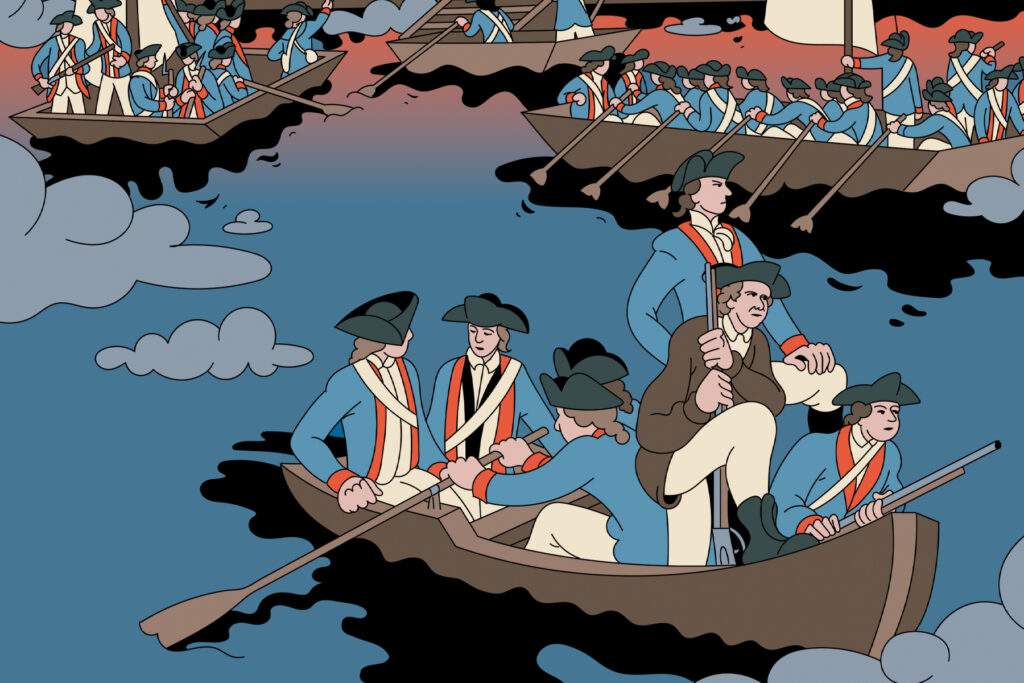
In another stroke of good luck for Washington and his troops, a heavy nor’easter suddenly blew up, preventing the enemy frigates from entrapping them. His movements disguised by a thick nighttime fog, Washington seized the moment and almost miraculously had his entire army of 9,500 whisked off the island by waiting fishermen from Marblehead, Massachusetts, commanded by Col. John Glover. Washington bravely remained on the island to the very end before embarking on the last boat to Manhattan. Everyone had vanished within six hours.
It would be the closest moment to defeat for the American Revolution.
The post The moment the revolution was nearly lost appeared first on Washington Post.