Both national parties will be mostly spectators as the 2028 presidential nominees are selected. It is not too soon to deplore the probable results.
Democratization — not a synonym for rule by meaningful majorities — has made the parties bystanders in candidate selection. Primaries pick the winners. Democratization is a ratchet that clicks only toward more of itself, so the role of primaries will not be reduced. But an improvement can be made: more closed primaries, open only to participation by registered party members.
Today, presidential candidates exemplify individual entrepreneurship, akin to start-up companies. Candidates curate their product (themselves), identify early investors (contributors) and develop marketing plans (platforms) targeting potential customers (voters). National parties are minor factors, principally as fundraisers, after the important decision has been made.
Before welfare state entitlements and civil service reforms arrived, the parties were often woven into the lives of communities, especially urban ones, dispensing jobs, food, help dealing with government, and other inducements to loyalty. As government grew, party machines withered.
Joseph Postell of Hillsdale College, writing for the Civitas Institute of the University of Texas at Austin, writes (“Bring Back the Smoke-Filled Room”) 19th-century presidential nominating conventions featured delegates chosen by local and state parties, with those deep roots in their communities. They were more concerned with candidates’ electability than with mollifying ideologically intense but unrepresentative factions for whom politics often is more about personal catharsis than governance.
In a smoke-filled room in Chicago’s Blackstone Hotel in 1920, Republican leaders picked Sen. Warren G. Harding of Ohio as their party’s presidential nominee. He is not the best argument for an enhanced role for party professionals. Neither is Joe Biden, whose floundering 2020 candidacy for the nomination was salvaged by the party’s establishment. Four years later, a sliver of this establishment, belatedly discovering the obvious, found him unfit, declared his hapless vice president the party’s presidential nominee, and called this fiat an “open primary.”
After more than half a century of actual primaries, the parties’ capacities for shaping events have atrophied. Recent nomination debacles (by Democrats in 2020 and 2024; by Republicans in 2016, 2020 and 2024) probably are harbingers of more such. How did we get here?
When John F. Kennedy won the 1960 Democratic nomination, there were just 16 primaries. More states than that had muscular party machines capable of selecting convention delegates focused on electability. In 1968, during racial and anti-war furies, Vice President Hubert Humphrey won the nomination without entering a primary. Although he came within a whisker of winning, a party commission recoiled, and initiated the proliferation of primaries.
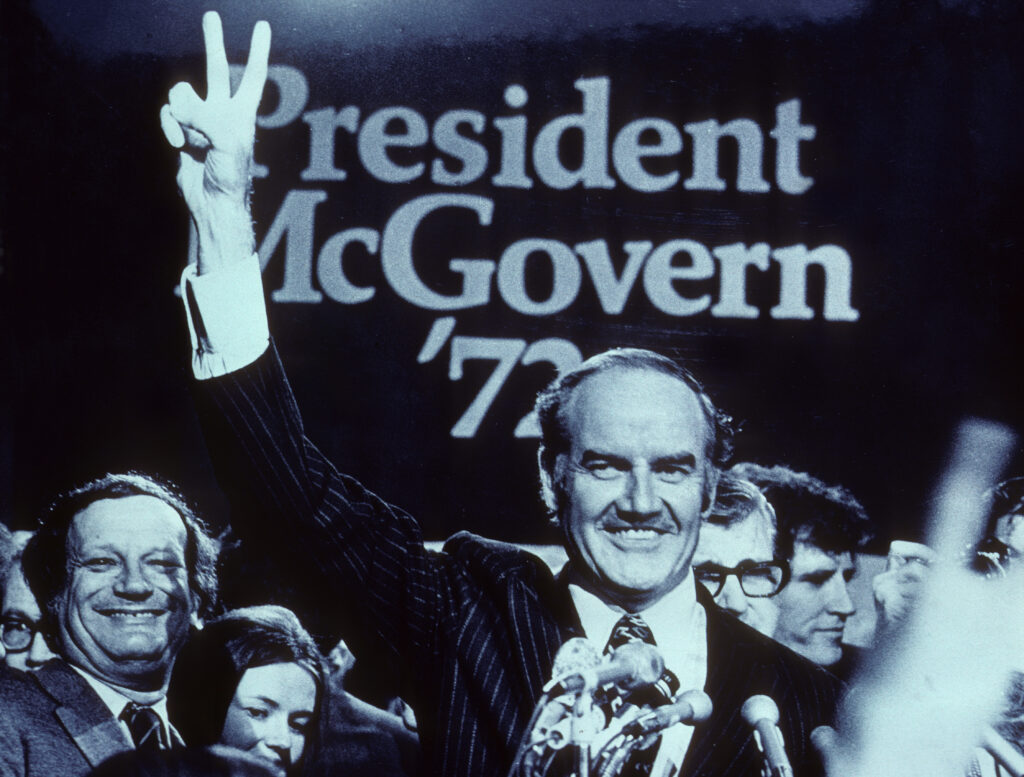
In 1972, this democratization of the process produced the nomination of one of the commission’s co-chairs, Sen. George McGovern of South Dakota. In the general election, this winner in the “democratized” nomination process lost 49 states. Which highlighted the perennial problem of protecting the nation, a majority of whose citizens are only mildly and intermittently interested in electoral politics, from the ideological enthusiasms of political obsessives.
State laws mandating open primaries might be unconstitutional — violations of the freedom of association, properly understood. This freedom, which includes a broad right not to associate, is entailed by the First Amendment right “to petition the Government for a redress of grievances.” This is what people join parties in order to do, and parties that cannot be associations of the like-minded are incoherent.
Also, open primaries are permanent incitements for trickery. Members of one party can pour into the other’s primaries to nominate beatable candidates.
States can argue (California has) that open primaries serve the “compelling” interest of encouraging the selection of “moderate problem-solvers” rather than “party hard-liners.” This proclaims viewpoint discrimination. It is, says constitutional scholar Robert Natelson, illegitimate for a state to impose a mechanism of political choice that is intended to advantage a particular political tendency.
It should be impermissible for states to prevent parties from nominating candidates preferred by people formally affiliated with the parties. In Colorado’s open 2022 primary, Natelson notes, the winning margin in the Republican gubernatorial contest was 48,970, but 246,341 of those who voted (37 percent) were not affiliated with the GOP.
As has been redundantly demonstrated, setting public policies by referendums empowers not “the people” but small, ideologically fervid or financially interested factions. They prevail when turnout is low because the temperate majority’s interest is low.
Democratizing candidate selection has produced a similar dynamic. So, after the 2028 nominating conventions, millions of voters probably will sourly ask: “How, in a nation of 340 million, did our choice come down to these two?”
The post How to make picking a president less likely to produce a debacle appeared first on Washington Post.