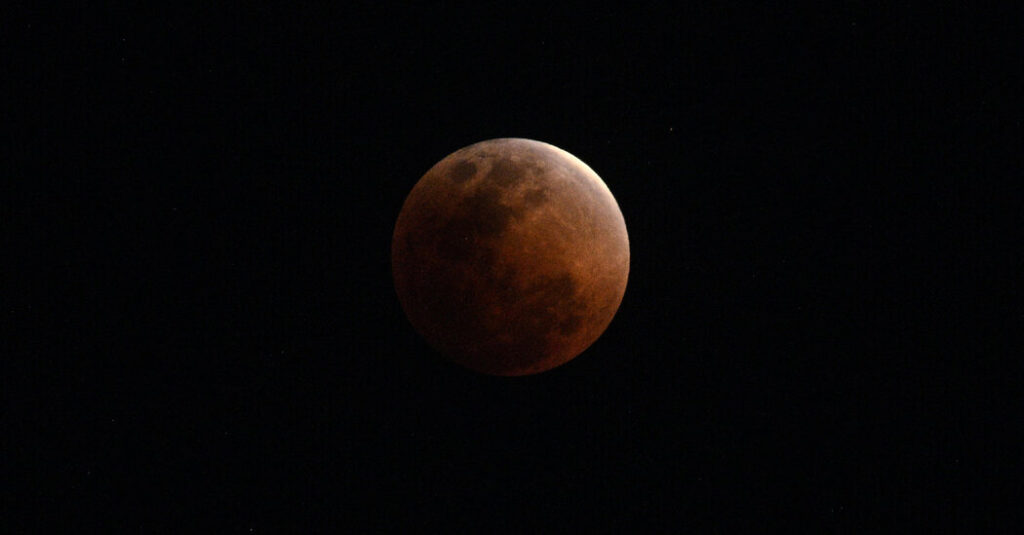
The moon is giving us one last hurrah this month. It will wander into Earth’s shadow and blush red during a lunar eclipse on Thursday night into Friday morning.
Lunar eclipses occur when Earth interjects itself between the sun and the moon. They are distinct from solar eclipses, which happen when the moon slips between Earth and the sun. But the two often occur in pairs, a couple of weeks apart — the amount of time it takes for the moon to travel from one side of our planet to the other.
Lunar eclipses are less striking than solar eclipses. At their most dramatic, the darkest part of Earth’s shadow, the umbra, fully engulfs the moon. This is a total lunar eclipse, which creates the effect of a blood moon because it makes the moon appear red.
Only 96 percent of the moon will pass through Earth’s umbra this time, classifying this event as a partial lunar eclipse. But enough of the lunar disk will be darkened for sky watchers to witness a blood moon. And unlike the solar eclipse that swept across Europe this month, which was visible only to people along a narrow path, the blood moon can be viewable by anyone on the night side of Earth.
It is safe to look at the moon with the unaided eye at any time during a lunar eclipse. NASA recommends finding a dark place, away from city lights, for the best views.
When and where can I see the lunar eclipse?
Lunar eclipses occur in phases. According to the U.S. Naval Observatory, the moon will begin to slide into the outer part of Earth’s shadow, or penumbra, at 9:22 p.m. Eastern time. This will cause the lunar surface to dim slightly.
At 10:34 p.m., the tip of the moon will reach Earth’s umbra. For nearly two hours, a growing chunk of the lunar disk will darken.
The maximum phase of the eclipse, when most of the moon is swallowed by Earth’s umbra, will occur at 12:13 a.m. During this time, 96 percent of the moon will shine scarlet, with a bright silver cap at one edge.
Then these phases will reverse. The moon will whiten as it slowly departs from Earth’s umbra, leaving it entirely at 1:52 a.m., and then it will leave the penumbra. The event will end at 3:04 a.m. Eastern time.
Moon gazers in South America and the eastern half of North America will experience the entire eclipse, as long as clouds don’t shroud the view. Except for a portion of Alaska, the western half of North America will see the moon rise after it has already entered either the penumbra or the umbra, depending on the viewer’s location. In Africa and Europe, the moon will set as it is leaving Earth’s shadow.
Will weather affect my view?
Clear skies are possible across parts of the United States, as it’s summertime when fewer large storms are rolling across the country.
On the West Coast, the best chance to see the spectacle is in the Pacific Northwest. Cloud cover is likely across the Southwest, including in California, as moisture pours into the region off the Pacific Ocean.
The skies are more likely to be clear in the middle of the country, from the Northern and Central Plains into the Midwest.
“For the most part the middle of the country looks to have the best chances,” said Cody Snell, a meteorologist with the Weather Prediction Center.
Scattered thunderstorms, showers and clouds are expected to obscure skies across the Eastern Seaboard, from Florida to Maine, but Mr. Snell said clouds may temporarily break in some locations.
Outside of the United States, some of the best conditions are expected in a broad swath of South America, stretching from Bolivia to Brazil. In Europe, some of the best eclipse-viewing weather will likely be in Spain, Portugal, Italy and Greece, while unobscured skies are expected across much of northern, eastern and southern Africa.
What causes a blood moon?
When all or most of the moon slips into the umbra, Earth blocks the sunlight that usually illuminates the lunar surface.
But some sunlight spills over the edges of our planet and travels through our atmosphere, which more readily scatters blue light. Red light is more likely to pass through the atmosphere without being scattered and light up the face of the moon. A similar scattering effect causes the colors in the sky during sunset and sunrise.
How red the moon appears depends on the makeup of Earth’s atmosphere during a lunar eclipse. Clouds, dust storms and volcanic eruptions can make the moon look redder.
When will the next eclipse be?
Lunar eclipses can happen several times a year, but not all of them go deep enough into Earth’s shadow to cause a blood moon. According to NASA, there will be three penumbral lunar eclipses next year, meaning the moon will dim only slightly as it grazes the outer part of Earth’s shadow. Two partial lunar eclipses will occur in 2028, and a total lunar eclipse will round out that year.
The next two years are also good ones for solar eclipses. A total solar eclipse will pass over North Africa next August, and another will cut across Australia in July 2028. Two “ring of fire” eclipses, in which the moon leaves an outer ring of the sun visible, will occur in February 2027 and January 2028.
Amy Graff contributed reporting.
The post Catch the Moon Blushing Blood Red During a Deep Lunar Eclipse appeared first on New York Times.