For a worst-case glimpse into Los Angeles’ future, look at Egypt’s past.
Alexandria was a cultural and intellectual hub for a millennium until a torrent of earthquakes and tsunamis pulled its coast underwater. Today, much of the iconic city sits at the bottom of the Mediterranean Sea.
L.A.’s semi-arid climate largely mirrors Alexandria’s: ocean abutting desert, heaps of sun and a plethora of natural disasters.
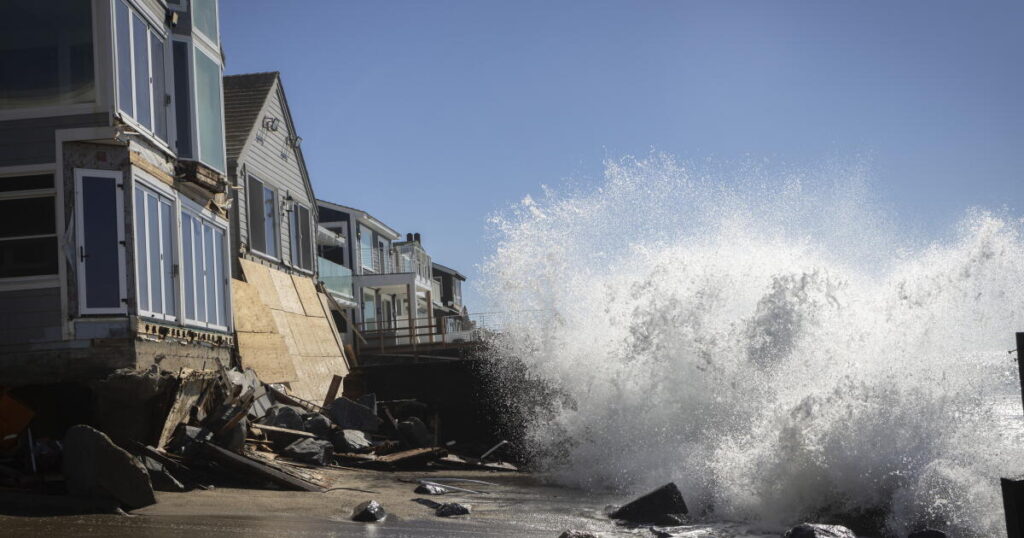
As monster waves flood coastal communities, and with a super El Niño on the horizon — all intensified by climate change — some are asking an existential question: how long will the quintessential California dream of living on the coast even be possible?
There is something striking about the way humans have conquered the landscape. Seaside bluffs are lathered with concrete so mansions can overlook the ocean. Beaches are punctured 80 feet deep with structural anchors so homes can hover above the surf.
Depending on who you ask, such properties are either a testament to human ingenuity or an affront to the natural world — a manifest destiny-esque declaration that Californians will live wherever they want, environments be damned.
But going forward, this unnatural lifestyle along the coast could be much more challenging — and more expensive. It’s happening elsewhere in the U.S. too, like in North Carolina’s Outer Banks, where houses perched on stilts are falling into the ocean.
“Not every scenic place can be a house,” said Essam Heggy, a research scientist at the Viterbi School of Engineering at the University of Southern California. “The coast is beautiful and the cliffs are nice, but these are fragile environments that shouldn’t have been built on in the first place.”
In 2024, Heggy co-authored a report asserting that development is rapidly deteriorating California’s coast, leading to shrinking shorelines and disappearing sand. The erosion will require ongoing beach nourishment projects such as sand dredging and dune formation, at a cost that will increase fivefold by 2050 due to a global increase in sand prices.
That same year, a report from the Public Policy Institute of California found that rising sea levels could destroy billions of dollars worth of buildings and completely erode one- to two-thirds of Southern California’s beaches without costly, large-scale intervention.
Homeowners insurance is skyrocketing as well, including in fire zones along the coast. As concern surrounding this season’s El Niño grows, many are rushing to get flood insurance, which isn’t covered by typical homeowners policies.
“Phones are wild with worried people,” said Aaron Farmer, president of California Flood Insurance. “We used to use Google advertising, but we turned it off because we don’t even need to advertise anymore.”
Many homeowners in high-risk zones are required to buy flood insurance, but the maximum policy is typically $250,000. Now, some are looking for additional coverage, and even people in low-risk zones are looking for quotes.
“I have people saying they need $1 or $2 million in coverage, and they don’t care what it costs,” Farmer said, adding that he estimates 80 to 85% of people living near the coast are under-insured.
But the rising costs of coastal living don’t seem to be deterring demand. It’s too early to gauge the market in places that have recently flooded, such as Huntington Beach and Long Beach, but so far, there’s no discount for homes facing disaster.
After all, Southern California’s coastline includes some of the most prized real estate on earth — and as the saying goes, they’re not making any more of it.
Oceanfront homes routinely fetch $100 million or more, and they appreciate in value at a much higher rate than inland properties. In Malibu, an empty piece of land on the coast that sold for $1.7 million in 2011 is asking $34.5 million. A few miles west, a mansion near the beach that sold for $2.4 million in 2005 is listed at $88 million.
However, experts say the massive waves might be starting to cause ripple effects — albeit small ones — in the market.
Real estate agent Daniel Milstein said that while there’s not an exodus of people leaving coastal properties, there is growing interest in moving slightly inland.
“Perception has shifted with all these natural disasters,” Milstein said. “If you live by the water, you’re going to have a lot of risk. It’s a matter of how comfortable you are taking on that risk.”
Milstein said that living in paradise magnifies the problems of owning a home. A typical homeowner deals with a burst pipe. A coastal homeowner deals with a rogue wave knocking out the first floor.
“It’s becoming a question of, ‘Is it worth it?’” he said.
Jess Lopez, 31, rents a first-floor apartment a few blocks from the ocean in Huntington Beach, and her street saw minor flooding in October. Her unit was fine, but she’s worried about this winter because her renter’s insurance doesn’t cover damage from external flooding.
Her lease is up in the spring, and she’s deciding whether to renew it.
“It’s a good deal and a great neighborhood, but it’s not worth risking losing all my stuff in a flood,” she said, adding that she’s thankful for the flexibility of renting instead of owning. “I’d be even more stressed if I had a mortgage.”
Other coastal residents are taking a calmer approach.
In September, Mitchell Leib was considering movingafter a storm sent boulders smashing into his Malibu beachfront home. But by November, he had a change of heart.
“There was all this doom-and-gloom anxiety with the media coverage and seeing houses down south being swallowed by the ocean,” said Leib, 67, who is retired after serving as president of music for Disney’s live-action film division. “But living on the beach is living in nature, and you have to be prepared for what nature brings. It’s like living in the forest and complaining about bears.”
Leib has lived by the ocean for 16 years, and he’s familiar with the dangers. His previous place — a cozy cottage on Las Tunas Beach — burned down after he sold it. In 2017, he had to replace all the windows in his current home after it was battered by fierce storms.
Further threats are likely coming this winter, but he’s embracing it all with zen-like acceptance.
“Nothing lasts forever, including us. I don’t know what’s around the corner. Could be rising tides, could be cancer. But you can’t live with what ifs. You have to live with what is. And where else would you want to live?” he said, fresh off a breezy bike ride down Pacific Coast Highway.
Leib compared living on the coast to living anywhere else in L.A., a city perpetually threatened by earthquakes and wildfires. His house sits just outside the section of coastal Malibu that was ravaged by the Palisades fire in January 2025.
“It’s a surety that a massive earthquake will strike California. But people aren’t leaving,” he said. “It’s about risk versus reward.”
The long-term threat facing Southern California’s coast also raises a larger question: not just can we live there, but should we?
In his controversial 1998 essay “The Case For Letting Malibu Burn,” Mike Davis, who vividly chronicled L.A.’s past, present and future, suggested that disasters are cyclical and inherent along the coast. Spending millions saving properties that will inevitably be destroyed is a waste of public resources, he argued.
The public-funding-for-private-homes dynamic manifests in multiple ways, whether it’s federal grants for rebuilding or surcharges on inland residents to help insurers recoup costs after last year’s devastating fires.
“We should be making these beautiful places public parks instead of houses, because private citizens don’t have the resources to maintain a fragile environment in the same way the city does,” Heggy said.
The concept of a beach house has changed dramatically over the decades. In the early 20th century, tents, shanties and small shacks sat on California’s sand. Today, they’ve been replaced by sprawling mansions and five-story estates that require significantly more infrastructure.
Heggy said the problem isn’t just the houses but also the landscaping surrounding them. In coastal communities, many wealthy homeowners fill their estates with verdant gardens that aren’t natural to the region: rolling lawns and towering oak trees instead of small shrubs and bushes more fitting for desert terrain.
The concrete and landscaping from these developments lock in the land beneath them, trapping sediment instead of letting it move to the coast and replenish the beach. As a result, California’s natural coast looks increasingly unnatural.
“It’s like ice skating rinks in Dubai, but on a bigger scale,” Heggy said. “People don’t realize L.A. is a desert. They’re blurred by the fake landscape we’ve created.”
He suggests a few fixes, such as retreating inland and improving our lines of defense against floods — sandbags, levees, etc. — as well as taxing developments in disaster-prone areas to raise money for tools that make people safe, such as storm monitoring systems.
Some of the solutions are far-fetched, but Heggy said the consequences of doing nothing could be severe. He pointed to Derna, Libya, which has a Mediterranean climate similar to L.A.’s, where a dam collapse unleashed a flood that killed thousands in 2023. He also compared California’s coast to modern Alexandria, Egypt, where roughly 40 buildings collapse every year due to rising sea levels and erosion.
Disasters need to be treated as regular occurrences instead of one-off events, Heggy said. But he’s not sure whether that’s possible.
“People living on the coast today will leave,” he said. “But others will come. And the cycle will go again.”
That’s already happening on the Long Beach peninsula, where an oceanfront house listed for $4.95 million couldn’t find a buyer. In September, the house was severely damaged after record swells flooded the living spaces.
Now, it’s on the market for $2.9 million: a hefty price cut, but still a big ask for a property that’ll likely be flooded again.
The post California’s coast is eroding, but beachfront homes are still worth millions. Will El Niño change that? appeared first on Los Angeles Times.