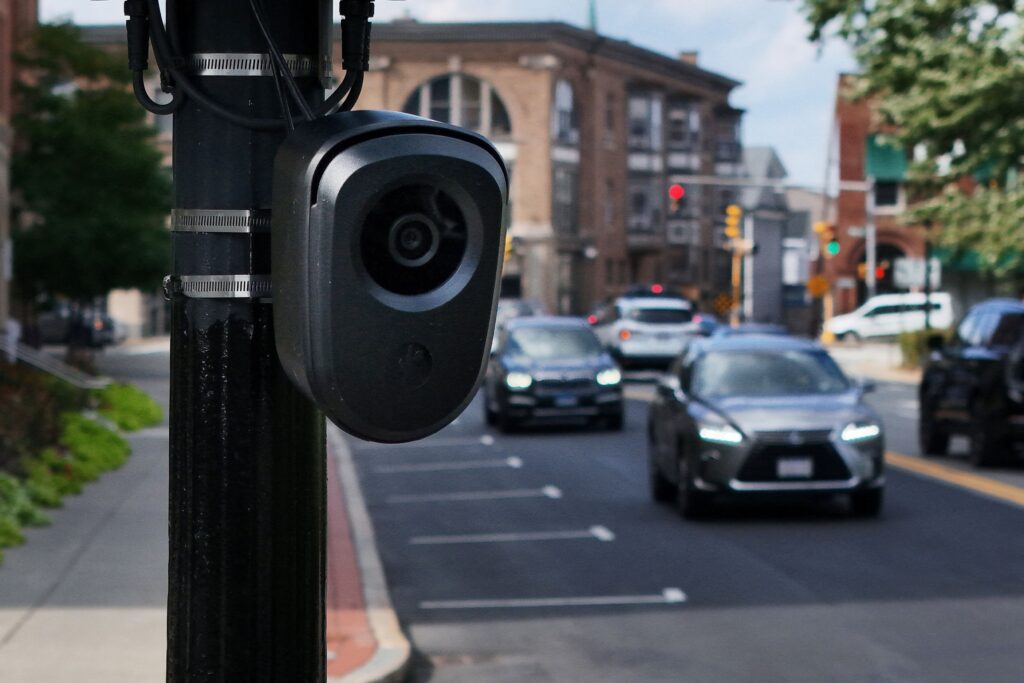
When Justin Cowgur, a city council member in Centerton, Arkansas, was asked two years ago to vote on a contract to install Flock license-plate readers, he found it easy to say yes. The Republican wine seller believed the artificial intelligence-powered cameras — which record passing cars’ plates into a database that officers can search to investigate crime — could help ease the strain on their understaffed police force and keep his bedroom community safe.
But lately, he’s come to regret the deal, saying he no longer trusts the company with the huge amount of data its roadside cameras collect. Earlier this month, after a parade of residents voiced concerns about their privacy and the system’s risk of abuse, he and other members voted unanimously to cancel the contract.
“Being a parent and having two girls, I wanted safety. But the way that the license plate readers have hit a lot of radars is very concerning,” Cowgur, 39, said in an interview. “People want to have privacy in some way, and you don’t want to feel like you’re being watched. … Do we really know where our data is going?”
Cowgur’s change of heart reflects the national mood on one of the fastest-growing surveillance tools in American policing, according to surveys from the polling firm YouGov. More Americans now oppose law enforcement’s use of the technology than support it, a reversal from last year as a growing backlash raises concerns about its potential for invasive monitoring and police misuse.
The cameras have been widely promoted as a crime-fighting breakthrough by private companies such as Flock, which since 2017 has installed more than 120,000 of them nationwide. But in a YouGov survey shared exclusively with The Washington Post, Americans said the systems wouldn’t make them feel any safer and they were reluctant to have the cameras installed near their homes.
Those findings follow a spike in online criticism of Flock by prominent right- and left-wing accounts, which exploded in early summer around the same time that some Republicans derided the technology as part of a “mass surveillance network,” according to a Post analysis of podcast appearances, speeches and social media posts.
Since then, right-wing accounts have posted about Flock cameras more than three times as often as left-wing ones, the analysis found. Sen. Josh Hawley (R-Missouri), chairman of the Senate Judiciary subcommittee on crime and counterterrorism, posted dozens of times about launching a federal investigation into the technology’s use. Rep. Chip Roy (R-Texas) posted last month on X, “Mass Surveillance + Government + AI is a very, very bad combo for freedom.”
The companies and their defenders say the cameras help stop kidnappings, find fugitives and investigate violent attacks. Nearly 40 percent of the nation’s roughly 18,000 law enforcement agencies have contracts with Flock, said the company, which claims that its systems help officers investigate 1 million crimes per year.
The tools have also raised concern because they record the movements of innocent people and can be transformed into personal spy devices. The Post reported this month that at least 69 police officials have been accused, charged with or convicted of misusing license-plate readers for unauthorized purposes, including to stalk their girlfriends or ex-wives.
Though Democrats and Republicans differed on some questions of personal privacy and police power, the YouGov survey found broad bipartisan consensus for the idea that police should need a warrant before accessing license-plate data, with about three-quarters of Democrats and roughly 6 in 10 independents and Republicans agreeing.
Officers do not currently need a warrant to search most license-plate-reader systems, which can include months of location records for cars, even those thousands of miles away. Proponents of the systems say a warrant requirement would hamstring the systems’ effectiveness during emergencies.
A Flock spokesman disputed some of YouGov’s questions, saying the firm had not explained the technology in a neutral way, and said other polls had found broader support for license-plate readers when their investigative benefits were more clearly stated.
“We know from our data and from customers we hear from every day that there is wide support for ALPR technology,” the spokesman said in a statement.
Flock chief executive Garrett Langley has publicly defended its system in interviews, saying the company has implemented safeguards to combat abuse and that the tool is vital to protecting Americans’ security and peace of mind.
“When people talk about just one of these, privacy or safety, they’re prioritizing the wrong thing,” he told Fox News last week. “What we have to prioritize as a country is compromise.”
The Post also shared the survey’s findings with some of the country’s other major sellers of license-plate readers, including Axon, Motorola Solutions and Leonardo. The companies did not immediately respond to requests for comment.
Automated license-plate readers, known as ALPRs, have scanned major roadways from tollbooths and police cruisers for more than two decades. But Flock’s pursuit of small-town contracts and its low-cost subscription model have fueled a recent boom in installations for the shoebox-size cameras and made them increasingly prominent on Americans’ daily commutes.
The systems saw broad support as recently as last year, but protests and recent reporting on misuse cases have coincided with a reversal of public sentiment. A YouGov survey this week of approximately 20,000 U.S. adults found that 46 percent said they oppose the technology being used in their communities, compared with 38 percent support.
When asked the same question last year, 33 percent voiced opposition and 45 percent voiced support. The change was largely driven by a spike in opposition among Democrats and independents, with only a slight uptick in Republicans’ disapproval, the survey said.
In a separate YouGov survey of about 1,000 U.S. adults shared with The Post, Americans were roughly split on their support for the license-plate readers being installed in their communities but narrowly opposed the cameras being installed on the streets where they lived.
Many said they were not sold on the companies’ promises of stopping crime. About 43 percent said the systems would make them feel “neither safer nor less safe,” while 27 percent said they felt safer. Thirty-eight percent said they didn’t believe the cameras reduced nearby crime, compared with 30 percent who did.
Just over half said protecting people’s privacy was more important than giving law enforcement more tools to address crime. And more than 4 in 10 said they were concerned about government surveillance and police misconduct in their communities, ranking them as more serious problems than illegal immigration. About 70 percent said government surveillance had “increased a lot” over the past 25 years, with around half saying the monitoring was “too much.”
Americans broadly disagreed with the industry’s business model, with 4 in 10 saying license-plate reader companies should not be allowed to charge police agencies for data access. Majorities said police should be allowed to use the cameras to track down stolen cars, find missing people or investigate violent crime, but many also said police should be banned from using the systems to track political protesters, non-U.S. citizens with temporary legal status, or pregnant women in abortion-restricted states.
While two-thirds of Americans said they believed officers often or sometimes used the cameras to solve crimes, more than 4 in 10 said they believed the cameras were also used to stalk or harass private citizens, or to build criminal cases against innocent people.
The YouGov surveys were conducted among U.S. adults through the firm’s opt-in online panel, which was weighted to match population demographics, partisanship and the 2024 presidential vote.
The findings could galvanize a growing pushback in Congress across the political divide from senators such as Ron Wyden (D-Oregon), who has said Flock abuse is “not only likely but inevitable,” and representatives such as Andrew Clyde, a Republican from Flock’s corporate home state of Georgia, who said last month on X that “Flock cameras belong in Communist China, not the United States of America.”
Political candidates have also started to make camera misuse a part of their platform. Angie Nixon, a Democrat in the Florida House who is running for U.S. Senate, said in a TV interview this week, “I don’t want to defund the police, I want to defund Flock cameras so that bad cops don’t have the ability to stalk their ex-girlfriends.”
Cowgur, the council member in Centerton, said the neighbors he has talked to in his corner of the Bentonville suburbs have increasingly said they don’t like the idea of information about their drives being recorded and stored in an online database. He added that he did not believe the cameras had helped solve a significant number of local crimes. The Centerton police did not respond to requests for comment.
When the city adopted the cameras, leaders thought “this was a way to really protect and serve the city,” he said. “Do you want somebody looking in your backyard 24 hours a day, or do you want to have a little bit of a wall of privacy, you know?”
Scott Clement contributed to this report.
The post Americans have turned against police cameras that track license plates, new survey shows appeared first on Washington Post.