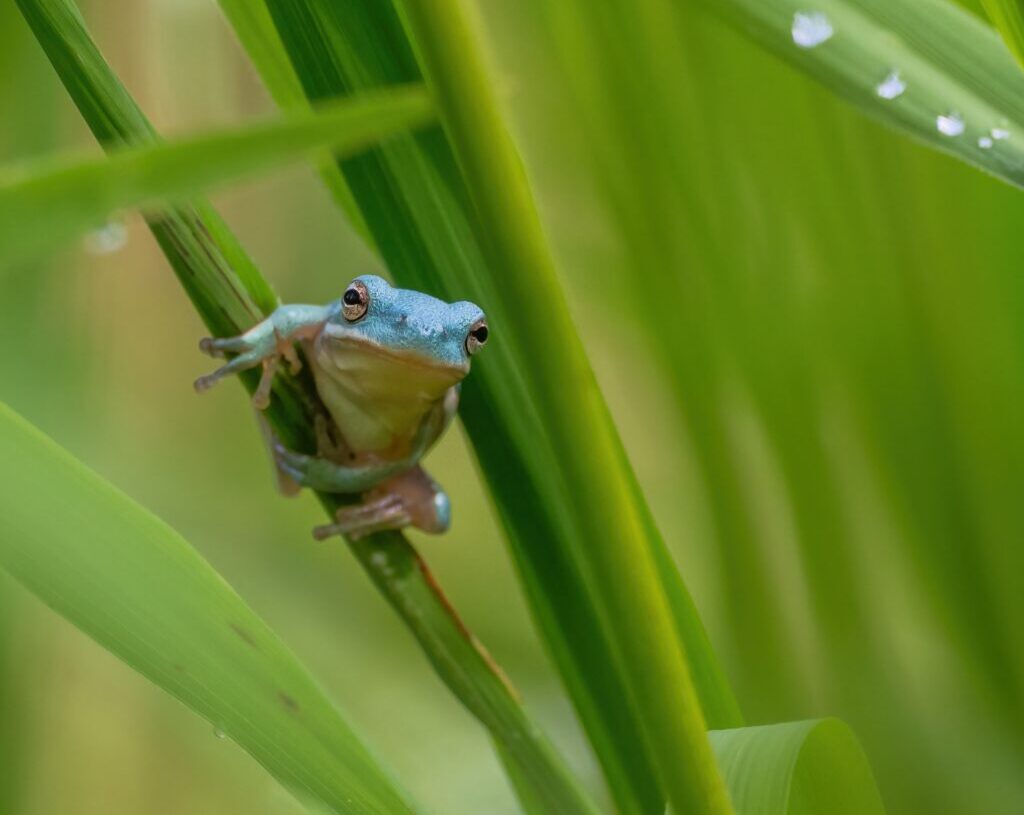
Just after sunrise on a recent hot morning, Mar Acevedo waited on a trail overlooking the grassy marshes of Huntley Meadows Park in Alexandria.
The retired public high school teacher had first seen the green tree frog with rare blue coloration about a week earlier. He had found it in a roughly five-foot patch of the sprawling park near Telegraph Road and wanted to see it again.
So he waited and waited.
More than four hours later, he got his wish.
“There it is,” he whispered to himself as he quickly snapped photos of the blue tree frog perched on a thick blade of grass.
Green tree frogs are commonly found in marshy areas across the Mid-Atlantic, as well as the Central and Southeastern United States. But seeing one that is blue is rare, experts said, and finding one that appears entirely blue is rarer still.
Over the past few weeks, the tiny creature has drawn dozens of naturalists, wildlife enthusiasts and hobby photographers to Huntley Meadows, where visitors have tried to catch a glimpse of a frog that has become a local attraction and generated a flurry of social media attention.
“They know it’s strange. They know it’s something special,” said Acevedo, who lives in Springfield, Virginia, of the chatter around the blue tree frog. “It’s not an everyday thing. It’s like a one in a million chance to see a frog that has this rare coloring.”
The blue frog is an American green tree frog, known scientifically as Dryophytes cinereus. The species typically ranges in color from dark olive green and brown to chartreuse, and like other amphibians, the frogs can alter the brightness or darkness of their skin in response to environmental conditions.
But some green tree frogs have a condition known as axanthism, in which yellow pigmentation is reduced or absent, causing them to appear blue.
Axanthism has not been widely documented in wild populations of green tree frogs, and scientists do not know exactly what causes it. Diet, environmental conditions or genetic mutations could play a role, experts said.
Seeing an all-blue green tree frog is a bit like spotting an albino squirrel, said Rayna Bell, curator of herpetology at the California Academy of Sciences in San Francisco.
“We don’t know much about green tree frogs being blue because so few have been seen and studied,” Bell said.
There may be some disadvantages to being blue. Blue individuals might be more conspicuous to predators because they do not camouflage themselves as effectively as green frogs of the species. Their coloring might also make them less attractive to other green tree frogs.
Scientists have had relatively few opportunities to study blue tree frogs because they are so rare. In the past century, Bell said, there have only been slightly more than 100 documented instances of axanthism in a handful of green frog species around the world.
But a chance encounter in Northern Virginia helped Bell find another way to study them.
About seven years ago, Barbara Saffir, a wildlife photographer and naturalist who lives in Montgomery County, Maryland, contacted Bell about a tree frog with blue coloring that she had spotted at Neabsco Regional Park in Woodbridge. At the time, Bell was a curator of amphibians and reptiles at the Smithsonian’s National Museum of Natural History.
Bell went on to launch a global study of unusual blue coloration in frogs, turning to iNaturalist, a community science platform where people can upload and track observations of wildlife and plants. The approach gave researchers access to something traditional scientific studies had not: thousands of people wandering their parks, forests and wetlands with cameras.
Last year, Bell and other researchers published a study identifying more than 300 records of blue coloration across 36 frog species. This summer, Bell said, the iNaturalist project on axanthic blue-colored frog species has now reached over 700 observations.
“We were able to find way more information from people just out in nature taking photos for fun than over a century of scientists trying to document this rare, natural phenomenon of these frogs,” Bell said.
The observations also revealed an intriguing geographic pattern. The D.C. region, particularly areas east of Interstate 95, appears to be a “hot spot,” Bell said, for blue individuals of the green tree frog species.
Why? Bell said, “We have no idea.”
“It could be a genetic thing where those individuals are surviving to the point where they can reproduce and pass it on to their offspring,” she said. “Or it could be something about their diet, or something about the ponds themselves that is making them blue.”
That mystery has helped turn the blue frog at Huntley Meadows into a local celebrity.
Green tree frogs in the D.C. region can generally be seen from late April through the end of October, locals said. They are nocturnal, hunting insects at night and resting during the day. When they’re green, Saffir said, they are the “queens and kings of camouflage,” small enough to disappear into grassy wetlands.
On a Facebook page for Huntley Meadows, Elaine Parker Starr recently shared a photo of the all-blue frog after spotting it on her way out of the park. Dozens of people commented: Wow. Awesome. Spectacular. Outstanding. One person wrote, “That is crazy amazing!”
Another saw something more romantic in the little blue frog: “Divine. Is he a prince in disguise? I’d be willing to kiss him to find out.”
For Acevedo, Saffir and frog watchers, the challenge of finding the tiny and unusual blue frog is part of the adventure.
“People think about finding a rarity in an exotic location,” Saffir said. “Everybody comes back from a place like the Amazon and says, ‘Oh, you should have seen the tree frogs there.’ I laugh and say, ‘You do realize we have similar tree frogs right here in our own backyard.’”
As Acevedo searched the marsh from the trail one recent morning, camera and long lens in hand, he spotted otters, beavers, herons, sandpipers and osprey. Then just after 10:15 a.m., he saw what he had come for: the all-blue frog creeping from beneath the grass to bask in the sun.
“It’s just a beautiful creature,” he said. “I like finding something that’s not easily found. You don’t expect to see something that looks so tropical here in suburban Alexandria, but here it is. It just brings you joy.”
The post A rare blue tree frog is drawing loads of spectators to a Virginia park appeared first on Washington Post.