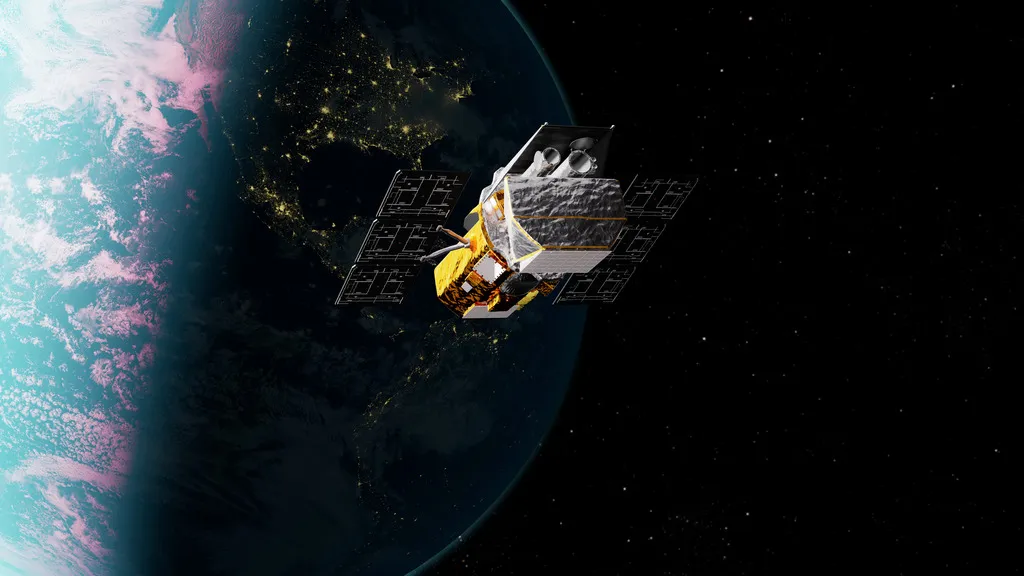
The Swift space observatory has been in operation since 2004. It specializes in gamma-ray bursts (GRBs), the most energetic electromagnetic explosions known in the universe. Its original mission was supposed to last just two years. More than two decades later, it continues to explore some of the most violent phenomena in the cosmos. Now it is nearing the end of its life.
Swift doesn’t have a propulsion system capable of significantly raising its orbit. Although it is hundreds of kilometers above the Earth’s surface, there are still atmospheric particles at that altitude that exert a small but constant drag on the satellite. With each orbit around Earth, it loses a tiny amount of energy and, little by little, altitude as well. If this process continues without intervention it will eventually reenter the atmosphere.
NASA knew that Swift had limited time left. Some models had indicated that the observatory could remain in orbit until the 2030s, but increased solar activity during 2024 changed those projections. Energy from the sun heated and expanded the upper layers of Earth’s atmosphere, increasing the drag on the satellite and accelerating its descent. Estimates eventually placed its likely reentry before the end of 2026.
Faced with the rapid deterioration of Swift’s orbit, NASA decided to attempt a rescue maneuver straight out of a movie. The plan was simple in concept but astonishingly complex to execute. A robotic mission would catch up to Swift, capture it with mechanical arms, and use its own thrusters to raise the observatory to a safer orbit, where it could continue operating. To do this, NASA turned to the company Katalyst Space Technologies and its LINK spacecraft.
LINK was launched into space on July 3, 2026. However, problems arose soon after. The spacecraft suffered failures in its attitude control system, which is responsible for keeping it properly oriented and stable in space. For weeks, engineers worked to regain control.
On Wednesday, NASA canceled the rescue mission. In a statement, agency administrator Jared Isaacman explained that the decision was due to problems with the spacecraft’s control system. LINK will no longer capture Swift or raise its orbit. The spacecraft will continue to approach the observatory to conduct demonstrations of rendezvous, navigation, and close-proximity operations. The agency hopes to use this attempt to gather information that can be applied to future missions aimed at repairing, relocating, or extending the lifespan of satellites in orbit.
“This is not the outcome we were working toward, but it does not change why this mission was worth attempting. The team moved with extraordinary speed to give Swift a chance to carry out more science while advancing capabilities America will need for satellite servicing in the future. We are going to learn everything we can from LINK’s rendezvous attempt and put those lessons to work on the missions that follow,” Isaacman said in a press release.
The agency had warned from the outset that this was a high-risk mission. Swift was not built to be captured or repaired in orbit, while LINK was developed and launched against the clock in response to the observatory’s rapid descent.
“NASA should be willing to move quickly and take smart risks when the potential return is worth it, and that is exactly what we did with this mission,” Isaacman noted.
Without an intervention to raise its orbit, Swift will continue to lose altitude until it reaches the denser layers of the atmosphere. During reentry, much of the observatory will be destroyed by intense heating and aerodynamic forces. It is still too early to determine exactly when and where this will occur.
For now, NASA estimates that Swift will likely reenter the atmosphere before the end of the year.
This story originally appeared on WIRED en Español and has been translated from Spanish.
The post NASA Cancels Its Rescue Mission for the Aging Swift Telescope appeared first on Wired.