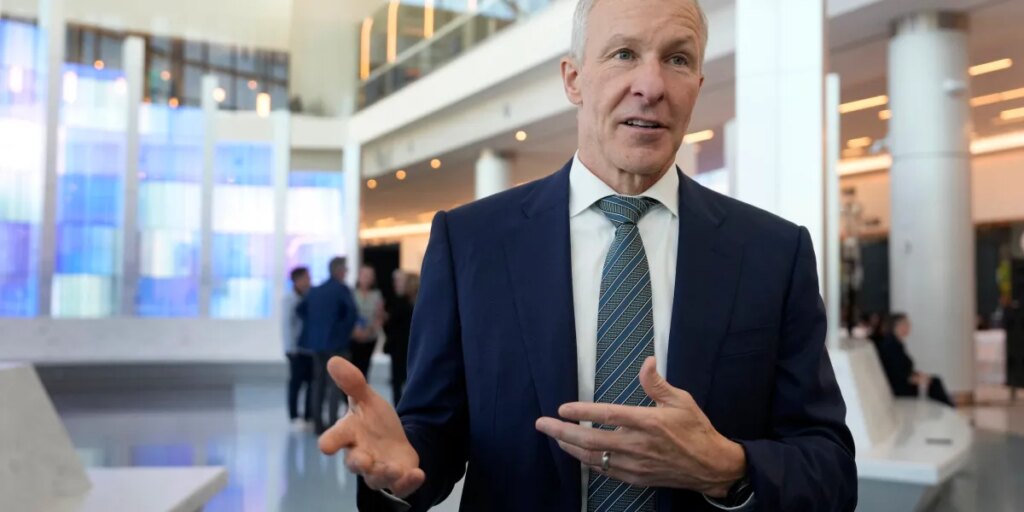
United Airlines CEO Scott Kirby took home about $32.3 million in total compensation last year, according to Fortune’s reporting on United’s proxy statement. He says people like him should be paying more, starting with a tax on the wealth they already hold.
In a wide-ranging interview with The New York Times in mid-October, Kirby said wealth inequality “has become a danger to our society” and called for a national wealth tax, plus inheritance taxes that “get close to 100% at some level.” “I would pay them,” he added.
The remarks drew swift pushback, much of it aimed at his paycheck. Fox Business asked United how Kirby squared his pay with his warnings about inequality; the company didn’t respond.
Kirby doubled down a few days later on CNBC’s Squawk Box, framing the idea as a matter of fairness.
“I think a wealth tax… is just about fairness…. If you’re wealthy enough, you can put money aside, and by the way, I think it would apply to me, put money aside, let it grow forever, never realize income on it, you can let it grow forever and it never gets taxed,” he said.
That is the gap Kirby wants to close. The federal system taxes income: in 2025, the top rate of 37% applied to single filers’ taxable income above $626,350, according to the IRS. Investments that rise in value but are never sold aren’t taxed.
Kirby’s view stands out because of who holds it. He runs a company on the 2026 Fortune 500 that brought in $59.1 billion in revenue last year.
He stressed that these were personal views and that he has no interest in politics or policymaking. If it were up to him, he said, he would prefer a system “where we had lower income taxes, and higher taxes, or some kind of taxes, on the gain in wealth.”
The case against taxing wealth
In practice, the idea draws pointed objections. Mariana Trujillo, managing director of government finance at the Reason Foundation, a libertarian-leaning think tank, tells Fortune it would undercut the very growth it’s meant to share.
“Taxing accumulated wealth discourages investment and entrepreneurship — the very forces that have made our lives better than those of our grandparents and great-grandparents. Economic progress, not the state, has driven improvements in our material condition. A wealth tax discourages the very thing it aims to promote,” she says.
Trujillo draws a sharp line between the two ideas Kirby floated. An inheritance tax hits wealth once, when it changes hands. An annual wealth tax hits it every year, and she argues that gives the wealthiest Americans, and their capital, a reason to leave.
“An annual wealth tax is entirely different from an inheritance tax…. People move out of states and countries for tax reasons. National wealth taxes failed in Europe, where countries including France, Sweden, and Germany abandoned them amid concerns about capital flight, administrative costs, and disappointing revenues.”
A few European countries have held on: Norway, Spain, and Switzerland still levy net wealth taxes, according to the Tax Foundation.
Trujillo also had a message for Kirby himself. “If Kirby believes his wealth could be better used to improve others’ lives, he is free to put it toward that purpose,” she said. “But I hope he recognizes that his compensation reflects the perceived value of his contributions to his company and, therefore, to society at large. Wealth does not need to be redistributed to be productive; it is already the result of creating value for others.”
California voters reject a billionaire tax
Kirby has argued that a state-by-state approach is doomed. “We should have a national wealth tax—it won’t work by state because people will just move,” he told the Times, as Fortune reported.
California just tested a state version. In the Nov. 3 election, voters rejected Proposition 40, the so-called billionaire tax, which would have imposed a one-time 5% tax on the net worth of state residents worth more than $1 billion. The Associated Press called the race on Nov. 9, with 52.8% of voters opposed, according to CalMatters.
The measure had high-profile backers, including six Nobel Prize–winning economists who argued it could kick-start similar efforts elsewhere. But opponents spent about $378 million against it, while the yes campaign raised $33.5 million, and Silicon Valley voters broke against it even as Los Angeles and San Francisco voted yes.
Trujillo sees the result as a verdict on the idea itself. “California’s wealth tax proposal failed at the ballot box for good reasons: first, because voters recognized it may reduce government revenue as people leave, and second, because they saw it as discouraging investment and innovation, which make our lives better.”
Kirby says the emails he received about his comments split about evenly for and against. If California is any guide, the rest of the country isn’t far off.
The post ‘It’s just about fairness’: United’s CEO doubles down on a wealth tax despite his $32 million pay appeared first on Fortune.