The mayor of a Boston suburb spent nearly $1 million on a plan to place two statues depicting Catholic saints in front a new public building in his city.
That vision won’t be realized after Massachusetts’ highest court ruled on Thursday that the installation would violate the State Constitution by promoting a religion.
The Massachusetts Supreme Judicial Court unanimously agreed, 7-0, with a lower-court ruling that had prohibited officials in Quincy, just south of Boston, from displaying the statues outside a police and fire complex.
The court also denied the city’s motion to dismiss the lawsuit filed by a group of local taxpayers from different religions, who sought to permanently stop the installation and the spending of more public money on the statues.
The plan by the mayor, Thomas Koch, who is Catholic, had raised the concern of many figures of other religions, representing Lutherans, Jews and Methodists, as well as Catholics. And it caused an uproar in Quincy, a city of 100,000 once dominated by working-class Italian and Irish immigrants but that is now nearly half nonwhite.
The statues, the court said in its opinion, “have a greater potential to be perceived as government endorsement of a particular religion, and subordination of other religions.”
The justices also pointed out that the artworks “are not part of a larger collection of statues and monuments that includes nonreligious ones, or statues of figures of particular importance to other religions.”
Quincy officials could not immediately be reached for comment. When reached by phone, Mr. Koch declined to comment.
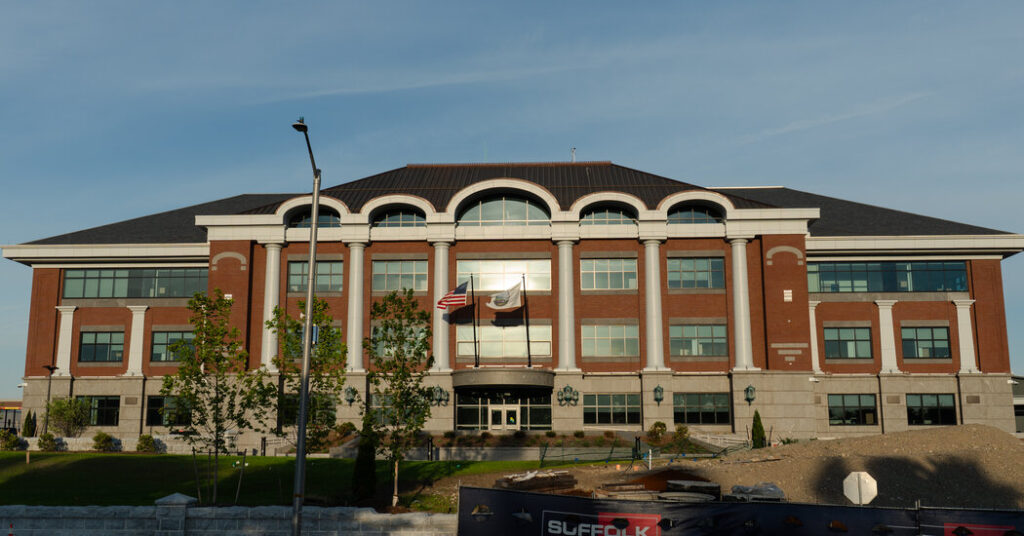
Mr. Koch commissioned an artist in Italy in 2023 to make the towering bronze statues of St. Michael the Archangel and St. Florian, the patron saints of emergency responders, as the finishing touch for the city’s new public safety complex, which opened in March.
The four-story building cost the city $175 million, with the figures of the saints coming in at about $850,000. Mr. Koch had not sought approval from voters before commissioning the art pieces, which had been stored in a warehouse while the Supreme Judicial Court was hearing the case.
After a local newspaper, The Patriot Ledger, published the mayor’s plans for the statues in an article last year, 200 residents showed up at a City Council meeting to voice their displeasure. More than 1,500 people signed an online petition opposing the statues’ installation. A group of 19 local religious leaders also issued a statement of concern.
The outcry, which soon led to a lawsuit against the city, filed by a group of residents and backed by the American Civil Liberties Union, reflected growing frustration with Mr. Koch, who has been mayor since 2008.
It also illustrated how much the city had changed since the 1980s. In recent years, Quincy has welcomed waves of Asian immigrants. Roughly 40 percent of students in its public schools are Asian, and the student body speaks more than 60 languages.
“I’m thrilled with this ruling, and I’m relieved that these statues will not be installed while we pursue our case against the city,” said Claire Fitzmaurice, a Quincy resident who was a plaintiff in the case, said in a statement with the A.C.L.U.
She added, “I believe that Quincy should be a place where we welcome people from all faiths and backgrounds. To have these imposing religious statues looming over the entrance of the public safety building would fly in the face of that pluralistic ideal — especially as our city continues to grow more diverse.”
Lawyers representing the city in the case argued that St. Michael and St. Florian, the figures depicted in the statutes, were important symbolic figures for police officers and firefighters.
They also argued that the saints have both religious and secular significance — St. Michael, they said, is a significant figure in other faiths — and that the saints represent virtue and bravery to police officers and firefighters.
The lawyers also cited several examples of the saints being used as symbols for emergency workers, adding that it was not uncommon for police officers who have tattoos related to their work to include a depiction of St. Michael. Several municipalities across Massachusetts, including Quincy, also use the Florian Cross, in honor of St. Florian, on fire department badges and other iconography.
Still, the judges found that members of the public would have to “confront” the statutes “regularly, experiencing feelings of subordination given their own religious beliefs or nonbeliefs.”
The post Massachusetts’ Top Court Bars Statues of Catholic Saints at City Building appeared first on New York Times.