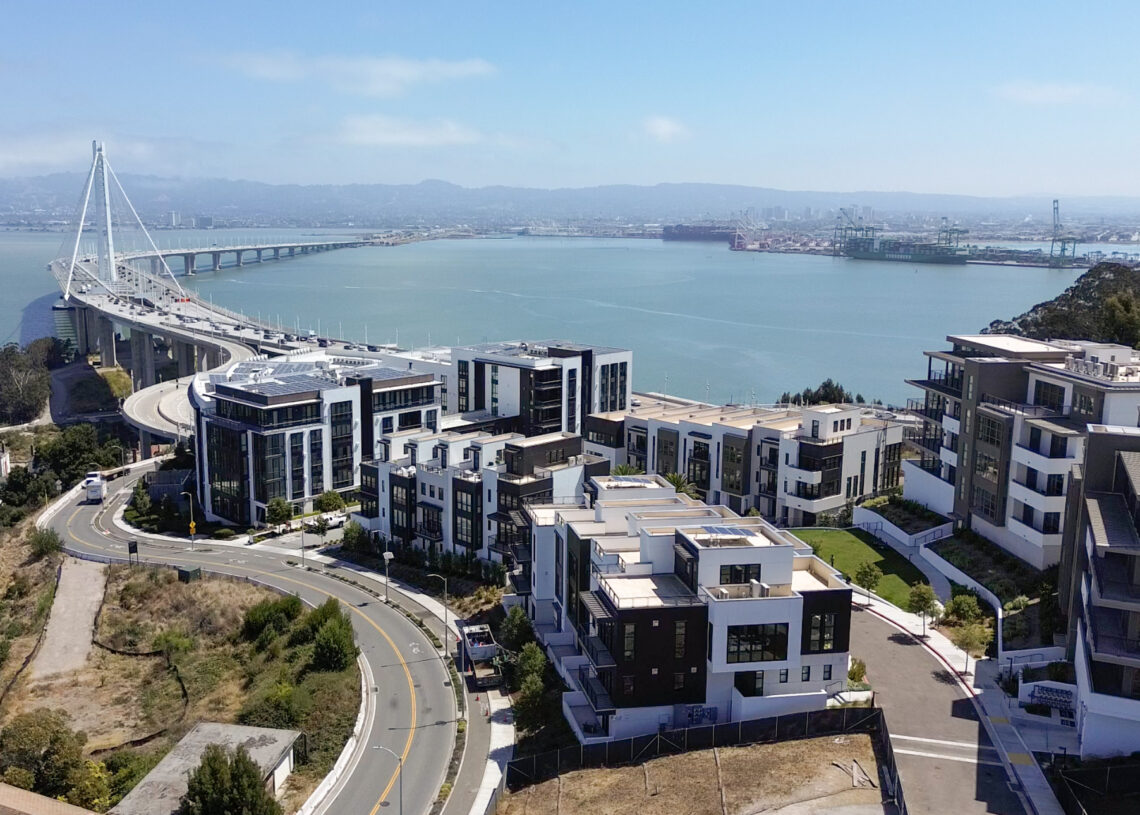
SAN FRANCISCO — In one of the nation’s most extraordinarily housing-constrained cities, where demand keeps pushing rents and sales prices to dizzyingly higher levels, people are finally moving into new apartments and condominiums on a 576-acre patch of land the U.S. Navy abandoned nearly 30 years ago.
These two small islands just off the coast of the city, Treasure Island and Yerba Buena Island, represent a rare opportunity for San Francisco to add a significant amount of housing. But years of lawsuits, public opposition and competing idealistic values underscore why it’s difficult to build in the city in the first place.
An eight-minute ferry ride off the mainland, Treasure Island was created as a man-made island, adjacent to the natural Yerba Buena Island, to host the 1939 World’s Fair. The Navy took over the two islands during World War II, used them for training for the next half-century, and moved out in 1997.
From the time the Navy started talking about leaving in the early ’90s, San Francisco leaders recognized that the islands, connected by the Bay Bridge, could help the city’s already-apparent housing woes. Yet it took more than 25 years for the first new homes to open.
Today, there are eight new buildings, totaling about 1,000 apartments and condos. Developers have plans to build another 7,000 units, with the goal of an eventual population of about 18,000 people on the two islands, and with more than half the land — over 300 acres — reserved as parks and open space.
But it will likely take until at least 2040 to complete that plan.
And some think that 8,000 new homes, meaning a density of just 13 units per acre, well below the norm in many urban and even suburban neighborhoods, is nowhere near as much as the islands could and should support, in a city so in need of places for people to live. That’s roughly the density of a typical block of rowhouses; mid-rise apartment blocks can be 10 times denser.
‘More quiet time’
Right now, Treasure Island is home to more people every day. Some live in gleaming, quiet condos, which they’ve paid up to $3.2 million for, and in luxe rental buildings. Others live in the two new affordable housing buildings on the island, one of which is reserved for veterans.
Nathan Williams, 50, and his husband decided to save money by moving out of their $7,400-a-month two-bedroom rental in the city and moving into a $5,400-a-month rental on Treasure Island last year.
Williams always considered himself a city person, and didn’t like the few times he lived in the suburbs. He has been surprised that he enjoys life on a half-deserted island, a 20-minute drive across the Bay Bridge from his job at a bank in the city.
“I wake up and I take the dog for a walk along the waterfront. The views, the open spaces, it’s all just been really incredible. It’s been fun watching the construction.”
Like many on the island, Williams hopes more businesses will open, supplementing the tiny grocer and the acclaimed Mersea restaurant that have been there for years.
“We were relying perhaps too heavily on dining out before,” Williams said. “It’s not the same living on Treasure Island. We’ve been a bit more self-sufficient.”
Maurice Sanders, 37, was one of the first new residents to move to the island, about three years ago, when he moved into the Maceo May building for low-income veterans. Like more than half the residents of his building, he was formerly homeless.
Sanders moved to San Francisco at age 22 after four years in the Army Reserve. Taken with the diversity and the natural beauty compared to his native Alabama, Sanders quickly decided he never wanted to leave — and also quickly realized he couldn’t afford the rent.
He’d been kicked out of an affordable building once before and couldn’t pass up the chance for subsidized rent on Treasure Island, even though he was skeptical of the seclusion. Now he hardly leaves, apart from his every-other-week therapy appointments. “It’s less fast-paced. You get more quiet time.”
‘Fighting at every step of the way’
Christopher Meany, whose company Wilson Meany is one of the lead developers of the island, says many of the people moving in are coming from the suburbs; they want to live close to the city without proximity to its crime and drug problems, and don’t necessarily mind the lack of walkable amenities.
After the city scrapped its initial efforts at planning for Treasure Island, Meany’s group was brought on in 2006, almost a decade after the Navy base closed. They spent five years coming up with plans, holding about 500 public meetings.
“It’s what it takes in California. And it’s bonkers. We all talk about how much we need housing. There was fighting at every step of the way: Should there be housing at all?”
Once the plans were approved in 2011, the work was prevented for another three years by a lawsuit led by Aaron Peskin, at that point a former member of the city’s board of supervisors who later returned to the board.
Though the suit focused on environmental concerns, Peskin said his primary motivation was the developer’s retreat from making 30 percent of the homes affordable below market rates down to 25 percent. (The number eventually rose again to 27.5 percent.)
“The fundamental question here [is,] what’s the maximum economically feasible amount of affordable housing? That’s always the question,” Peskin said. “The developer’s job is to get the maximum profit, and the government’s job is to get the maximum affordability.”
He brushes off criticism that his environmental suit slowed down the project. “It didn’t cost them anything. They still didn’t build anything for years and years,” he said. Once the suit was dismissed in 2014, the developers said they were raising capital, then doing the massive infrastructure work required.
‘A complicated piece of property’
Matthew Lewis, spokesman for the pro-housing group California YIMBY, says of the whole project: “It took way too long. It has far less housing than it could have.”
And yet he also calls Treasure Island “a success story” for a city that’s “so stridently anti-housing.”
Lewis describes the attitude of many in power in San Francisco as: “‘We’re full. We like it the way it is. You can go somewhere else.’ And I think that the fight over Treasure Island is sort of indicative. … It was still so unambitious in the context of what other major world cities would have tried to do there.”
The similarly super-pricey city of Vancouver, British Columbia, for instance, is turning heads in the housing world by building 6,000 new homes on a parcel of just 10 acres, about 45 times denser than Treasure Island.
Meany’s group has proposed building at least 2,000 more housing units on Treasure Island on top of what’s already been approved. But he also isn’t sure it’s economically feasible to keep building housing on Treasure Island at a price that buyers would want to pay, particularly because of the many requirements to build in the city. Among hundreds of codes and rules, San Francisco is one of the few U.S. cities to require solar panels on new homes; has unusually strict requirements that construction waste be recyclable; and bans natural gas and allows only electric appliances in new construction and home renovations.
“We have set up these utopian ideas that make building a house in San Francisco more expensive than it is anywhere else,” Meany said. “San Francisco can have an insane demand for housing, and yet we might not be able to satisfy it at price levels those people can afford.”
Nella Goncalves, executive director of the group responsible for the nonprofit housing on Treasure Island, is interested in the additional affordable housing that would be created if private developers get to build more. Goncalves expects the next three designated affordable buildings, including one focused on supporting formerly homeless families and one for very low-income seniors, will be built by 2029.
She also worries about traffic congestion. Already people are grumbling about a lack of places to park on the islands, and traffic gets clogged on and off the bridge. The Trump administration revoked a federal grant meant to improve shared transit options on the islands, and the idea of adding rapid transit or a bike lane to the Bay Bridge has been proposed and rejected for decades.
“I wouldn’t say that I’m against it, but there are definitely some questions and some real issues” to building more housing, Goncalves said. She’s been working on the project for 27 years. Some day, she wants to retire and live in the senior building herself.
Goncalves’s predecessor, Sherry Williams, said that practical constraints would always have prevented the islands from turning into a super-dense yes-in-my-back-yard fantasy. “They had to address sea-level rise. They had to address earthquake security. There’s just a lot of things that make it a complicated piece of property. It’s not like it’s just this open land,” Williams said.
When the Navy moved out, more than 1,000 renters moved into the military housing, which was nearing the end of its lifespan. But those temporary renters are now longtime residents. They were promised when they first arrived that they’d have units set aside for them in the new buildings, at a similar monthly rent.
Emily Rapoport, 69, is dreading it, even though some of her friends are already happily living in the new apartments.
“They told me I was going to have to move, that this was temporary. … I didn’t realize ‘soon’ was about 20 years or so. I like my house. I really don’t want to move ever. And I sort of resent the fact that they’re going to pry me out.”
The aging military quarters she calls home are slated to be torn down, replaced with new apartment towers. Some day. There could still be years or decades more delays.
The post What it took to finally build housing on some of the nation’s most in-demand land appeared first on Washington Post.