Newt Gingrich, a Republican, served as U.S. House speaker from 1995 to 1999.
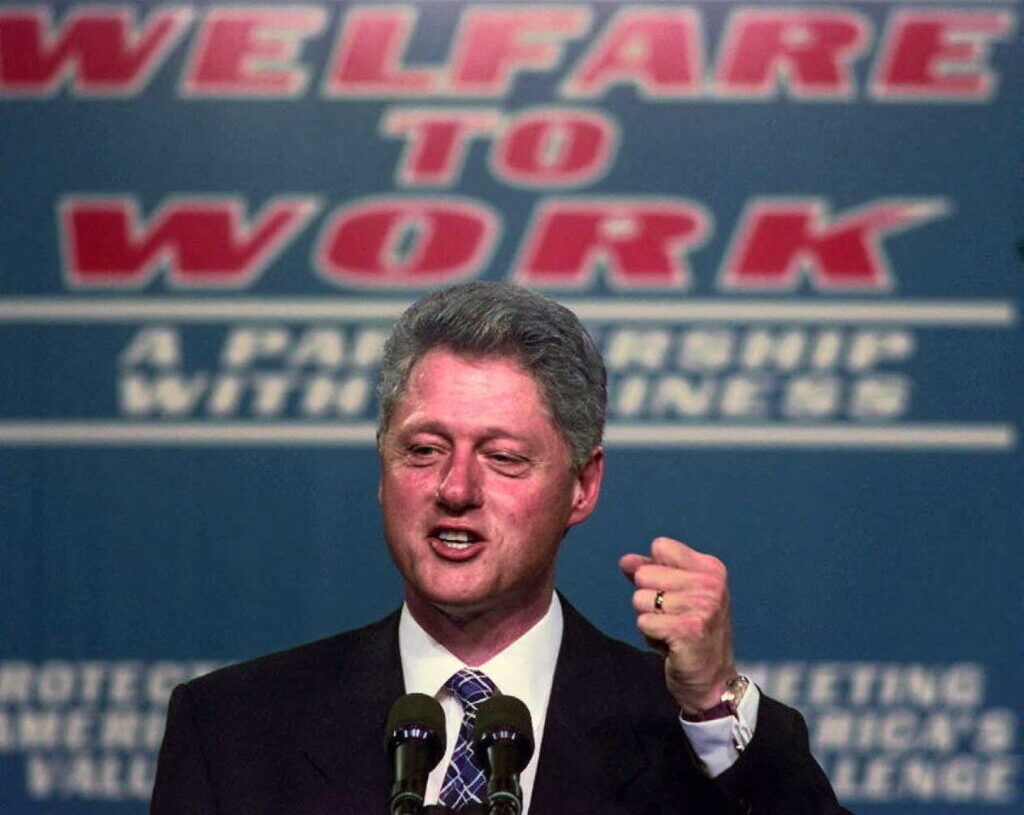
Thirty years ago, on Aug. 22, a new era of welfare reform began when President Bill Clinton signed the Personal Responsibility and Work Opportunity Reconciliation Act. The legislation, also known as the Welfare Reform Act, was a bipartisan success, the sign of an emerging consensus that giving money away with no strings attached was destructive. The resulting overhaul of the dependency-oriented welfare system, which had grown out of President Lyndon B. Johnson’s Great Society, was an enormous shift in the nation’s anti-poverty policy.
The road to the reform started in 1966 when Ronald Reagan, then running to be governor of California, advocated prioritizing work in welfare policy. Once in office, he couldn’t find a sitting governor of either party who would join him. It wasn’t until he won the presidency several years later that he made more significant headway. Reagan’s administration, among other things, amended Social Security contribution requirements and instituted work mandates for some welfare beneficiaries. As the president put it: “The best social program is a job.”
That was true, and the effort to break out of the Great Society’s models was impressive. Yet it ultimately wasn’t strong enough in the face of a bureaucracy committed to enabling dependency.
By 1991, Bill Clinton, then governor of Arkansas, was promising to “put an end to welfare as we know it.” That term, of course, could easily be interpreted in different ways. Three years later, when Republicans won control of Congress running on the “Contract with America” campaign, we were deeply committed to acting on that dictum and implementing the work-oriented reform that Reagan had first envisioned. I had a front-row seat to those efforts and recall being moved by several developments across the states.
We were especially impressed with Wisconsin Republican Gov. Tommy Thompson’s strong work-requirement reforms. We also closely observed America Works in New York, a job training and placement program championed by Democratic Gov. Mario Cuomo. If the group succeeded in getting an entrenched welfare recipient a job, it would receive a fee from the state. If that person were permanently rolled onto an employer’s payroll after four months, the group would receive a more generous payment. It worked. America Works was proof that people could be weaned off welfare and enter the workforce, which would increase their income and social mobility.
Finally, we had been deeply influenced by Marvin Olasky’s 1992 book “The Tragedy of American Compassion,” which clearly articulated that traditional reformers disliked giving the poor money because they were convinced it increased dependency and subsidized alcoholism and drug addiction. Olasky made the case that Johnson’s Great Society and War on Poverty were sharp breaks from the classic American approach to effective philanthropy. In his view, the president’s methods had institutionalized a passive vision of the poor as helpless and inevitably requiring government help.
We managed to develop a bill that transformed welfare offices into job-finding offices. The centerpiece — replacing the Aid to Families with Dependent Children program with Temporary Assistance for Needy Families — created incentives that encouraged people to acquire the habits and skills that form the basis of independence. The results were stunning. There was a sharp increase in employment for single mothers with children, especially between 1996 and 2000. The rate of poverty among African American children reached record lows. The number of adults collecting welfare checks dropped from 4.4 million in 1995 to 570,000 in 2024.
“In the checkered history of US social policy, TANF is a bright spot,” wrote Robert Doar, a welfare-reform expert and the president of the American Enterprise Institute. “Few programs have generated such strong gains in poverty reduction and employment.” The primary reason: “Its work-first approach.”
As Ron Haskins, who helped write the reform as a senior expert for the House Committee on Ways and Means, explained for Brookings Institution: “In addition to limiting most families to five years of cash welfare, every state designed a TANF program intended to encourage, cajole, and require parents to work at the threat of having their cash benefit reduced or even ended.” The results were astounding. “TANF rolls plummeted by well over 50 percent,” Haskins noted, and “work rates among single mothers reached their highest level.”
The Trump administration has already taken great strides toward reforming dependency models in food stamps, Medicaid and other programs. It might consider going all the way, revisiting every federal assistance program in the spirit of TANF. Work should be at the heart of receiving taxpayer assistance. Serious education and apprenticeship programs can be included as part of that requirement, but the goal should be to have every American improving his or her ability to contribute positively to society.
President Reagan was right: The best social program is a job. We followed his example and created a bipartisan reform that helped millions leave poverty and go on to more prosperous lives. America can develop that approach again by reviewing the whole of government with that work-first standard in mind.
The post The Welfare Reform Act at 30: Work is still the answer appeared first on Washington Post.