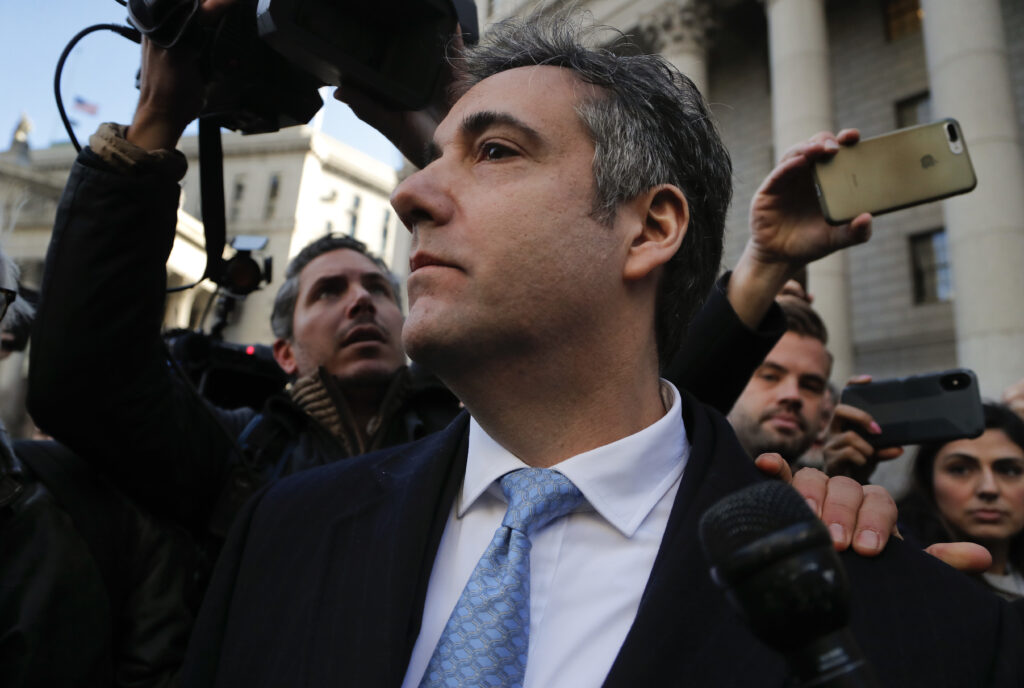
President Donald Trump publicly reconciled Thursday with Michael Cohen, his former fixer who became a key prosecution witness against him, calling into Cohen’s radio show and podcast to argue that the criminal cases they once bitterly fought over were products of political weaponization — while using the platform to reprise familiar talking points about Iran and the economy.
Trump dialed into “When You Know You Know” Thursday morning, and Cohen said the interview would be split between two broadcasts, one that aired Friday evening, the other Sunday.
Trump’s appearance on Cohen’s show — their first public conversation since their falling out — marks a striking turn in a relationship that went from fierce loyalty to open warfare and, now, seems headed toward some form of reconciliation.
The move reflects a recurring reality about Trump’s relations with associates: While he will sometimes fire an aide who displeases him, there are almost no cases of permanent exile from Trumpworld.
For those looking for clues about how the reconciliation came about, Friday’s installment didn’t provide many revelations. There was little nostalgic reflection on Trump’s political rise with Cohen at his side, or on the sex scandal and court case over payments to adult-movie actress Stormy Daniels that ruptured their relationship.
When the subject did arise, Trump insisted that Cohen had been used by the president’s political opponents.
“And then they weaponized you like no one has ever been weaponized,” Trump said. “They weaponized you. They weaponized a lot of people. And I respect the fact that you recanted everything you said.”
Cohen said the two had spoken three times over roughly the last year, and, while they still disagreed over many aspects of their turbulent relationship, those differences had not prevented them from moving forward.
“For me, it felt very familiar,” Cohen said in introducing the segment with Trump. “It felt very similar to the old days when I would sit across the desk from him. I always sat in the far-right, velvet red chair, and we would have these open conversations. The dialogue. It was again. It was easy. It was familiar, and it’s extremely informative.”
It was definitely familiar.
Trump, speaking in long, uninterrupted stretches, largely recycled arguments he has made for months about the war with Iran, boasting that the United States had “wiped out” that country’s military and leadership and dismissing the economic fallout and higher gasoline prices as temporary costs of preventing what he called “the bully of the Middle East” from obtaining a nuclear weapon.
“If you had a country like that, they would absolutely use the nuclear weapon,” Trump said. “And I stopped that. I stopped it cold with the B-2 bombers.”
He also said the economy was “never stronger” and that immigrants had been “pouring into the country” before his return to the White House.
Cohen spent more than a decade as one of Trump’s closest aides and fiercest defenders, serving as his personal attorney and self-described “fixer.”
Their relationship imploded in 2018, when Cohen pleaded guilty to federal crimes that included campaign-finance violations stemming from a $130,000 payment he made to Daniels shortly before the 2016 election.
Cohen later became a key witness in the Manhattan case that led to Trump’s conviction on 34 felony counts of falsifying business records. Prosecutors said Trump disguised reimbursements to Cohen as legal expenses to conceal “hush money” payments to Daniels; Cohen testified that Trump approved both the payment and the reimbursement arrangement.
Trump has denied having sex with Daniels and repeatedly attacked Cohen as a liar.
More recently, Cohen has criticized the New York prosecutors who pursued Trump, saying the offices of Manhattan District Attorney Alvin Bragg and New York Attorney General Letitia James “pressured and coerced” him during their investigations of Trump.
Cohen’s claims dovetail with Trump’s long-running assertion that the cases against him were improper efforts to damage him. He has repeatedly portrayed the Manhattan prosecution as election interference and called the case a “politically motivated” effort by Bragg. After his conviction, he denounced the proceeding as a “rigged” trial and New York state Justice Juan Merchan, who presided, as biased.
In January 2025, Trump received an unconditional discharge from Merchan in the case, meaning he would not face time behind bars, a fine or probation. Trump has continued to try to void the conviction entirely, appealing the verdict in state court and, separately, seeking to move the case to federal court.
The post President Trump and ally-turned-antagonist Michael Cohen reconcile appeared first on Washington Post.