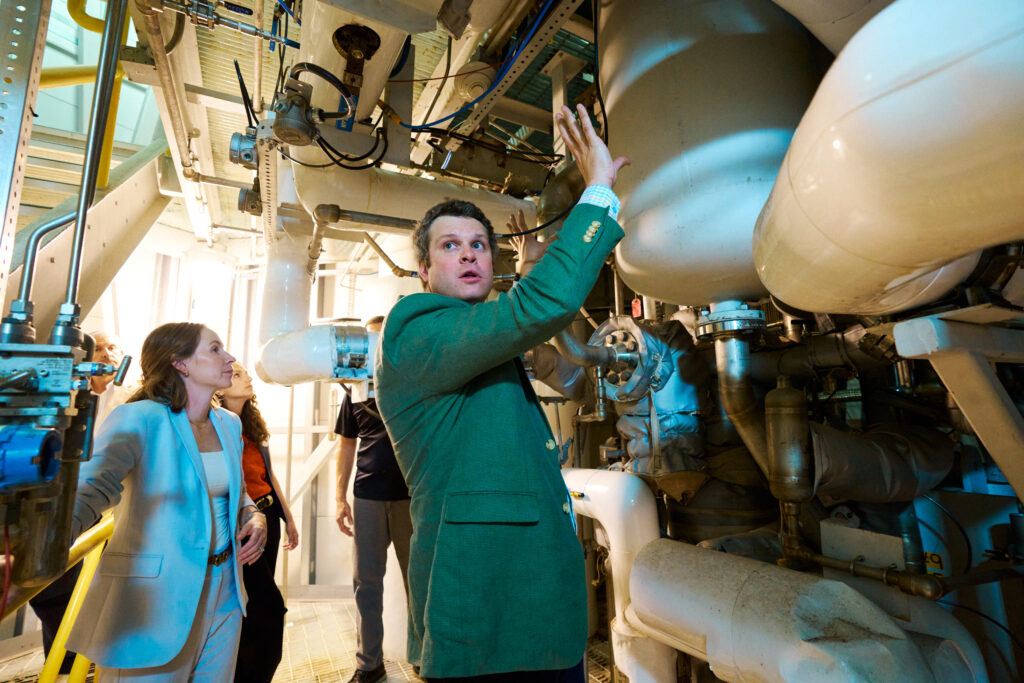
LYNCHBURG, Va. — The sci-fi-worthy machine soaring 120 feet tall in the hills outside Lynchburg had been all but left for dead — a $400 million experiment that collapsed as the energy economy shifted and the financial prospects for next-generation nuclear technology soured.
The faux eight-story reactor in Lynchburg, built to mimic a nuclear plant but run on electricity so engineers can safely monitor and tinker with it, languished a decade unused on a Liberty University engineering campus.
Now, with the AI build out exploding across the country, a pair of engineering wizards with a nuclear start-up and SpaceX pedigree see in it a lucrative solution to one of the country’s most vexing challenges: powering the proliferation of data centers.
They are betting that they can leverage a forgotten test facility started in 2009 as a launchpad to build the small, more nimble nuclear reactors that the industry has been promising for decades could create cheap, reliable energy.
Billions have been spent developing such reactor designs since the 1960s. Not a single one of them is operating in the U.S. commercial market. Plenty of experts predict this will be yet another nuclear flop done in by spiraling costs, community safety concerns and engineering glitches.
“We are now living in about the fifth supposed ‘nuclear renaissance’ in the U.S.,” said David Schlissel, a longtime nuclear consultant to consumer and environmental groups. “The industry keeps claiming they have new designs that will be cheaper and faster to build. It keeps turning out not to be true.”
But in the frenzy to find power, plans for futuristic technologies that were abandoned years ago are on the ascent. Investment capital is flooding in. Deals are being inked. Silicon Valley is promising big paydays for whatever start-ups can solve their immense challenge of finding enough energy to feed modern data centers.
“We’re standing on the shoulders of giants here, right?” Ben Kellie, the former SpaceX engineer from Alaska who co-founded Applied Atomics, said inside the Lynchburg facility housing the small-reactor project, known as mPower. “We’re starting with something that had $400 million in investment put into it, and significant time and effort. That’s a leg up.”
One of the other two co-founders, Paul Keutelian, was also a high-level engineer at SpaceX.
MPower is owned by a legacy nuclear company, BWXT, that has been building naval reactors for the military since the 1950s. The company’s partnership with Applied Atomics, a start-up formed only last year, is built around the young firm’s vision that nuclear engineers just need to figure out how to more effectively harness technology that has already been developed. MPower is basically a scaled-down version of the giant light-water nuclear reactors providing power across the United States today. Those reactors use nuclear fission to produce steam that spins an electricity-generating turbine, with water acting as a coolant to help slow neutrons in the chain reaction.
It is a starkly different blueprint than other small-reactor companies are using. Several firms are trying to design plants that use more highly enriched fuels to operate at higher temperatures and are cooled with sodium or gas. They argue that the designs are more modern, cheaper to operate and safer than traditional light-water reactors. The claims are very much in dispute, with nonproliferation experts warning that all the designs carry sobering safety risks that could result in a reactor meltdown that releases radiation.
The more novel the design, the bigger a hurdle it could face with regulators — slowing down development of reactors Silicon Valley wants to deploy as quickly as possible.
Even Applied Atomics acknowledges that if all goes according to plan, its first 195-megawatt reactor — providing the energy equivalent it takes to power about 155,000 homes — won’t be operating commercially for another five years. The hope is that tech firms or other clients will bundle them at projects, perhaps installing as many as five or 10 side by side.
Or maybe they will be floating out at sea. The companies are working with a firm called Core Power that is exploring building floating power plants that would be anchored just offshore and would provide electricity to a nearby power grid or to a large industrial facility, like a data center or steel plant, on shore.
“We have great interest from utilities in the U.S.,” said Mikal Boe, CEO of Core Power. “Several are engaging with us on where they could put this.”
Boe said the allure is that floating plants can be manufactured and permitted more quickly, with the modular plants built in one central location on an assembly line with a single design that does not need to be changed based on where it operates.
It is another element of mPower that echoes the past. The initial project grew from a 1960s initiative by Babcock & Wilcox — which would later become BWXT — to power merchant ships with nuclear reactors. Two such ships did operate out of the U.S. and West Germany into the 1970s as part of government-sponsored demonstration programs.
But the concept was not a financial success.
“It was really good as a diplomatic mission,” said Erik Nygaard, vice president of micronuclear reactor products at BWXT. “They sailed all over the world and did some really cool stuff. But it could never compete economically with bunker fuel.”
Market forces would doom the Lynchburg experiment after Babcock & Wilcox had bet the test facility would be the launchpad for building a nuclear reactor on the site of a retired coal plant. When the shale gas revolution happened, prices for natural gas in the U.S. plummeted. Investors in mPower grew concerned it could not compete.
“The economics started falling from underneath us,” Nygaard said. “Basically, we just didn’t have any customers. And no customers means we shouldn’t keep spending on product development.”
There was another issue. The Fukushima nuclear accident in Japan in 2011, triggered by a tsunami, soured the world on any new nuclear plants. By 2017, BWXT pulled the plug on mPower.
All these years later, the outlook for nuclear has changed, said Kate Kelly, president of BWXT Advanced Technologies. Demand for energy is soaring, and tech companies are willing to pay a premium to lock down low-emissions electricity for their data centers. “The landscape looks very different today,” she said.
But before the first mPower reactor is even sold, there are considerable obstacles. Like existing reactors, small ones create radioactive waste. There is no national storage facility, meaning any community that grants permits for the reactors to operate must be willing to have the waste stored in caskets on-site indefinitely.
In the case of floating nuclear plants, the plan would be to store the waste at the shipyard where they are built and the reactors are refueled. Such a facility could prove challenging and legally difficult to permit.
They are among the reasons many in the industry are skeptical that the mPower design — like other small-reactor designs in development — will ever make it out of the testing phase.
“We still can’t say for sure how much any of these reactors will ultimately cost,” said Schlissel, the longtime nuclear consultant. “And when there are major cost overruns and delays — as there always are with nuclear — who will pick up the tab? Are investors willing to do that? I doubt it. They never have in the past.”
“It is not just about whether the technology is viable,” he said. “It is also whether the cost is viable. … The industry is running around with all this hype trying to sell nuclear broadly. But they still have not fully tested and built any of these new reactors.”
Kellie, who was the lead engineer for the inaugural West Coast launch of the SpaceX Vandenberg SLC-4E rocket, says the skepticism is familiar, given that the space firm faced the same cost concerns.
SpaceX ultimately overcame them by shedding the development process of duplication, inefficiencies, byzantine processes and silos of engineers competing with one another. It replaced that with a coordinated effort focused on delivering a reliable product at the lowest possible cost rather than one constantly redesigned, with the economics as an afterthought.
“We know how to split the atom,” Kellie said. “We’ve been doing it for a very long time. We know light-water reactors are effective and safe.”
He argued that like every large infrastructure project struggling in the U.S., nuclear struggles not with engineering but with efficiently and economically executing construction. “The one place where that’s really changed has been in aerospace, which created this drop in cost of access to space by orders of magnitude,” Kellie said.
But the challenge of bringing the nuclear industry to the same place has flummoxed engineers and investors for decades. If Applied Atomics or any other start-up does manage to pull it off, it would be among nuclear’s biggest breakthroughs since the atom was split.
The post How a failed project could help solve the world’s biggest energy need appeared first on Washington Post.