This August features a stunning divergence. The world becomes more dangerous as U.S. governance becomes more frivolous.
The president is miffed with South Korea because of, among other insolences, that nation’s insufficient help regarding his (you and South Korea might suppose) redundant second military operation against Iran. The second was undertaken to destroy Iran’s nuclear weapons program, which the president said the first operation “obliterated.”
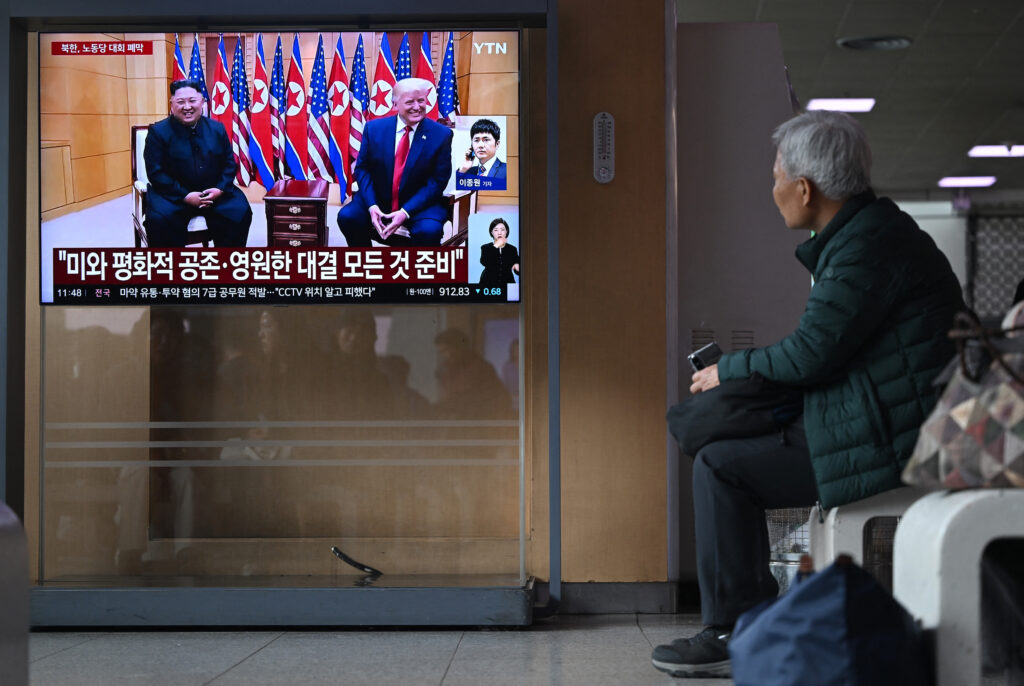
The president, regretting that “it is too late to cancel,” decided to “substantially reduce” joint U.S.-South Korea military exercises. He said these “send a signal that is totally inappropriate and hostile” to North Korea, which has been, he said, “unthreatening” during his presidency.
The president sees nothing threatening about North Korea’s development of ballistic missiles capable of delivering its nuclear warheads to California. He is consistent. On June 13, 2018, the president said, “There is no longer a nuclear threat from North Korea.” On Sept. 29, 2018, he explained to some perhaps perplexed West Virginians in Wheeling that he and North Korea’s dictator, Kim Jong Un, “fell in love” after exchanging letters.
The presidential patience with Iran is exhausted, so he has unleashed a one-two punch. He has threatened to “bomb the shit out of” a U.S. ally, Oman, if it “gets in the way” of negotiations with Iran. And he has proclaimed the Strait of Hormuz a “NEW U.S. territory,” perhaps like the Straits of Mackinac that separate Michigan’s Upper Peninsula from the Lower. This should make Iran think.
Dabbling in naval architecture, the polymathic president has got the Navy thinking about what The Washington Post calls his “preferred aesthetic” for aircraft carriers. His taste favors the World War II look, when carriers’ command centers, called “islands,” were farther forward, nearer the middle than, as today, the back of the ships. He also wants to return to steam-powered catapults to launch jets off the carriers, replacing the newer electromagnetic catapults the Navy thinks serve launching efficiency.
Making these changes, which would alter the ships’ balances, would cost billions of dollars and delay by years delivering the carriers to the fleet. The president also wants a “Golden Fleet” including 15 new battleships, costing an average of $18 billion, more than the $13.3 billion newest and largest carrier, the USS Gerald R. Ford.
The aesthetics of aircraft carriers, and the counterintuitive argument for enormous surface warships in an era of proliferating anti-ship missiles, will be considered by the Navy. Probably until noon, Jan. 20, 2029.
Regarding another “desperately needed” (his words) national security construction: The president recently remembered that his proposed White House ballroom is actually not about his original justification for it — more-elegant presidential parties. In a Truth Social post that did not use the word “ballroom,” he said that beneath the ballroom would be a military complex.
He did not say why a ballroom must sit on top of this. He did say that people blocking what he later called the “great Military Complex/Ballroom” are “TREASONISTS” who “revealed Top Military Secrets!”
The ballroom’s contribution to national security is contestable. Its contribution to constitutional law might break the “national security” spell that transfixes courts. They might reasonably block this presidential mania, saying that Congress must authorize the destruction and construction of government buildings. And that incantations of the phrase “national security” are not substitutes for thinking.
Fifty years ago, the Supreme Court held that its inquiry into matters of national security “is highly constrained.” But such inquiry is not impermissible for anyone. Otherwise, “security” becomes an elastic justification for government to do whatever it wants.
A week before his first inauguration, Barack Obama came to a columnist’s home for dinner. The neighbors across the street, a couple and their young son, came out to see the president-elect. The Secret Service ordered them back into their house. An American family was banished from its front lawn, to maximize a government agency’s mission, security.
The “The Guns of August” is Barbara Tuchman’s riveting history of Europe’s 1914 stumble into a four-year catastrophe. On Aug. 23, 1939, the Hitler-Stalin “nonaggression pact” presaged the war that began with Germany’s invasion of Poland eight days later. On Aug. 2, 1990, Iraq invaded Kuwait. A large and long U.S. military involvement in the region would follow.
This August, an ally on the Korean Peninsula has been slighted for the benefit a contiguous enemy. At least the president refrained from threatening to “bomb the shit” out of South Korea. Battleships and ballrooms, another August to remember.
The post Amid an August of mounting danger, a frivolous, oblivious president appeared first on Washington Post.