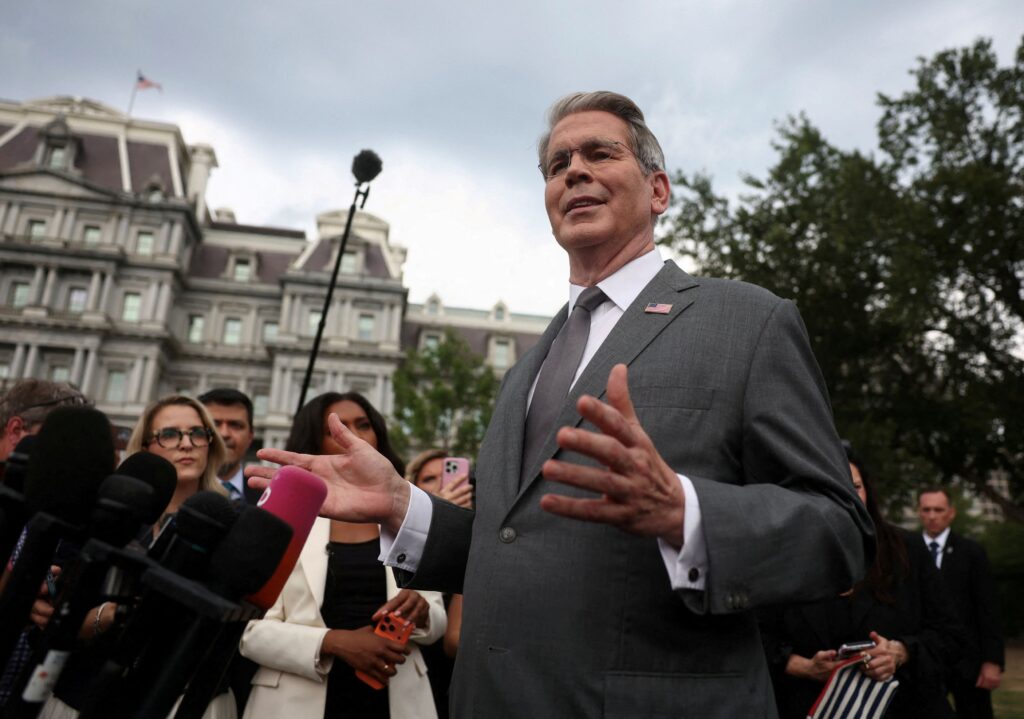
On Thursday, the bond market shrugged off Treasury Secretary Scott Bessent’s unusual effort to head off rising government borrowing costs. In early trading, the 30-year bond yield rose to 5.27 percent before settling back down to 5.24 percent, erasing more than half the drop in costs that had greeted Bessent’s market intervention.
Bessent on Wednesday said that Treasury would at least double a planned buyback of long-term Treasury securities from $2 billion to $4 billion or more, a move that quickly lowered yields and eased pressure on borrowing costs for governments, businesses and consumers. By repurchasing government debt from private investors, Treasury aims to reduce the supply of such securities and bring yields down.
But yields rose again on Thursday even as Bessent appeared on CNBC in a bid to further reassure bondholders.
Why is the bond market so skittish? Part of the problem is the size of the national debt, which this week hit a new high of $40 trillion. The Trump administration not only has not put forward a plan for reducing borrowing, it has pushed through major economic policies that have helped make the situation worse.
Here’s how the bond market got so trigger-happy.
Why is the bond market important?
Of the $40 trillion national debt, about $32 trillion is held by investors and the public in the form of Treasury securities. When yields go up, it means investors are demanding a greater return on their money and that borrowing will cost Washington more. In the worst-case scenario, it could also signal that investors are losing confidence in the United States and its ability to make good on its promises to pay off its debt, though recent demand for Treasurys suggests we are nowhere near that crisis point.
Meanwhile, higher Treasury yields ripple into mortgage rates, corporate debt and other borrowing, worsening affordability problems throughout the economy.
What happened this week?
Tuesday, the returns that investors demanded on 30-year U.S. Treasury bonds spiked to their highest level in nearly two decades — about 5.3 percent. In response, Bessent doubled the size of a planned buyback of public debt, hoping to head off a potentially destabilizing rise in government borrowing costs. His intervention sent bond yields down to 5.18 percent and boosted stock prices, but analysts warned those effects were likely to be short-lived.
Lawrence Gillum, chief fixed income strategist for LPL Financial, called Bessent’s announcement “more about a strategic symboling than an actual fix.” The size of the buyback wasn’t meaningful in the $32 trillion Treasurys market, Gillum said in emailed commentary. “But it is a reminder that the Treasury Department is paying attention and will do whatever it can to keep yields from getting too high too quickly.”
Has the Trump administration reduced borrowing?
No. As a candidate, Donald Trump promised to eliminate the federal budget deficit — the annual gap between revenue and spending that necessitates borrowing — and even pay off the nation’s accumulated debt. In fact, the debt has doubled since he first took office. And his most recent policies have produced a deficit that is expected to exceed $2 trillion this year — more than 6 percent of the nation’s gross domestic product — according to the nonpartisan Congressional Budget Office.
In the past, Washington has run such enormous deficits only during wartime or a financial crisis. Today, the economy is at or near full employment and growing.
Last week, Bessent blamed the Biden administration for the government’s budget woes, but he acknowledged in an interview with Newsmax that Trump’s tariff policy — and his signature tax cut — had contributed to the problem. In fact, Trump’s tax-cut measure, the One Big Beautiful Bill, will add an estimated $4.7 trillion to the debt over the next decade, according to the CBO.
Bessent told Newsmax that a provision of the law allowing companies to immediately deduct the expense of new factories is contributing to this year’s swollen deficit. “That is a hit now to the deficit, but we are creating productive assets for future growth, which will be paying taxes all the way down the line. So I think of that more as like pulling back a slingshot and creating a lot of potential energy that becomes kinetic,” he told the conservative cable channel.
The CBO projects that the bill will add hundreds of billions of dollars to deficits every year over the next decade, though the negative impact does get somewhat smaller over time.
Why is the bond market so nervous?
The sell-off this week in U.S. Treasury securities — at $32 trillion the world’s largest financial market — came amid surging public debt in the United States, Europe, Japan and Canada; renewed conflict in the Middle East; and uncertainty about the Federal Reserve’s intentions on interest rates.
Much of the bond market’s unsettling tumult results from basic supply and demand. As governments and corporations jostle for the pool of available investment capital, they are driving the cost of borrowed money higher. Political leaders in the U.S., Europe and Japan must fund ambitious public spending plans, while hyperscalers such as Alphabet and Microsoft need money to build their artificial intelligence networks.
At the same time, the collapse of the fragile U.S.-Iran ceasefire has reignited fears that an interruption in Persian Gulf oil supplies will keep energy costs and inflation high. On Thursday, Brent crude, the global oil benchmark, topped $88 per barrel, up from around $72 during the recent pause in hostilities.
In this atmosphere of economic uncertainty, economists say it would be wise for the Trump administration to come up with a plan to restrain borrowing. Trump has never offered such a plan, however, and is pressing Congress to increase borrowing to pump hundreds of billions of additional dollars into the Pentagon and his war with Iran.
The post What’s behind the bond market roller coaster? appeared first on Washington Post.