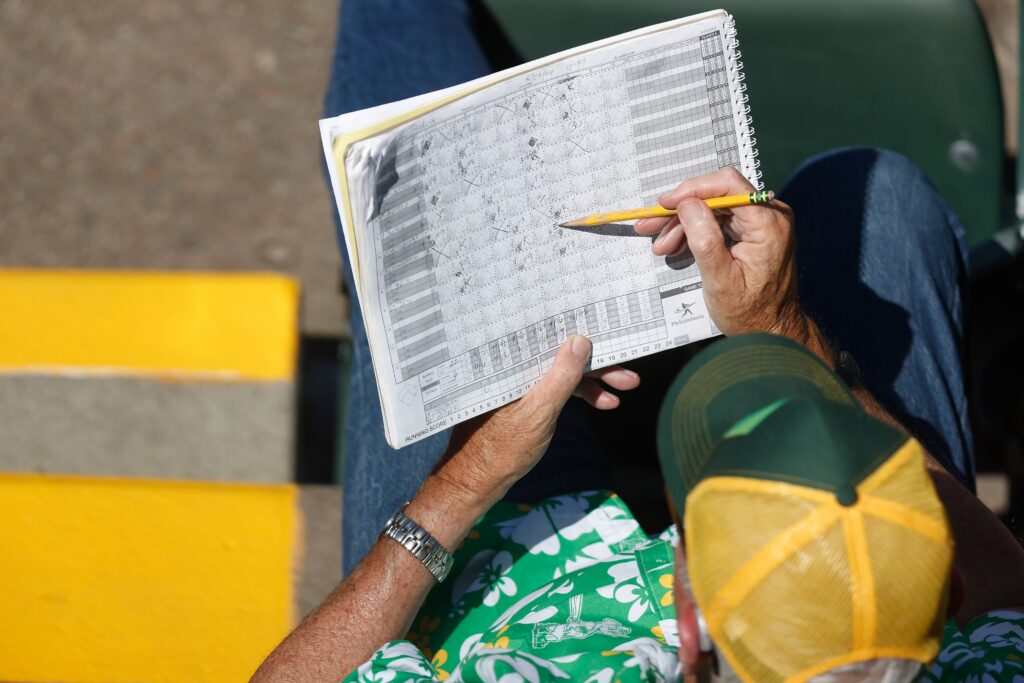
While at Busch Stadium last week watching my beloved St. Louis Cardinals with my father, I noticed two 20-something dudes doing an unusual thing: not looking at their phones. In fact, they didn’t seem to have their phones out at all; instead, they were both holding pens. They were watching the game, intently, and after each play, they would write something down. It wasn’t difficult to figure out what they were doing. I was, after all, doing the same thing.
They were keeping score.
Keeping score — or “keeping book,” as my grandfather called it — is a grand baseball tradition. I learned it from my father, whose father taught him, whose mother taught him, which makes it sound more complicated than it is. When you keep score at a baseball game, you are simply writing down all the things that happen, batter by batter, even pitch by pitch. That might seem strange in this day and age, when every pitch of every game is chronicled online through MLB.com, where you can even find the velocity, break and spin rate of the pitches. That information is helpful — as a die-hard baseball fan, I use it all the time.
But in the moment, in the stands at a game, it is also beside the point. Scoring a baseball game, using a pen and a score book, and hopefully with a cool beverage and someone you care deeply about next to you, is a way to capture history — and the fact that you were present for it. Filmmaker Ken Burns once said that to score a game is to reward the act of “pondering inaction,” which is a wonderful way to put it. It’s no wonder Dwight D. Eisenhower, Barbara Bush and Tom Hanks gloried in the practice.
I have been keeping score at games since I was little: I remember boiling in the bleachers at age 8, trying to figure out how to spell “Oberkfell.” But I couldn’t have told you why scorekeeping mattered until I moved away from home.
While living in Los Angeles in the late ’90s, I returned to the Midwest for a weekend to visit Busch with my dad. When he arrived, he had a gift for me: a C.S. Peterson Scoremaster score book, helpfully labeled “A Complete Record of Game and Player.” It was the same model that my mother had used to score my Little League games. “Make sure you bring it with you when you come back next year,” he said. And I did.
Every year after that, too. We even got to a game in 2020, the covid year: We watched — and I scored — from a rooftop bar across the street from the stadium. I have kept score at every game I have been to since 1998, and I have every filled-in book stored in a closet that gets a little more full every year. Those books are a chronicle of baseball history. More important, they’re a chronicle of my life.
Each page contains, obviously, a complete record of game and player. I’ve seen, and can go back and find, Greg Maddux and Barry Bonds and Albert Pujols and Rickey Henderson. I wrote down what Dennis Martínez, who was born in 1955, did in 1998, and I wrote down what Konnor Griffin, who was born in 2006, did in 2026. But on the side of the page, in the “Scorers Notes” section, is the most vital part, which is who I went to the game with.
Go back far enough, and you can find that old friend from high school I lost touch with, an old girlfriend who’s doing great these days, that beloved uncle from Philadelphia who has been gone for two decades — people I shared a few hours with, outside, watching, cheering, talking about whatever, doing all the things that make going to a baseball game so wonderful. You can find my dad’s name there, many, many times. These days, you can also find my son’s. I have to make a special notation for that; he and Dad have the same name.
A score book gives us what our computers and social media posts can’t: an actual, physical record of what we did, where we did it and who we did it with. A memento, which is to say a memory. It’s not something I have to upload to the cloud. It’s not something I have to subscribe to. It’s not something I have to hope isn’t bought by some private equity firm that will one day liquidate the software that hosts it. It’s a book. With names. Of people I saw, of people I knew, of a life I have lived.
No wonder young adults — the ones I saw at Busch Stadium told me gleefully they were already on their second score books — are embracing something so old-fashioned. Raised on an internet built to vanish, they are seeking out the analog, whether it’s vinyl, or hardcover books, or even a good-old-fashioned diary. They understand what is slowly dawning on Gen X and the boomers: In this age of digital impermanence, you can only really count on things you can hold in your own hands.
Life flies at us fast, and it fades into the past even faster. A score book is a way to slow down, to reflect, to chronicle and, someday, to remember. Someday, my father will not be with me, and my sons will have moved away. But I’ll have that book, and their names, along with so many others, to look at — and return.
The post The old-school tradition making a comeback at the ballpark appeared first on Washington Post.