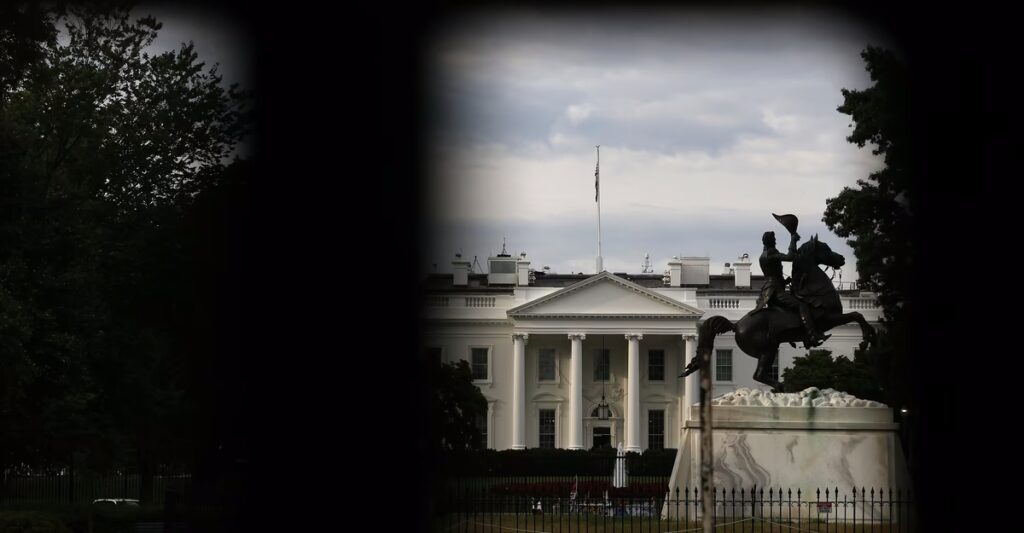
On a recent afternoon in Washington, I put on a pair of augmented-reality glasses for a tour of some very recent ruins: the White House East Wing. In recent months, black fencing has overtaken the area, where Donald Trump’s ballroom construction is speeding along as the Supreme Court decides its fate. Visitors can’t see much of anything from the street. As I wore the clunky eyewear, though, historic images of the structure flashed in front of me. The glasses showed me features wiped away by the president during his ongoing renovation spree, such as the Jacqueline Kennedy Garden and the White House Family Theater. Looking around, I could see a panorama of images visualizing Trump’s plans to transform Washington, D.C.: the Reflecting Pool, the Triumphal Arch, the Eisenhower Executive Office Building, and more.
The tour guide, a public historian named Lexi Cleveland, created this very 2026 experience as the executive vice president of ARtGlass, an AR company. (One of the co-founders is Greg Werkheiser, a cultural-heritage lawyer currently suing the Trump administration over plans to paint the Eisenhower Executive Office Building.) Cleveland prompted me with questions throughout. “What do we actually lose when we lose a building?” she asked. When the glasses showed me a Black Lives Matter mural that the city removed after Trump’s return to office, Cleveland juxtaposed it with the equestrian statue of President Andrew Jackson in front of the White House. The populist Jackson is one of Trump’s favorite presidents; expanding slavery and signing the Indian Removal Act are inextricable parts of his legacy. The construction of the statue, completed in 1852, involved an enslaved apprentice. “If you got to decide,” Cleveland asked, “does the statue stay, go, get contextualized with signage, or get moved to a museum?”
She plans to ask these questions to larger groups when the tours start in full this month, and she’s prepared to mediate debates. The approach feels fitting in a country engaged in an active struggle over how to remember its past.
History is on Trump’s mind. He wants to become part of it by reshaping the commemorative landscape of Washington. And he wants to reframe how history is told within Washington’s museums. For over a year, the White House has scolded and threatened the Smithsonian. But last month, the president took an unprecedented step toward pushing that feud into the real world. In an executive order, he called on the National Park Service to place signs outside the National Museum of American History, which the White House has said is subject to “ideological capture” at the hands of “a radical activist cohort.” The Park Service will direct visitors to “accurate information” about the nation’s past and mount its own temporary exhibit about the signatories of the Declaration of Independence, who the White House says aren’t showcased enough by the museum. The fight for public memory will soon spill into the streets.
It will happen on the National Mall, where the National Guard continues to roam and not far from the transformed White House, with its abundant fencing—at this point, a core aesthetic of the second Trump administration. Across town, scaffolding outside the Kennedy Center blocks the part of the facade where Trump’s name once hung above the late president’s. Historic statues at Arlington Memorial Bridge have been swallowed up by blinding gold. Meanwhile, at two plazas in downtown Washington, statues that came down during the Black Lives Matter protests have been reinstalled: One of Confederate General Albert Pike returned to Judiciary Square last fall, and one of Caesar Rodney (which was toppled in Wilmington, Delaware), who signed the Declaration of Independence and enslaved hundreds of people, now overlooks Freedom Plaza.
Historians, preservationists, and activists are finding ways to work their own ideas and stories back into public space, in spite of the obstacles. The most visible example might be a series of viral art pieces by the guerilla art group the Secret Handshake that keep appearing on the Mall. (In March, the group plopped a gold toilet by the Lincoln Memorial to poke fun at Trump’s redevelopment projects.) But there are more sober ventures too. When Trump’s exhibit goes up outside the American History Museum, a group called Citizen Historians for the Smithsonian plans to send docents to “interpret” the signage for visitors—a nerdy form of counter-protest. Even the Smithsonian American Women’s History Museum, which has not yet been assigned a site because of partisan fighting in Congress, is oddly of a piece with this renegade spirit: It has resorted to an augmented-reality exhibit that dreams up some new monuments for D.C.
The projects get at the central disagreement fueling these feuds over history: whether, as Trump sees it, American history is best told through a simple, sweeping narrative of grandeur or, as these groups see it, through a compendium of diverse stories. If the city suddenly feels like it’s in rough-draft form, Trump isn’t the only one with a red pen in hand.
A few days after Trump issued his executive order about the National Museum of American History, I arrived at a very wholesome protest: about a dozen concerned museumgoers holding signs outside the staff entrance to the building and singing patriotic songs such as “My Country, ’Tis of Thee.” The makeshift choir is part of a larger group, Citizen Historians for the Smithsonian, that came together last year to archive material across the Smithsonian because it feared that the Trump administration might start altering exhibits. I found one of Citizen Historians’ leaders, Jessica Dickinson Goodman, explaining the recent drama to a group of tourists, a kind of test run for conversations to come.
Earlier this month, the group’s role expanded from DIY archivists to rogue docents when it put out a call for help interpreting the signage that Trump is adding to the Mall. In its newsletter, the group described the effort as nonconfrontational and fact-based. Dozens of volunteers came forward. Dickinson Goodman told me that they’re creating instructions for the types of topics that might arise: “We’ll start showing up as soon as we hear of construction starting.”
[Read: Trump’s trigger warnings]
One place where the grand, old-school version of history that the Trump administration seems to prefer prevails in the monuments and memorials on the National Mall. Here, the subject matter is clear, and the tone, though solemn, is usually celebratory.
The sole memorial dedicated to a named historical woman is for Eleanor Roosevelt, though the statue is incorporated into her husband’s larger commemorative site. For its 250th celebration, the Smithsonian American Women’s History Museum put out its augmented-reality exhibit, “Unhidden Heroines,” to highlight five women associated with five major monuments—and to underscore their absence from public art. It’s hard not to perceive an exhibition squished onto your phone screen as an indicator of where women’s history stands these days.
Still, it’s worth a “visit.” At the Jefferson Memorial, the geotagged exhibition focuses on Mary Katharine Goddard, who printed the first copy of the Declaration of Independence to list most of the signers. At the Martin Luther King Jr. Memorial, Dorothy Height talks about how she helped organize the March on Washington but did not speak at it. At the end of each anecdote, a “monument” of sorts pops up next to whatever your camera is pointing at. The figures appear so large on the screen, they sometimes dwarf the actual monuments. “That was intentional, of course, because they were towering women in their own right,” Karri Nussle, the museum’s associate director for advancement and external affairs, told me.
It was fun. Well done too. But sitting there with my phone and my headphones and the make-believe monuments, I also felt kind of sad. Eventually, the augmented-reality glasses come off. The phone screen goes black. The volunteer docents go home. What’s left? At the Jefferson Memorial, after I put my phone down, sending a cartoonish Mary Katharine Goddard back into the digital ether, it was just me and the man cast in bronze.
The post The New History Wars appeared first on The Atlantic.